80 usable questions with CBP’s official answer and answer-key sources where supplied. Worked walkthroughs are free for the first 10; the rest come with the pass. Answers are collapsed so you can try first.
Designated references
Harmonized Tariff Schedule of the United States — 2018 or 2019 Basic Edition
Title 19, Code of Federal Regulations — 2018 Annual Edition
What is a customs broker required to have in order to conduct customs business on behalf of others?
A A copy of the Customs Regulations
B Commercial invoices
C Payment of services rendered
D A valid power of attorney
E All of the above
Show the official answer
Answer: D — A valid power of attorney
Why D is Correct: A Valid Power of Attorney
The Controlling Regulation
19 CFR 141.46 is explicit and unambiguous:
*"Before transacting Customs business in the name of his principal, a customhouse broker is required to obtain a valid power of attorney to do so."
This is a prerequisite — the broker must have the POA before transacting customs business on behalf of a client. Without it, the broker has no legal authority to act in the principal's name.
Key additional details from 141.46:
The broker is NOT required to file the POA with CBP
The POA must be retained with books and papers
It must be made available to Treasury representatives under 19 CFR Part 111, Subpart C
Why the Closest Distractor (E: "All of the above") is Wrong
Choice E is tempting but incorrect because:
A (Copy of Customs Regulations): Not required by any regulation to conduct customs business
B (Commercial invoices): These are entry documents required for specific shipments under 19 CFR 141.83, not a general prerequisite for a broker to conduct business
C (Payment of services rendered): Completely unsupported — no regulation makes payment a legal prerequisite for transacting customs business
Since A, B, and C are not universally required prerequisites for a broker to conduct customs business, "All of the above" cannot be correct.
Summary Table
Choice
Required to Conduct Customs Business?
Authority
A
❌ No
N/A
B
❌ Not universally
19 CFR 141.83
C
❌ No
N/A
D
✅ Yes — mandatory
19 CFR 141.46
E
❌ No (A, C are not required)
—
Find it fast: In the CFR viewer, search '141.46' — the section title 'Powers of attorney' will appear immediately. The key sentence begins 'Before transacting Customs business...' in the first paragraph.
John Henry, who is a licensed customs broker, presently has a permit in the port of Chicago. He would like to obtain a national permit. John has identified to CBP the following information: 1. License number and date of issuance 2. Address and telephone number of the office designated as the office of record 3. Set forth the name, broker, license number, office address and telephone number of the individual broker who will exercise responsible supervision and control In order for John Henry to obtain his national permit, what other function would be required?
A Cancel his district permit
B Hire a licensed broker
C Attached a receipt of payment
D Prepare his email to CBP
E Prepare a waiver
Show the official answer
Answer: C — Attached a receipt of payment
CBP's official answer: C
The answer key gives the controlling authority as 19 CFR 111.19(f) 1-4.
Why there is no walkthrough here
This question is from the October 2019 exam, which was sat against the 2018 or 2019 Basic Edition HTSUS and the 2018 Annual Edition of Title 19 CFR. We check every walkthrough against the references we hold — the editions designated for the current sitting — and for this question we could not confirm the official answer from that text closely enough to walk you through it honestly.
This one does not turn on a tariff number, so the answer has most likely not changed. The cited text is either not in the corpus we check against, or is there in a form our verifier could not match to the answer. We would rather show you CBP's answer with that caveat than invent a walkthrough.
Read the cited source yourself. It is short, and confirming the answer from the text is the same exercise the exam asks of you.
Bills resulting from dishonored Automated Clearinghouse House transactions are due within ____days of the date of the issuance of the bill.
A 10
B 15
C 30
D 45
E 90
Show the official answer
Answer: B — 15
CBP's official answer: B
The answer key gives the controlling authority as 19 CFR 24.3(e).
Why there is no walkthrough here
This question is from the October 2019 exam, which was sat against the 2018 or 2019 Basic Edition HTSUS and the 2018 Annual Edition of Title 19 CFR. We check every walkthrough against the references we hold — the editions designated for the current sitting — and for this question we could not confirm the official answer from that text closely enough to walk you through it honestly.
This one does not turn on a tariff number, so the answer has most likely not changed. The cited text is either not in the corpus we check against, or is there in a form our verifier could not match to the answer. We would rather show you CBP's answer with that caveat than invent a walkthrough.
Read the cited source yourself. It is short, and confirming the answer from the text is the same exercise the exam asks of you.
Andrew Balder, an employee of PM Morris Customs Brokerage (MCB), decides to import dual color lapel men’s dress jackets to take advantage of the exploding popularity. One of the clients of MCB regularly imports comparable dress jackets and has outstanding sales. Which of the following statements is CORRECT?
A Andrew Balder may not import items similar to that of clients of MCB because it would be a conflict of interest.
B An employee of a broker may not also be an importer.
C Andrew Balder must notify the port director for permission to import such articles.
D Andrew Balder must apply for a waiver from the Commissioner.
E Andrew Balder must notify the client of MCB that they are also going to import dual color lapel men’s dress jackets.
Show the official answer
Answer: E — Andrew Balder must notify the client of MCB that they are also going to import dual color lapel men’s dress jackets.
CBLE Walkthrough: Broker/Employee Importing Similar Merchandise (19 CFR 111.31(c))
The Rule
19 CFR 111.31(c) governs situations where a broker (or a broker's employee) is also an importer:
Find it fast: In the CFR viewer, Ctrl+F search for "111.31" — then read subsection (c) which begins with 'Importations by broker or employee'. The key phrase is 'unless the client has full knowledge of the facts' and 'The same restriction will apply if a broker's employee is an importer.'
Which of the following is NOT “Customs Business” as defined in the Code of Federal Regulations?
A The payment of duties, taxes and other charges
B Corporate compliance activity
C Determining the admissibility of merchandise
D Determining the classification of merchandise
E The preparation and filing of CBP Form 7501
Show the official answer
Answer: B — Corporate compliance activity
Why B is Correct: Corporate Compliance Activity is NOT Customs Business
The Rule (19 CFR 111.1)
The definition of "Customs business" in 19 CFR 111.1 explicitly states:
"'Customs business' does not include the mere electronic transmission of data received for transmission to CBP and does not include a corporate compliance activity.'"
So the regulation directly carves out corporate compliance activity from the definition of customs business.
Why the Other Choices ARE Customs Business
Choice
Why it IS Customs Business
A – Payment of duties, taxes, and other charges
Explicitly listed: "the payment of duties, taxes, or other charges assessed or collected by CBP on merchandise by reason of its importation"
C – Determining admissibility of merchandise
Explicitly listed: "transactions with CBP concerning the entry and admissibility of merchandise"
D – Determining classification
Explicitly listed: "its classification and valuation"
E – Preparation and filing of CBP Form 7501
Covered by: "the preparation, and activities relating to the preparation, of documents in any format and the electronic transmission of documents…intended to be filed with CBP"
Why the Closest Distractor (E) Is Wrong
Choice E (CBP Form 7501 — the Entry Summary) is the most tempting distractor because it involves paperwork rather than a direct transaction. However, 19 CFR 111.1 is clear that preparing and filing documents intended for CBP is customs business — even if the preparer does not sign or file them personally.
Key Takeaway
Only two things are explicitly excluded from customs business:
Mere electronic transmission of data received for transmission to CBP
Corporate compliance activity
The answer is B.
Find it fast: In the reference viewer, Ctrl+F for 'does not include a corporate compliance' — this unique phrase appears only once in 19 CFR 111.1 and takes you directly to the exclusion.
How many days does an examinee have to file an appeal of a failure to attain a passing grade on the customs broker written exam?
A 30 days
B 45 days
C 60 days
D 120 days
E 180 days
Show the official answer
Answer: C — 60 days
Correct Answer: C — 60 Days
Why C is Correct
Under 19 CFR § 111.13(f), if an examinee fails to attain a passing grade on the customs broker license examination, they may challenge that result by filing a written or electronic appeal with the Office of Trade at CBP Headquarters, Attn: Broker Management Branch, within 60 calendar days after the date of the written or electronic notice of the examination result (provided under § 111.13(e)).
"...the examinee may challenge that result by filing a written or electronic appeal...within 60 calendar days after the date of the written or electronic notice provided for in paragraph (e) of this section."
So the answer is straightforwardly 60 calendar days.
Why the Closest Distractor (A — 30 days) is Wrong
30 days is a common distractor because many regulatory deadlines in CBP rules use 30-day windows. However, § 111.13(f) explicitly states 60 calendar days, not 30. There is no 30-day appeal window anywhere in § 111.13.
Note also: The second-level review (after CBP affirms the failing grade on appeal) also carries a 60-day deadline — meaning both the initial appeal and the request for further review share the same 60-day timeframe, which reinforces answer C.
Key Takeaway
Appeal of failing grade → 60 calendar days from notice of exam result
Find it fast: Open 19 CFR Part 111; Ctrl+F search for '111.13' then search for '60 calendar days' — it appears in paragraph (f) which governs the appeal of a failing grade.
A Each broker must designate a knowledgeable company employee to be the contact for Customs for broker-wide customs business and financial recordkeeping requirements.
B Other than power of attorney, records must be retained for at least 5 years after the date of entry.
C The status report must be accompanied by a fee of $100 to defray the cost of administering the reporting requirements.
D A person must obtain a license to transact customs business as a broker.
E A application for a broker’s license must be submitted in triplicate to the director of the port where the applicant intends to be business.
Show the official answer
Answer: E — A application for a broker’s license must be submitted in triplicate to the director of the port where the applicant intends to be business.
Why E is FALSE (and the Correct Answer)
Statement E claims: "An application for a broker's license must be submitted in triplicate to the director of the port where the applicant intends to do business."
This is FALSE on multiple grounds, per 19 CFR § 111.12(a):
Submission destination: The application must be submitted to the processing Center — NOT to a port director.
Number of copies: The regulation requires one copy of the appropriate attachment (Articles of Agreement, affidavit, Articles of Incorporation, etc.) — NOT triplicate.
Method: The application may be submitted through a CBP-authorized EDI system, or if unavailable, in writing to the processing Center.
Timing: The application must be submitted within the 3-year period after passing the examination.
Statement E is wrong in two distinct ways: wrong recipient (port director vs. processing Center) and wrong quantity (triplicate vs. one copy of attachment).
A Five years after the revocation or cancellation “with prejudice” of a license, the ex-broker may petition the Assistant Commissioner for authorization to assist, or accept employment with, a broker.
B If a monetary penalty is assessed and no appeal from the Secretary's order is filed, payment of the penalty must be tendered within 60 calendar days after the effective date of the order, and, if payment is not tendered within that 60-day period, the license or permit of the broker will immediately be suspended until payment is made.
C If a broker who has been granted a permit for an additional district fails, for any continuous period of 180 days, to employ within that district (or region) at least one person who holds a valid individual broker's license, that failure will, in addition to any other sanction that may be imposed under this part, result in the revocation of the permit by operation of law.
D Each broker must file a written status report with Customs on February 1, 1985, and on February 1 of each year after that date.
E The broker must provide a written notification to each active client concerning the method of payment no later than February 28, 1983, and at least once at any time within each 12-month period after that date. An active client means a client from whom a broker has obtained a power of attorney and for whom the broker has transacted customs business on at least two occasions within the 12-month period preceding notification. Category 2 – Entry
Show the official answer
Answer: D — Each broker must file a written status report with Customs on February 1, 1985, and on February 1 of each year after that date.
Why D is INCORRECT (and therefore the right answer to "which is INCORRECT")
The Incorrect Statement — Choice D
Choice D states: "Each broker must file a written status report with Customs on February 1, 1985, and on February 1 of each year after that date."
This is wrong in two critical ways:
It is not annual — it is triennial (every 3 years). Per 19 CFR § 111.30(d)(1): "Each broker must file a triennial status report with CBP on February 1 of each third year after 1985." Filing every year is incorrect.
It is not a "written" report — it must be filed through a CBP-authorized EDI system. The regulation specifies electronic filing; only if a CBP-authorized EDI system is not available must the report be filed with the processing Center. The characterization as simply "written" is outdated and inaccurate.
The first report year is 1985, but the cycle is every third year thereafter (e.g., 1988, 1991, 1994 … 2024, 2027), not every year.
Why the Other Choices Are Correct (and thus NOT the answer)
Choice A — Correctly reflects the 5-year waiting period before a revoked broker may petition to assist or be employed by a broker (19 CFR § 111.53 / § 111.51 framework).
Choice B — Correctly states the 60-calendar-day payment window after a monetary penalty order, with immediate license/permit suspension for non-payment (19 CFR § 111.74).
Choice C — Correctly states the 180-day continuous period rule for district/regional permit employment of a licensed individual, resulting in permit revocation by operation of law (19 CFR § 111.19 / § 111.45).
Choice E — Correctly states the client notification requirement (at least once per 12-month period) and the definition of "active client" (POA holder for whom broker transacted business at least twice in the preceding 12 months) under 19 CFR § 111.29.
Closest Distractor
Choice D might tempt a candidate who remembers that the report is due on February 1 — that part is correct. The trap is missing that it is triennial (every 3 years), not annual, AND that it must be filed electronically via CBP-authorized EDI, not simply as a written document.
Key Rule to Remember
19 CFR § 111.30(d)(1): Triennial status report → February 1 of each THIRD year after 1985 → filed via CBP-authorized EDI system → not considered received until the fee under § 111.96(d) is paid → a report received during February is timely → failure to file by March 1 = license suspended by operation of law.
Find it fast: In the CFR viewer, search '111.30' to jump to the section, then search 'triennial' to locate paragraph (d)(1) quickly. The word 'triennial' appears only a few times and will immediately confirm the every-third-year cycle.
If the commercial invoice is in a foreign currency, the foreign currency shall be converted to U.S. dollars using the proclaimed rate or certified rate or rates effective on the_______ .
A Date the duties, taxes and fees are paid
B Commercial invoice date
C Release date
D Date of importation
E Date of exportation .
Show the official answer
Answer: E — Date of exportation .
Currency Conversion – Date of Exportation
The Rule
Under 19 CFR 159.32, the date used for converting a foreign currency commercial invoice to U.S. dollars is fixed by reference to 19 CFR 152.1(c). That provision establishes that the applicable exchange rate is the proclaimed rate or certified rate effective on the date of exportation of the merchandise.
Why (E) is Correct
The date of exportation is the controlling date for currency conversion purposes. CBP uses the rate proclaimed by the Federal Reserve Bank (or certified by the NY Federal Reserve) that was in effect on the date the goods were exported from the foreign country. This is consistent and objective — it is tied to a fixed point in time that is independent of when the importer files the entry or pays duties.
Why the Closest Distractor is Wrong
(D) Date of importation is the most tempting wrong answer because many duty-related calculations (e.g., applicable duty rates, AD/CVD rates) are determined as of the date of importation (the date the vessel arrives or the merchandise arrives at the port). However, currency conversion is explicitly an exception — Congress and CBP specifically anchored it to the date of exportation, not importation. Confusing these two dates is a classic CBLE trap.
(A) Date duties are paid — no regulatory basis for this date in currency conversion.
(B) Commercial invoice date — the invoice date is irrelevant to the conversion rate selection.
(C) Release date — also not the controlling date for currency conversion.
Key Takeaway
Foreign currency → USD conversion = Rate effective on the DATE OF EXPORTATION (19 CFR 159.32 → 152.1(c))
Find it fast: In the exam viewer, search '159.32' — it is a short one-line section that points you directly to 152.1(c); then search '152.1' to confirm 'date of exportation' language for the rate anchor.
Which of the below statements concerning nominal consignees is FALSE?
A For formal entry of a shipment, nominal consignees have the right to make entry on their own behalf.
B Nominal consignees may not certify electronic transmissions of an entry summary.
C Express consignment operators are an example of nominal consignees.
D Nominal consignees may not enter merchandise for Temporary Importation Under Bond on their own behalf.
E For informal entry of a shipment valued under $800, nominal consignees have the right to make entry on their own behalf.
Show the official answer
Answer: A — For formal entry of a shipment, nominal consignees have the right to make entry on their own behalf.
CBLE Explanation: Nominal Consignees – Which Statement is FALSE?
Correct Answer: A — "For formal entry of a shipment, nominal consignees have the right to make entry on their own behalf."
This statement is FALSE because nominal consignees do not have the right to make formal entry on their own behalf. Under 19 CFR Part 141, only the owner, purchaser, or a licensed customs broker may make formal entry. A nominal consignee (e.g., a freight forwarder or express consignment operator who has no actual ownership interest in the goods) lacks the legal standing to file a formal entry in their own name.
Why the Closest Distractor is Wrong
Choice E states: "For informal entry of a shipment valued under $800, nominal consignees have the right to make entry on their own behalf."
This statement is actually TRUE — and therefore is not the false statement. Under 19 CFR 143.26(b), for shipments valued at $800 or less qualifying for informal entry, the consignee (which can include a nominal consignee) may make entry using reasonable care. This is a specific statutory carve-out that grants nominal consignees entry rights for de minimis-level informal entries, but this right does not extend to formal entries.
Key Distinctions
Entry Type
Nominal Consignee Right to Enter?
Formal Entry
❌ NO
Informal Entry ($800–$2,500)
❌ NO (only owner/purchaser or broker)
Informal Entry (≤$800)
✅ YES (consignee may enter)
Choice B (TRUE): Nominal consignees may not certify electronic entry summary transmissions.
Choice C (TRUE): Express consignment operators are a classic example of nominal consignees.
Choice D (TRUE): Nominal consignees may not enter merchandise for TIB on their own behalf.
Citation Anchor
19 CFR 143.26(a) & (b) — the $800–$2,500 and ≤$800 informal entry provisions that define who may make entry, including the consignee for sub-$800 shipments.
Find it fast: In the CFR viewer, search '143.26' — the section heading 'Shipments valued between $800' will appear; read both subsections (a) and (b) carefully to compare who qualifies as an authorized entrant at each value threshold.
What action shall CBP take with regard to entries covering merchandise that is possibly prohibited by the Federal Food, Drug, and Cosmetic Act or the Federal Insecticide, Fungicide, and Rodenticide Act or the Federal Hazardous Substances Act before it is admitted into the United States?
A Admission shall be refused.
B Liquidation shall be suspended.
C Merchandise shall be destroyed.
D Merchandise shall be exported.
E Merchandise shall be admitted and transferred to bonded warehouse.
Show the official answer
Answer: B — Liquidation shall be suspended.
The worked walkthrough for this one — why the right answer is right, why each distractor fails, and where to find it in the crippled viewer — comes with the pass. The citation above is the source it’s built on; you can read it yourself in our 19 CFR navigator.
Prep of 7501, Appendix 2 Rules for constructing the Manufacturer Identification Code
Using the rules for constructing the manufacturers ID code, construct an identifying code for the following example: Ace Metal Fabrication 1579 Long Avenue Whitehorse, Yukon Territory Canada
A CAACEMET1579WHI
B CAACEMETFAB1WHI
C YTACEMET1579WHI
D XYACEMET1579WHI
E YTACMETFA1579WHI
Show the official answer
Answer: D — XYACEMET1579WHI
The worked walkthrough for this one — why the right answer is right, why each distractor fails, and where to find it in the crippled viewer — comes with the pass. The citation above is the source it’s built on; you can read it yourself in our 19 CFR navigator.
The carrier, importer, or broker must present all required information to CBP by means of a CBP-approved electronic data interchange system no later than ____________ prior to the carrier’s reaching the first port of arrival in the United States.
A The scheduled date or time of arrival of the truck
B Either 30 minutes or 1 hour
C 5 working days in advance of the arrival of the first conveyance
D 15 calendar days after landing from a vessel, aircraft or vehicle, or after arrival at the port of destination
E Within 30 days
Show the official answer
Answer: B — Either 30 minutes or 1 hour
The worked walkthrough for this one — why the right answer is right, why each distractor fails, and where to find it in the crippled viewer — comes with the pass. The citation above is the source it’s built on; you can read it yourself in our 19 CFR navigator.
Which of the following options CANNOT be imported on a Temporary Importation Bond?
A Articles intended for consumption in the United States
B Articles to be repaired, altered or processed Merchandise imported for testing
C Articles intended solely for testing, experimental or review purposes
D Professional equipment, tools of trade, repair components for equipment or tools imported by nonresidents sojourning temporarily in the United States
E Automobiles brought temporarily into the United States by nonresidents for the purpose of taking part in races or other specific contests
Show the official answer
Answer: A — Articles intended for consumption in the United States
The worked walkthrough for this one — why the right answer is right, why each distractor fails, and where to find it in the crippled viewer — comes with the pass. The citation above is the source it’s built on; you can read it yourself in our 19 CFR navigator.
The filing of an entry or entry summary for warehouse must be made by the importer of record (i.e., owner, purchaser, licensed customs broker). According to 19 CFR 144.31, only the importer of record would then have the right to withdraw merchandise from the warehouse unless ____.
A An actual owner’s declaration is filed
B A superseding bond is filed
C The right to withdraw the goods has been transferred
D None of the above
E All of the above
Show the official answer
Answer: E — All of the above
The worked walkthrough for this one — why the right answer is right, why each distractor fails, and where to find it in the crippled viewer — comes with the pass. The citation above is the source it’s built on; you can read it yourself in our 19 CFR navigator.
The entry documentation required to secure the release of merchandise includes the CBP Form 3461 and ALL of the following supporting documentation EXCEPT:
A Evidence of the right to make entry
B Commercial Invoice
C Packing list
D Identification describing the consignee of the merchandise
E A unique 3-digit filer code
Show the official answer
Answer: E — A unique 3-digit filer code
CBP's official answer: E
The answer key gives the controlling authority as 19 CFR 141.61.
Why there is no walkthrough here
This question is from the October 2019 exam, which was sat against the 2018 or 2019 Basic Edition HTSUS and the 2018 Annual Edition of Title 19 CFR. We check every walkthrough against the references we hold — the editions designated for the current sitting — and for this question we could not confirm the official answer from that text closely enough to walk you through it honestly.
This one does not turn on a tariff number, so the answer has most likely not changed. The cited text is either not in the corpus we check against, or is there in a form our verifier could not match to the answer. We would rather show you CBP's answer with that caveat than invent a walkthrough.
Read the cited source yourself. It is short, and confirming the answer from the text is the same exercise the exam asks of you.
If merchandise has been entered under other than a warehouse entry, a warehouse entry may be substituted for the previous entry if _________.
A A warehouse entry may not be substituted
B It has remained in continuous customs custody
C The duty has not been paid
D The merchandise is perishable
E None of the above
Show the official answer
Answer: B — It has remained in continuous customs custody
The worked walkthrough for this one — why the right answer is right, why each distractor fails, and where to find it in the crippled viewer — comes with the pass. The citation above is the source it’s built on; you can read it yourself in our 19 CFR navigator.
A nonresident corporation, which is not incorporated within the customs territory of the United States or in the Virgin Islands of the United States, wishes to enter merchandise for consumption. The nonresident corporation will not file the entry from a remote location pursuant to subpart E of Part 143 of title 19 of the C.F.R. In order to enter the merchandise for consumption, which of the following is CORRECT?
A The nonresident corporation must have a non-resident agent in the state where the port of entry is located.
B The nonresident corporation must have a resident agent in the state where the port of entry is located who is not authorized to accept service of process against that corporation.
C The nonresident corporation must file a bond, but the bond does not have to contain the bond conditions set forth in 19 C.F.R. § 113.62.
D The nonresident corporation must file a bond having a nonresident corporate surety to secure the payment of any increased and additional duties which may be found due.
E The nonresident corporation must have a resident agent in the state where the port of entry is located who is authorized to accept service of process against that corporation.
Show the official answer
Answer: E — The nonresident corporation must have a resident agent in the state where the port of entry is located who is authorized to accept service of process against that corporation.
The worked walkthrough for this one — why the right answer is right, why each distractor fails, and where to find it in the crippled viewer — comes with the pass. The citation above is the source it’s built on; you can read it yourself in our 19 CFR navigator.
Which of the following statements is NOT true of the Agreement on Trade in Pharmaceutical Products?
A Product eligibility will be indicated in the HTSUS by a duty rate of “Free” followed by the symbol “K” in parentheses appearing in the “special” sub column for a heading or subheading.
B The product must be of a country eligible for tariff treatment under column 1.
C Salts, Esters, and hydrates of International Non-Proprietary Name products must be classifiable in the same 6-digit tariff provision as the relevant product enumerated in table.
D It can be found in General Note 14 of the HTSUS.
E Products must be included in the Pharmaceutical Appendix to the tariff schedule to be eligible. Category 3 – Marking
Show the official answer
Answer: D — It can be found in General Note 14 of the HTSUS.
The worked walkthrough for this one — why the right answer is right, why each distractor fails, and where to find it in the crippled viewer — comes with the pass. The citation above is the source it’s built on; you can read it yourself in our 19 CFR navigator.
All of the following are General exceptions to Country of Origin marking requirements EXCEPT:
A Articles that cannot be marked prior to shipment to the United States without injury
B Articles for which the marking of the containers will reasonably indicate the origin of the articles
C Articles which were produced 15 years prior to their importation into the United States
D Articles imported for use by the importer and not intended for sale in their imported or any other form
E Goods of a NAFTA country which are provided for in subheading 6904.10 or heading 8541 or 8542 of the Harmonized Tariff Schedule of the United States (HTSUS) (19 U.S.C. 1202)
Show the official answer
Answer: C — Articles which were produced 15 years prior to their importation into the United States
The worked walkthrough for this one — why the right answer is right, why each distractor fails, and where to find it in the crippled viewer — comes with the pass. The citation above is the source it’s built on; you can read it yourself in our 19 CFR navigator.
Articles without country of origin marking, as required, shall be subject to additional duties of _____ percent of the final appraised value unless exported or destroyed under Customs supervision prior to liquidation of the entry.
A 10
B 20
C 50
D 100
E 200
Show the official answer
Answer: A — 10
The worked walkthrough for this one — why the right answer is right, why each distractor fails, and where to find it in the crippled viewer — comes with the pass. The citation above is the source it’s built on; you can read it yourself in our 19 CFR navigator.
All of the following are part of the J-List except:
A Steel Bands
B Briarwood in blocks
C Staples
D Raw hides
E Cotton fabric
Show the official answer
Answer: E — Cotton fabric
The worked walkthrough for this one — why the right answer is right, why each distractor fails, and where to find it in the crippled viewer — comes with the pass. The citation above is the source it’s built on; you can read it yourself in our 19 CFR navigator.
Ace Business Rules Version 9.75 Section 3.1 Page 5
An eBond Single Transaction Bond may be changed to obtain a lower amount for an unconditionally duty free entry______________.
A Upon submission of entry summary
B Upon payment of statement
C Between cargo release and entry summary
D After submission of entry summary
E At anytime
Show the official answer
Answer: C — Between cargo release and entry summary
The worked walkthrough for this one — why the right answer is right, why each distractor fails, and where to find it in the crippled viewer — comes with the pass. The citation above is the source it’s built on; you can read it yourself in our 19 CFR navigator.
Ace Business Rules Version 9.75 Section 5.3.4 Page 9
An importer may cancel and replace a blanket NAFTA Certification in order to make the following changes EXCEPT:
A Description change
B Criterion change
C Net cost indicator from “No” to “NC”
D Name change of exporter, producer, or importer
E Date of submission
Show the official answer
Answer: E — Date of submission
The worked walkthrough for this one — why the right answer is right, why each distractor fails, and where to find it in the crippled viewer — comes with the pass. The citation above is the source it’s built on; you can read it yourself in our 19 CFR navigator.
Ace Business Rules Version 9.75 Section 5.1.2 Page 8 – Section 1.4 Page 1 – Section 4.1 Page 6
Which of the following statement is FALSE?
A Filers have the ability to change ACE Entry Summary data until the Entry Summary status is updated to “Paid.”
B Customs brokers must possess a valid national permit to file Remote Location Filing (RLF).
C If examination notification is received per 19 CFR10.38 a completed CF 3495 must accompany the goods to the designated examination location at the time of export.
D An entry summary that has been flagged for reconciliation may only be corrected if the change does not affect the flagged issue.
E An Affidavit of Manufacture declaration does not need the HTUS listed.
Show the official answer
Answer: E — An Affidavit of Manufacture declaration does not need the HTUS listed.
The worked walkthrough for this one — why the right answer is right, why each distractor fails, and where to find it in the crippled viewer — comes with the pass. The citation above is the source it’s built on; you can read it yourself in our 19 CFR navigator.
Tonya MacDonald imported sodium nitrate from Germany, which is classified under 2834.10.10 Harmonized Tariff Schedule of the United States, at a 5.5% ad valorem duty rate and is subject to antidumping duties under antidumping order A-428-841-000. The sodium nitrate is shipped by air and formally entered at John F. Kennedy International Airport. The total value of the shipment is $8,432.00. The applicable antidumping duty cash deposit is 180.52%. What is the total amount of estimated duties and fees that should be reported on the CBP Form 7501?
A $463.76
B $492.97
C $503.51
D $15,685.21
E $15,714.42
Show the official answer
Answer: E — $15,714.42
CBP's official answer: E
The answer key gives no citation for this question.
Why there is no walkthrough here
This question is from the October 2019 exam, which was sat against the 2018 or 2019 Basic Edition HTSUS and the 2018 Annual Edition of Title 19 CFR. We check every walkthrough against the references we hold — the editions designated for the current sitting — and for this question we could not confirm the official answer from that text closely enough to walk you through it honestly.
The answer key gives no citation for this one, so we cannot tell whether the underlying text has moved since the exam or our verifier simply could not locate it. Treat CBP's answer as correct for its exam and confirm it against the current references before relying on it.
Which of the below is NOT considered an interested party. `
A A foreign manufacturer, producer, or exporter, or any importer (not limited to importers of record and including the party against whom the allegation is brought), of covered merchandise or a trade or business association a majority of the members of which are producers, exporters, or importers of such merchandise
B A manufacturer, producer, or wholesaler in the United States of a foreign like product
C A trade or business association a majority of the members of which manufacture, produce, or wholesale a domestic like product in the United States
D A certified union or recognized union or group of workers that is representative of an industry engaged in the manufacture, production, or wholesale in the United States of a domestic like product
E If the covered merchandise is a processed agricultural product, as defined in 19 U.S.C. 1677(4)(E), a coalition or trade association that is representative of any of the following: processors; processors and producers; or processors and growers
Show the official answer
Answer: B — A manufacturer, producer, or wholesaler in the United States of a foreign like product
The worked walkthrough for this one — why the right answer is right, why each distractor fails, and where to find it in the crippled viewer — comes with the pass. The citation above is the source it’s built on; you can read it yourself in our 19 CFR navigator.
John Henry imported seven ball bearings with integral shafts from China, which are classified under subheading 8482.10.10, Harmonized Tariff Schedule of the United States, at a 2.4% ad valorem duty rate and subject to antidumping duties. The ball bearings are shipped by air and formally entered at John F. Kennedy International Airport. The total value of the shipment is $10,455.60. The applicable antidumping duty case deposit rate is 23.89%. What are the total amount of fees and estimated duties that should be reported on the CBP Form 7501? (Note: 301, 232, 201 are not applicable)
A $250.94
B $2748.88
C $2497.94
D $2785.00
E $2785.10
Show the official answer
Answer: E — $2785.10
CBP's official answer: E
The answer key gives no citation for this question.
Why there is no walkthrough here
This question is from the October 2019 exam, which was sat against the 2018 or 2019 Basic Edition HTSUS and the 2018 Annual Edition of Title 19 CFR. We check every walkthrough against the references we hold — the editions designated for the current sitting — and for this question we could not confirm the official answer from that text closely enough to walk you through it honestly.
The answer key gives no citation for this one, so we cannot tell whether the underlying text has moved since the exam or our verifier simply could not locate it. Treat CBP's answer as correct for its exam and confirm it against the current references before relying on it.
A Entries of merchandise subject to antidumping duties are liquidated once the CBP Import Specialist determines that dumping has occurred.
B Liquidation of entries that include merchandise subject to antidumping duties is extended for up to 4 years.
C Liquidation of entries that include merchandise subject to antidumping duties is suspended pending notification from the Commissioner of Customs.
D Importers remit antidumping duties to the affected domestic producers.
E Antidumping entries that are not liquidated within 1 year from the date of entry are deemed liquidated by operation of law.
Show the official answer
Answer: C — Liquidation of entries that include merchandise subject to antidumping duties is suspended pending notification from the Commissioner of Customs.
The worked walkthrough for this one — why the right answer is right, why each distractor fails, and where to find it in the crippled viewer — comes with the pass. The citation above is the source it’s built on; you can read it yourself in our 19 CFR navigator.
What is the CLASSIFICATION for a wooden brush used to groom a horse that at time of importation is valued at $1.46?
A 9603.29.8010
B 9603.29.8090
C 9603.90.8050
D 9615.19.4000
E 9615.19.6000
Show the official answer
Answer: C — 9603.90.8050
CBP's official answer: C
The answer key gives the controlling authority as HTSUS 9603.90.8050.
Why there is no walkthrough here
This question is from the October 2019 exam, which was sat against the 2018 or 2019 Basic Edition HTSUS and the 2018 Annual Edition of Title 19 CFR. We check every walkthrough against the references we hold — the editions designated for the current sitting — and for this question we could not confirm the official answer from that text closely enough to walk you through it honestly.
The likely reason is edition drift rather than a mistake by anyone: tariff subheadings are split and renumbered between HTSUS editions, General Notes are re-lettered, and rates change every year. The answer was right for its exam. It may not be right today.
Use this question for the reasoning, not the number. The structure of the problem is still exactly what the current exam tests; the specific code or figure should be re-derived from the current tariff.
What is the CLASSIFICATION for this Light-emitting diode (LED) tube? The LED light tube consists of a linear glass tube with double ended bases (caps) and LEDs inside. It is designed to be used inside the light fixture as replacement lamp.
A 7013.99.9000
B 8535.50.0010
C 8539.50.0050
D 8543.70.7100
E 9405.40.8440
Show the official answer
Answer: C — 8539.50.0050
CBP's official answer: C
The answer key gives the controlling authority as HTSUS 8539.50.0050.
Why there is no walkthrough here
This question is from the October 2019 exam, which was sat against the 2018 or 2019 Basic Edition HTSUS and the 2018 Annual Edition of Title 19 CFR. We check every walkthrough against the references we hold — the editions designated for the current sitting — and for this question we could not confirm the official answer from that text closely enough to walk you through it honestly.
The likely reason is edition drift rather than a mistake by anyone: tariff subheadings are split and renumbered between HTSUS editions, General Notes are re-lettered, and rates change every year. The answer was right for its exam. It may not be right today.
Use this question for the reasoning, not the number. The structure of the problem is still exactly what the current exam tests; the specific code or figure should be re-derived from the current tariff.
Which product is CLASSIFIED under 2008.97.1040, Harmonized Tariff Schedule of the United States (HTSUS), which provides for fruit … otherwise prepared or preserved, whether or not containing added sugar or other sweetening matter or spirit, not elsewhere specified or included … other … mixtures … in airtight containers and not containing apricots, citrus fruits, peaches or pears … other?
A Cranberry fruit jam of whole cranberries, pieces of apples, strawberries and raspberries, containing added sugar and cinnamon, baked and packed in an airtight container.
B Guava preserved in brine packed in an airtight container.
C Infant food composed of a finely homogenized mixture of pears and beef packed in an airtight container.
D Peach Mango Paradise Baked Fruit Crisps mainly composed of rice flour, potato flakes, dried apples, sugar, whole oat flour, fructose, dextrose, dried peaches, and dried mangos. The ingredients are blended together to form a batter then baked to provide crispiness packed in an airtight container.
E Steamed coconut meat containing sugar, packed in an airtight container.
Show the official answer
Answer: A — Cranberry fruit jam of whole cranberries, pieces of apples, strawberries and raspberries, containing added sugar and cinnamon, baked and packed in an airtight container.
The worked walkthrough for this one — why the right answer is right, why each distractor fails, and where to find it in the crippled viewer — comes with the pass. The citation above is the source it’s built on; you can read it yourself in our 19 CFR navigator.
What is the CLASSIFICATION of cut-to-length stainless steel round wire? The stainless steel wire consists of 1.2 percent carbon, 12 percent chromium and 10 percent nickel. It is coldformed and has a diameter of 1 mm.
A 7215.50.0090
B 7221.00.0018
C 7222.20.0043
D 7223.00.1045
E 7229.90.5031
Show the official answer
Answer: C — 7222.20.0043
The worked walkthrough for this one — why the right answer is right, why each distractor fails, and where to find it in the crippled viewer — comes with the pass. The citation above is the source it’s built on; you can read it yourself in our 19 CFR navigator.
What is the CLASSIFICATION of bathroom wall tiles which measure 30 centimeters long by 30 centimeters wide by .8 centimeters thick, and are comprised of approximately 71% natural dolomite uniformly agglomerated with a plastic binder?
A 6802.10.0000
B 6802.99.0060
C 6808.00.0000
D 6810.19.1200
E 6815.91.0070
Show the official answer
Answer: D — 6810.19.1200
The worked walkthrough for this one — why the right answer is right, why each distractor fails, and where to find it in the crippled viewer — comes with the pass. The citation above is the source it’s built on; you can read it yourself in our 19 CFR navigator.
What is the CLASSIFICATION of a plastic saucer shaped disc marketed to be sold and used as a dog toy? The plastic disc is identical in design, durability, thickness and size to that of a traditional “Frisbee- like” toy. The item is composed of 100% plastic and contains a printed image of a dog’s paw print on the top. The plastic saucer-shaped disc measures approximately 8" in diameter and is marketed for use as an entertaining throw or toss fetch toy, much like a toy ball, but with an added unique aerodynamic characteristic.
A 3924.90.5650
B 3926.90.9900
C 4016.99.2000
D 9503.00.0090
E 9506.99.6080
Show the official answer
Answer: D — 9503.00.0090
The worked walkthrough for this one — why the right answer is right, why each distractor fails, and where to find it in the crippled viewer — comes with the pass. The citation above is the source it’s built on; you can read it yourself in our 19 CFR navigator.
The dress is constructed of a knitted fabric which is composed wholly of man-made fibers. The dress features a floral print and is marked as “24 months.” You’ve been informed, and later confirmed, that the garment is for girls with a body height not exceeding 86 centimeters. Within which ten digit subheading of Chapter 61 of the Harmonized Tariff Schedule of the United State (HTSUS) is the dress CLASSIFIED?
A 6104.42.0020
B 6104.43.1020
C 6104.43.2020
D 6110.30.3025
E 6111.20.4000
Show the official answer
Answer: E — 6111.20.4000
CBP's official answer: E
The answer key gives the controlling authority as HTSUS 6111.20.4000 · Chapter Note 6(a)(b).
Why there is no walkthrough here
This question is from the October 2019 exam, which was sat against the 2018 or 2019 Basic Edition HTSUS and the 2018 Annual Edition of Title 19 CFR. We check every walkthrough against the references we hold — the editions designated for the current sitting — and for this question we could not confirm the official answer from that text closely enough to walk you through it honestly.
The likely reason is edition drift rather than a mistake by anyone: tariff subheadings are split and renumbered between HTSUS editions, General Notes are re-lettered, and rates change every year. The answer was right for its exam. It may not be right today.
Use this question for the reasoning, not the number. The structure of the problem is still exactly what the current exam tests; the specific code or figure should be re-derived from the current tariff.
HTSUS 6202.13.4020 · Section Note XI · subheading note 2(A) · Note 8 to Chapter 62
What is the CLASSIFICATION of an 80% polyester, 20% cotton, woven, unisex cape. The garment is manufactured in adult sizes.
A 6201.12.2050
B 6201.12.4030
C 6202.12.2050
D 6202.13.3010
E 6202.13.4020
Show the official answer
Answer: E — 6202.13.4020
CBP's official answer: E
The answer key gives the controlling authority as HTSUS 6202.13.4020 · Section Note XI · subheading note 2(A) · Note 8 to Chapter 62.
Why there is no walkthrough here
This question is from the October 2019 exam, which was sat against the 2018 or 2019 Basic Edition HTSUS and the 2018 Annual Edition of Title 19 CFR. We check every walkthrough against the references we hold — the editions designated for the current sitting — and for this question we could not confirm the official answer from that text closely enough to walk you through it honestly.
The likely reason is edition drift rather than a mistake by anyone: tariff subheadings are split and renumbered between HTSUS editions, General Notes are re-lettered, and rates change every year. The answer was right for its exam. It may not be right today.
Use this question for the reasoning, not the number. The structure of the problem is still exactly what the current exam tests; the specific code or figure should be re-derived from the current tariff.
What is the CLASSIFICATION of unassembled shower enclosures (enclosures consist of glass panels framed in aluminum, stainless steel fasteners and pulls, vinyl doorsteps and agglomerated stone bases) valued at $10.00 each from China?
A 6810.19.5000
B 6810.99.0080
C 7010.90.5049
D 7013.99.9000
E 7018.90.5000
Show the official answer
Answer: D — 7013.99.9000
CBP's official answer: D
The answer key gives the controlling authority as HTSUS 7013.99.9000.
Why there is no walkthrough here
This question is from the October 2019 exam, which was sat against the 2018 or 2019 Basic Edition HTSUS and the 2018 Annual Edition of Title 19 CFR. We check every walkthrough against the references we hold — the editions designated for the current sitting — and for this question we could not confirm the official answer from that text closely enough to walk you through it honestly.
The likely reason is edition drift rather than a mistake by anyone: tariff subheadings are split and renumbered between HTSUS editions, General Notes are re-lettered, and rates change every year. The answer was right for its exam. It may not be right today.
Use this question for the reasoning, not the number. The structure of the problem is still exactly what the current exam tests; the specific code or figure should be re-derived from the current tariff.
What is the CLASSIFICATION of a floor-standing industrial washing machine used to clean sheets or panels of glass? The machine, which incorporates a self-contained electric motor, uses brushes to clean the glass of dirt and contaminants.
A 8424.89.9000
B 8450.19.0000
C 8464.90.0110
D 8467.19.5090
E 8479.89.9499
Show the official answer
Answer: E — 8479.89.9499
CBP's official answer: E
The answer key gives the controlling authority as HTSUS 8479.89.9499.
Why there is no walkthrough here
This question is from the October 2019 exam, which was sat against the 2018 or 2019 Basic Edition HTSUS and the 2018 Annual Edition of Title 19 CFR. We check every walkthrough against the references we hold — the editions designated for the current sitting — and for this question we could not confirm the official answer from that text closely enough to walk you through it honestly.
The likely reason is edition drift rather than a mistake by anyone: tariff subheadings are split and renumbered between HTSUS editions, General Notes are re-lettered, and rates change every year. The answer was right for its exam. It may not be right today.
Use this question for the reasoning, not the number. The structure of the problem is still exactly what the current exam tests; the specific code or figure should be re-derived from the current tariff.
The submitted sample identified by the importer as style # FF 888 is a pair of women’s closed toe/open back, below the ankle, slip-on, house slippers. The upper is made of a polyester material. The midsole is composed of a plastic foam cushion. The polyester textile material outer sole is attached to flexible cardboard and is less than 3.5 mm thick. Small PVC dots, spaced approximate 3/8 to ½ of an inch apart, are added to the exterior surface of the textile for traction. The constituent material, that which has the greatest surface area in contact with the ground, is durable textile. Textile edging finishes and secures the perimeter of the outer sole unit. The F.O.B. value is $5.00 per pair. What is the CLASSIFICATION, within the Harmonized Tariff Schedule of the United States (HTSUS), for these slippers?
A 6402.99.7960
B 6403.99.9005
C 6404.19.7715
D 6405.20.9015
E 6405.90.9060
Show the official answer
Answer: D — 6405.20.9015
The worked walkthrough for this one — why the right answer is right, why each distractor fails, and where to find it in the crippled viewer — comes with the pass. The citation above is the source it’s built on; you can read it yourself in our 19 CFR navigator.
What is the CLASSIFICATION of a zinc bracelet plated in 18-karat gold that is set with 3 glass stones measuring 5 millimeters (mm), 10 imitation plastic gemstones measuring 7mm, and 2 Cubic Zirconia (CZ), semiprecious gemstones measuring 1.5mm?
A 7113.19.5090
B 7116.20.0500
C 7117.19.9000
D 7117.90.7500
E 7117.90.9000
Show the official answer
Answer: B — 7116.20.0500
CBP's official answer: B
The answer key gives the controlling authority as HTSUS 7116.20.0500.
Why there is no walkthrough here
This question is from the October 2019 exam, which was sat against the 2018 or 2019 Basic Edition HTSUS and the 2018 Annual Edition of Title 19 CFR. We check every walkthrough against the references we hold — the editions designated for the current sitting — and for this question we could not confirm the official answer from that text closely enough to walk you through it honestly.
The likely reason is edition drift rather than a mistake by anyone: tariff subheadings are split and renumbered between HTSUS editions, General Notes are re-lettered, and rates change every year. The answer was right for its exam. It may not be right today.
Use this question for the reasoning, not the number. The structure of the problem is still exactly what the current exam tests; the specific code or figure should be re-derived from the current tariff.
HTSUS 3808.92 · GRI 1, 3, 6 · Application to Note 2 to Chapter 33 · Application to Note 1 to Chapter 29 · Application of Section VI – Note 2 in conjunction with the terms of the cited Headings
In which of the following 6 digit subheadings would you CLASSIFY the imported product described in the paragraph below? You have a mixture of the following chemical substances: 1H-Imidazole-1-carbonitrile (CAS # 36289-36-8), and 30 percent other additives and dispersing agents. The main chemical ingredient listed is a fungicide, used to kill fungus on various plants and surfaces. In its pure chemical form the main ingredient is a: Heterocyclic compounds with nitrogen hetero-atom(s) only. It is non-aromatic. The product is packaged for sale as imported for retail sale directly to consumers. Please be aware of the following Section and Chapter Notes. Chapter 29 Note 1 (a-h), Section VI (Products of the Chemical or Allied Industries) Note 2.
A 2924.11
B 2930.90
C 3302.10
D 3808.92
E 3824.99
Show the official answer
Answer: D — 3808.92
The worked walkthrough for this one — why the right answer is right, why each distractor fails, and where to find it in the crippled viewer — comes with the pass. The citation above is the source it’s built on; you can read it yourself in our 19 CFR navigator.
HTSUS 6403.91.30 · Additional U.S. Note 1(a) to Chapter 64 · Note 4(a) to Chapter 64
What is the correct CLASSIFICATION of an above the ankle hunting boot that consists of a rubber outer sole and an upper that is composed primarily of leather with textile ornamentation? A textile lip connects the boot’s insole to the boot’s leather upper. The lip is sewn to the underside of the insole and then connects to the upper portion of the boot. A black welt strip extends around the top edge of the tread portion of the boot. The welt is affixed to the top edge of the outer sole by means of a single seam stitch and the toe cap of the boot is made of reinforced cowhide leather.
A 6403.40.30
B 6403.91.30
C 6404.11.20
D 6404.11.90
E 6405.10.00
Show the official answer
Answer: B — 6403.91.30
The worked walkthrough for this one — why the right answer is right, why each distractor fails, and where to find it in the crippled viewer — comes with the pass. The citation above is the source it’s built on; you can read it yourself in our 19 CFR navigator.
On an active bond, when any identifying information concerning an importer changes, e.g., name change or address change, you must submit a_________.
A Notification Letter to the Port Director Office at the local port with all changes outlined
B CBP Form 7501 filed with corrections made concerning address and/or name change
C CBP Form 4811 to National Finance Center for system update
D CBP Form 5106 and bond rider submitted to National Finance Center where bond is on file for system update.
E Note attached to any entry package with requested changes noted
Show the official answer
Answer: D — CBP Form 5106 and bond rider submitted to National Finance Center where bond is on file for system update.
The worked walkthrough for this one — why the right answer is right, why each distractor fails, and where to find it in the crippled viewer — comes with the pass. The citation above is the source it’s built on; you can read it yourself in our 19 CFR navigator.
If merchandise is transferred directly to a container station from an importing carrier, which of the following entities is liable under bond for the safekeeping and delivery of the merchandise until it is formally receipted?
A Importer
B Broker
C Container Station
D Importing Carrier
E Bonded Warehouse
Show the official answer
Answer: D — Importing Carrier
The worked walkthrough for this one — why the right answer is right, why each distractor fails, and where to find it in the crippled viewer — comes with the pass. The citation above is the source it’s built on; you can read it yourself in our 19 CFR navigator.
All of the following must be a continuous bond with the EXCEPTION of:
A Basic Custodial Bond
B Commercial Gauger Bond
C Basic Importation Bond
D Foreign Trade Zone Operator
E Control of Containers and Instruments of International Traffic Bond
Show the official answer
Answer: C — Basic Importation Bond
The worked walkthrough for this one — why the right answer is right, why each distractor fails, and where to find it in the crippled viewer — comes with the pass. The citation above is the source it’s built on; you can read it yourself in our 19 CFR navigator.
What is mandatory to establish exportation and to cancel an export bond for narcotic drugs or any equipment, stores, or machinery for vessels if the articles are not placed on board vessels or aircraft under the provisions of section 309 or 317, Tariff Act of 1930?
A An International Carrier Bond
B Customs Form 4455
C A Foreign Landing Certificate
D The record of clearance of the export vessel
E Listing the merchandise on the outward manifest or outward bill of lading
Show the official answer
Answer: C — A Foreign Landing Certificate
The worked walkthrough for this one — why the right answer is right, why each distractor fails, and where to find it in the crippled viewer — comes with the pass. The citation above is the source it’s built on; you can read it yourself in our 19 CFR navigator.
All of the following are provided directly and free of charge by the U.S. buyer of imported merchandise for use in connection with the production or sale for export to the United States of high-end bathroom cabinets. What cost do you advise the U.S. buyer NOT to include in the transaction value of the bathroom cabinets?
A Advertising space on social media purchased by the U.S. buyer for the Chinese manufacturer to post prices and photos of the completed bathroom cabinets
B Metal hinges purchased by the U.S. buyer and sent to the Chinese manufacturer for incorporation into the cabinets
C A custom-made circular saw purchased by the U.S. buyer and sent to the Chinese manufacturer for precision cutting of the cabinet doors
D Luxury high-gloss paint purchased by the U.S. buyer and sent to the Chinese manufacturer to paint the cabinets
E A schematic drawing made in Ireland and provided by the U.S. buyer to the Chinese manufacturer for the cabinets’ unique top made out of weathered, reclaimed wood
Show the official answer
Answer: A — Advertising space on social media purchased by the U.S. buyer for the Chinese manufacturer to post prices and photos of the completed bathroom cabinets
The worked walkthrough for this one — why the right answer is right, why each distractor fails, and where to find it in the crippled viewer — comes with the pass. The citation above is the source it’s built on; you can read it yourself in our 19 CFR navigator.
Which of the following costs should NOT be added to the price actually paid or payable to determine the transaction value for an entry of plush toys of a popular cartoon character?
A The cost of several high-speed sewing machines provided free of charge by the U.S. buyer/importer to the foreign manufacturer/exporter to sew the plush toys
B The sewing pattern designed in Canada, which is provided free of charge by the U.S. buyer to the foreign manufacturer
C The shipping costs paid by the U.S. buyer to import the plush toys
D The packing costs paid by the U.S. buyer
E The royalty fees related to the plush toys which the U.S. buyer is required to pay as a condition of the sale
Show the official answer
Answer: C — The shipping costs paid by the U.S. buyer to import the plush toys
The worked walkthrough for this one — why the right answer is right, why each distractor fails, and where to find it in the crippled viewer — comes with the pass. The citation above is the source it’s built on; you can read it yourself in our 19 CFR navigator.
Auto Parts USA, located in Michigan, is a subsidiary of Auto Parts International, located in Germany. Auto Parts USA buys and imports thousands of brake pads from Auto Parts International each year. Auto Parts USA purchases each brake pad from Auto Parts International for exactly $10 per brake pad. Auto Parts USA would like to apply transaction value to its importations of brake pads. In order to establish that the relationship between Auto Parts USA and Auto Parts International did not affect the price actually paid or payable, Auto Parts USA has submitted to CBP the two parties’ relevant bills, invoices and financial statements. In fiscal year 2018, the manufacturing bills and invoices showed that after recovering all costs, Auto Parts International made a profit of approximately 6 percent on each sale of its brake pads to Auto Parts USA. The financial statements reflected that Auto Parts International captured a firm-wide profit of approximately 6.3 percent on total brake pad sales in fiscal year 2018. On what basis has Auto Parts USA demonstrated that the relationship between the two parties did not affect the price actually paid or payable?
A The two parties settled the price in a manner consistent with the normal pricing practices of the auto parts industry.
B The two parties showed that the price closely approximates a test value.
C The two parties showed that the price closely approximates the transaction value of similar merchandise in sales to unrelated buyers in the United States.
D The two parties showed that CBP has previously examined the relationship.
E The two parties showed that the price is adequate to ensure recovery of all costs plus a profit which is equivalent to the firm’s overall profit realized over a representative period of time in sales of merchandise of the same class or kind.
Show the official answer
Answer: E — The two parties showed that the price is adequate to ensure recovery of all costs plus a profit which is equivalent to the firm’s overall profit realized over a representative period of time in sales of merchandise of the same class or kind.
CBP's official answer: E
The answer key gives the controlling authority as 19 CFR 152.103(1)(1)(iii) · 19 CFR 152.103(j).
Why there is no walkthrough here
This question is from the October 2019 exam, which was sat against the 2018 or 2019 Basic Edition HTSUS and the 2018 Annual Edition of Title 19 CFR. We check every walkthrough against the references we hold — the editions designated for the current sitting — and for this question we could not confirm the official answer from that text closely enough to walk you through it honestly.
This one does not turn on a tariff number, so the answer has most likely not changed. The cited text is either not in the corpus we check against, or is there in a form our verifier could not match to the answer. We would rather show you CBP's answer with that caveat than invent a walkthrough.
Read the cited source yourself. They are short, and confirming the answer from the text is the same exercise the exam asks of you.
What is the transaction value of the shipment in the following scenario? A U.S. business located in Duluth, Minnesota contracts with a manufacturer in Korea to produce 100 electric motors at a cost of $10 per motor. The U.S. business also contracts with a design company in New York to prepare the schematics for use in the production of the motors at a cost of $5,000. Upon completion, the motors are exported from Korea to China and used in the manufacture of household vacuum cleaners at a cost of $100 per vacuum cleaner. The completed vacuum cleaners are shipped to the U.S. business and an invoice from the China manufacturer in the amount of $10,000 is included in the shipment at the time of importation.
A $1,000
B $5,000
C $10,000
D $11,000
E $15,000
Show the official answer
Answer: D — $11,000
The worked walkthrough for this one — why the right answer is right, why each distractor fails, and where to find it in the crippled viewer — comes with the pass. The citation above is the source it’s built on; you can read it yourself in our 19 CFR navigator.
A Notice of Intent to Export, Destroy, or Return Merchandise for Purposes of Drawback on CBP Form 7553 for merchandise that is going to be destroyed, shall be filed by the claimant with the CBP port where the destruction is to take place at least _______ working days prior to the date of intended destruction.
A 1
B 2
C 7
D 10
E 14
Show the official answer
Answer: C — 7
The worked walkthrough for this one — why the right answer is right, why each distractor fails, and where to find it in the crippled viewer — comes with the pass. The citation above is the source it’s built on; you can read it yourself in our 19 CFR navigator.
A drawback claimant must furnish a properly executed drawback bond if approved for _________ privilege.
A Waiver of prior notice of intent to export
B Accelerated payment
C Exporters summary procedure
D One time waiver of prior notice for past exports
E Commercial interchangeability pre-determination
Show the official answer
Answer: B — Accelerated payment
The worked walkthrough for this one — why the right answer is right, why each distractor fails, and where to find it in the crippled viewer — comes with the pass. The citation above is the source it’s built on; you can read it yourself in our 19 CFR navigator.
Merchandise transferred to a Foreign Trade Zone shall be given _________ status in order to be considered exported for purposes of drawback.
A Non-privileged foreign
B Privileged foreign
C Zone restricted status
D Domestic
E Non-zone restricted
Show the official answer
Answer: C — Zone restricted status
CBP's official answer: C
The answer key gives the controlling authority as 19 CFR 191.181 · 19 CFR 191.182.
Why there is no walkthrough here
This question is from the October 2019 exam, which was sat against the 2018 or 2019 Basic Edition HTSUS and the 2018 Annual Edition of Title 19 CFR. We check every walkthrough against the references we hold — the editions designated for the current sitting — and for this question we could not confirm the official answer from that text closely enough to walk you through it honestly.
This one does not turn on a tariff number, so the answer has most likely not changed. The cited text is either not in the corpus we check against, or is there in a form our verifier could not match to the answer. We would rather show you CBP's answer with that caveat than invent a walkthrough.
Read the cited source yourself. They are short, and confirming the answer from the text is the same exercise the exam asks of you.
Which of the following statements regarding the Notice of Intent to Export, Destroy, or Return Merchandise for Purposes of Drawback is CORRECT?
A The claimant or the exporter must file at the port of intended examination a notice on CBP Form 7514 at least 30 working days prior to the date of intended exportation unless CBP approves another filing period or the claimant has been granted a waiver of prior notice.
B Within 5 working days after receipt, CBP will notify the party designated on the Notice in writing of CBP’s decision to either examine the merchandise to be exported, or to waive examination.
C If CBP notifies the designated party, in writing, of its decision to waive examination of the merchandise, or, if timely notification of a decision by CBP to examine or to waive examination has not been received, the merchandise may be exported after 2 working days without delay.
D If CBP gives timely notice of its decision to examine the exported merchandise, the merchandise to be examined must be promptly presented to CBP, and CBP must examine the merchandise within 10 working days after presentation of the merchandise.
E If the examination is to be completed at a port other than the port of actual exportation or destruction, the merchandise shall be transported in-bond to the port of exportation.
Show the official answer
Answer: E — If the examination is to be completed at a port other than the port of actual exportation or destruction, the merchandise shall be transported in-bond to the port of exportation.
The worked walkthrough for this one — why the right answer is right, why each distractor fails, and where to find it in the crippled viewer — comes with the pass. The citation above is the source it’s built on; you can read it yourself in our 19 CFR navigator.
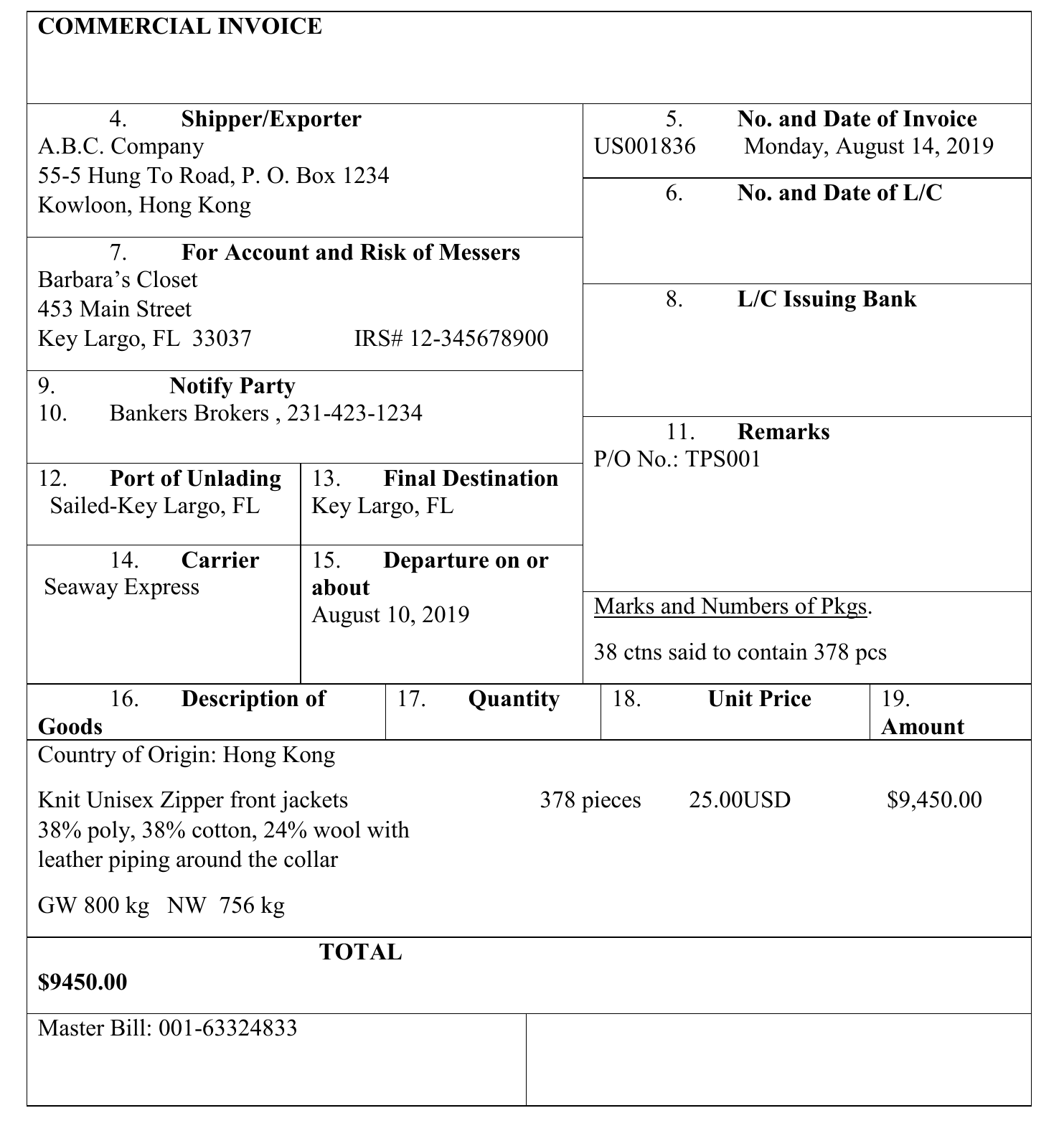
What is the Manufacturer’s ID? A.B.C. Company 55-5 Hung To Road, P. O. Box 1234 Kowloon, Hong Kong
Exhibit — the document this question is answered from
Text version
COMMERCIAL INVOICE
4. Shipper/Exporter A.B.C. Company 55-5 Hung To Road, P. O. Box 1234 Kowloon, Hong Kong
5. US001836
7. For Account and Risk of Messers Barbara’s Closet 453 Main Street Key Largo, FL 33037 IRS# 12-345678900
9.
10. Notify Party Bankers Brokers , 231-423-1234
12. Port of Unlading Sailed-Key Largo, FL
13. Final Destination Key Largo, FL
14. Carrier Seaway Express
15. Departure on or about August 10, 2019 No. and Date of Invoice Monday, August 14, 2019
6. No. and Date of L/C
8. L/C Issuing Bank
11. Remarks P/O No.: TPS001 Marks and Numbers of Pkgs. 38 ctns said to contain 378 pcs
16. Description of Goods Country of Origin: Hong Kong
17. Knit Unisex Zipper front jackets 38% poly, 38% cotton, 24% wool with leather piping around the collar
GW 800 kg
NW 756 kg
TOTAL $9450.00
Master Bill: 001-63324833 Quantity
18. 378 pieces Unit Price 25.00USD
19. Amount $9,450.00
A CNABC555KOW
B HKABC555KOW
C CNABCCOM1234KOW
D HKABCCOM1234HON
E KOABCCOM123KOW
Show the official answer
Answer: D — HKABCCOM1234HON
CBP's official answer: D
The answer key gives the controlling authority as 19 CFR 102 Appendix 7 – HKABCCOM1234HON.
Why there is no walkthrough here
This question is from the October 2019 exam, which was sat against the 2018 or 2019 Basic Edition HTSUS and the 2018 Annual Edition of Title 19 CFR. We check every walkthrough against the references we hold — the editions designated for the current sitting — and for this question we could not confirm the official answer from that text closely enough to walk you through it honestly.
This one does not turn on a tariff number, so the answer has most likely not changed. The cited text is either not in the corpus we check against, or is there in a form our verifier could not match to the answer. We would rather show you CBP's answer with that caveat than invent a walkthrough.
Read the cited source yourself. It is short, and confirming the answer from the text is the same exercise the exam asks of you.
What is the CLASSIFICATION of the knit unisex zipper front jacket?
Exhibit — the document this question is answered from
Text version
COMMERCIAL INVOICE
4. Shipper/Exporter A.B.C. Company 55-5 Hung To Road, P. O. Box 1234 Kowloon, Hong Kong
5. US001836
7. For Account and Risk of Messers Barbara’s Closet 453 Main Street Key Largo, FL 33037 IRS# 12-345678900
9.
10. Notify Party Bankers Brokers , 231-423-1234
12. Port of Unlading Sailed-Key Largo, FL
13. Final Destination Key Largo, FL
14. Carrier Seaway Express
15. Departure on or about August 10, 2019 No. and Date of Invoice Monday, August 14, 2019
6. No. and Date of L/C
8. L/C Issuing Bank
11. Remarks P/O No.: TPS001 Marks and Numbers of Pkgs. 38 ctns said to contain 378 pcs
16. Description of Goods Country of Origin: Hong Kong
17. Knit Unisex Zipper front jackets 38% poly, 38% cotton, 24% wool with leather piping around the collar
GW 800 kg
NW 756 kg
TOTAL $9450.00
Master Bill: 001-63324833 Quantity
18. 378 pieces Unit Price 25.00USD
19. Amount $9,450.00
A 6101.20.0010
B 6101.30.1500
C 6101.30.2010
D 6102.30.1000
E 6102.30.0500
Show the official answer
Answer: D — 6102.30.1000
CBP's official answer: D
The answer key gives the controlling authority as HTSUS 6102.30.1000.
Why there is no walkthrough here
This question is from the October 2019 exam, which was sat against the 2018 or 2019 Basic Edition HTSUS and the 2018 Annual Edition of Title 19 CFR. We check every walkthrough against the references we hold — the editions designated for the current sitting — and for this question we could not confirm the official answer from that text closely enough to walk you through it honestly.
The likely reason is edition drift rather than a mistake by anyone: tariff subheadings are split and renumbered between HTSUS editions, General Notes are re-lettered, and rates change every year. The answer was right for its exam. It may not be right today.
Use this question for the reasoning, not the number. The structure of the problem is still exactly what the current exam tests; the specific code or figure should be re-derived from the current tariff.
What is the duty, taxes, and fees due on the shipment?
Exhibit — the document this question is answered from
Text version
COMMERCIAL INVOICE
4. Shipper/Exporter A.B.C. Company 55-5 Hung To Road, P. O. Box 1234 Kowloon, Hong Kong
5. US001836
7. For Account and Risk of Messers Barbara’s Closet 453 Main Street Key Largo, FL 33037 IRS# 12-345678900
9.
10. Notify Party Bankers Brokers , 231-423-1234
12. Port of Unlading Sailed-Key Largo, FL
13. Final Destination Key Largo, FL
14. Carrier Seaway Express
15. Departure on or about August 10, 2019 No. and Date of Invoice Monday, August 14, 2019
6. No. and Date of L/C
8. L/C Issuing Bank
11. Remarks P/O No.: TPS001 Marks and Numbers of Pkgs. 38 ctns said to contain 378 pcs
16. Description of Goods Country of Origin: Hong Kong
17. Knit Unisex Zipper front jackets 38% poly, 38% cotton, 24% wool with leather piping around the collar
GW 800 kg
NW 756 kg
TOTAL $9450.00
Master Bill: 001-63324833 Quantity
18. 378 pieces Unit Price 25.00USD
19. Amount $9,450.00
A $989.54
B $1256.03
C $1547.09
D $2296.19
E $2308.00
Show the official answer
Answer: D — $2296.19
CBP's official answer: D
The answer key gives the controlling authority as HTSUS 6102.30.1000.
Why there is no walkthrough here
This question is from the October 2019 exam, which was sat against the 2018 or 2019 Basic Edition HTSUS and the 2018 Annual Edition of Title 19 CFR. We check every walkthrough against the references we hold — the editions designated for the current sitting — and for this question we could not confirm the official answer from that text closely enough to walk you through it honestly.
The likely reason is edition drift rather than a mistake by anyone: tariff subheadings are split and renumbered between HTSUS editions, General Notes are re-lettered, and rates change every year. The answer was right for its exam. It may not be right today.
Use this question for the reasoning, not the number. The structure of the problem is still exactly what the current exam tests; the specific code or figure should be re-derived from the current tariff.
What is the Manufacturer ID? Fabrica de Artigos de Vestuario Top Job Grand River Building, Fi 2-4 Caracas, Venezuela
Exhibit — the document this question is answered from
Text version
COMMERCIAL INVOICE
20. Shipper/Exporter Fabrica de Artigos de Vestuario Top Job Grand River Building, Fi 2-4 Caracas, Venezuela
21. US001836
23. For Account and Risk of Messers Quilting Express 678 Palmer Street Chicago, IL IRS# 98-765432100
25.
26. Notify Party Penny Brokers , 431-123-5874
28. Port of Unlading Chicago, IL
29. Final Destination Chicago, IL
30. Carrier Venezuela Airlines
31. Departure on or about July 1, 2019 No. and Date of Invoice July 9, 2019
22. No. and Date of L/C
24. L/C Issuing Bank
27. Remarks P/O No.: TPS001 Marks and Numbers of Pkgs. 50 cartons stc 5500 pieces
32. Description of Goods Country of Origin: Venezuela
33. Quantity
34. Printed 100% cotton plain weave patchwork fabric 5500 pieces Unit Price 2.35USD
35. Amount $12,925.00
GW 1250 kg
NW 1200 kg
TOTAL $12,925.00
Master Bill: 001-63324833
ADDITIONAL INFORMATION: The fabric is made from patchwork squares, approximately 6” x 6” each, which have been sewn together for customers to use in making quilts. The fabric pieces contain 59 single yarns per centimeter in the warp and 28 single yarns per centimeter in the filling, and weigh 97.11 g/m2. The average yarn number for this product has been calculated to be 89 in the metric system.
A VEFABDECAR
B VEFABGRACAR
C VETOPJOB24CAR
D VETOPJOBCAR
E VEFABDE24CAR
Show the official answer
Answer: C — VETOPJOB24CAR
CBP's official answer: C
The answer key gives the controlling authority as 19 CFR 102 Appendix 7.
Why there is no walkthrough here
This question is from the October 2019 exam, which was sat against the 2018 or 2019 Basic Edition HTSUS and the 2018 Annual Edition of Title 19 CFR. We check every walkthrough against the references we hold — the editions designated for the current sitting — and for this question we could not confirm the official answer from that text closely enough to walk you through it honestly.
This one does not turn on a tariff number, so the answer has most likely not changed. The cited text is either not in the corpus we check against, or is there in a form our verifier could not match to the answer. We would rather show you CBP's answer with that caveat than invent a walkthrough.
Read the cited source yourself. It is short, and confirming the answer from the text is the same exercise the exam asks of you.
What is the CLASSIFICATION of the of the printed 100% cotton plain weave patchwork fabric?
Exhibit — the document this question is answered from
Text version
COMMERCIAL INVOICE
20. Shipper/Exporter Fabrica de Artigos de Vestuario Top Job Grand River Building, Fi 2-4 Caracas, Venezuela
21. US001836
23. For Account and Risk of Messers Quilting Express 678 Palmer Street Chicago, IL IRS# 98-765432100
25.
26. Notify Party Penny Brokers , 431-123-5874
28. Port of Unlading Chicago, IL
29. Final Destination Chicago, IL
30. Carrier Venezuela Airlines
31. Departure on or about July 1, 2019 No. and Date of Invoice July 9, 2019
22. No. and Date of L/C
24. L/C Issuing Bank
27. Remarks P/O No.: TPS001 Marks and Numbers of Pkgs. 50 cartons stc 5500 pieces
32. Description of Goods Country of Origin: Venezuela
33. Quantity
34. Printed 100% cotton plain weave patchwork fabric 5500 pieces Unit Price 2.35USD
35. Amount $12,925.00
GW 1250 kg
NW 1200 kg
TOTAL $12,925.00
Master Bill: 001-63324833
ADDITIONAL INFORMATION: The fabric is made from patchwork squares, approximately 6” x 6” each, which have been sewn together for customers to use in making quilts. The fabric pieces contain 59 single yarns per centimeter in the warp and 28 single yarns per centimeter in the filling, and weigh 97.11 g/m2. The average yarn number for this product has been calculated to be 89 in the metric system.
A 5208.51.8020
B 5209.51.6015
C 5811.00.2000
D 6307.90.9889
E 9404.90.8505
Show the official answer
Answer: D — 6307.90.9889
The worked walkthrough for this one — why the right answer is right, why each distractor fails, and where to find it in the crippled viewer — comes with the pass. The citation above is the source it’s built on; you can read it yourself in our 19 CFR navigator.
What is the duty, taxes, and fees due on the shipment?
Exhibit — the document this question is answered from
Text version
COMMERCIAL INVOICE
20. Shipper/Exporter Fabrica de Artigos de Vestuario Top Job Grand River Building, Fi 2-4 Caracas, Venezuela
21. US001836
23. For Account and Risk of Messers Quilting Express 678 Palmer Street Chicago, IL IRS# 98-765432100
25.
26. Notify Party Penny Brokers , 431-123-5874
28. Port of Unlading Chicago, IL
29. Final Destination Chicago, IL
30. Carrier Venezuela Airlines
31. Departure on or about July 1, 2019 No. and Date of Invoice July 9, 2019
22. No. and Date of L/C
24. L/C Issuing Bank
27. Remarks P/O No.: TPS001 Marks and Numbers of Pkgs. 50 cartons stc 5500 pieces
32. Description of Goods Country of Origin: Venezuela
33. Quantity
34. Printed 100% cotton plain weave patchwork fabric 5500 pieces Unit Price 2.35USD
35. Amount $12,925.00
GW 1250 kg
NW 1200 kg
TOTAL $12,925.00
Master Bill: 001-63324833
ADDITIONAL INFORMATION: The fabric is made from patchwork squares, approximately 6” x 6” each, which have been sewn together for customers to use in making quilts. The fabric pieces contain 59 single yarns per centimeter in the warp and 28 single yarns per centimeter in the filling, and weigh 97.11 g/m2. The average yarn number for this product has been calculated to be 89 in the metric system.
A $859.05
B $949.52
C $1130.47
D $1660.40
E $1699.17
Show the official answer
Answer: B — $949.52
CBP's official answer: B
The answer key gives the controlling authority as HTSUS 6307.90.9889.
Why there is no walkthrough here
This question is from the October 2019 exam, which was sat against the 2018 or 2019 Basic Edition HTSUS and the 2018 Annual Edition of Title 19 CFR. We check every walkthrough against the references we hold — the editions designated for the current sitting — and for this question we could not confirm the official answer from that text closely enough to walk you through it honestly.
The likely reason is edition drift rather than a mistake by anyone: tariff subheadings are split and renumbered between HTSUS editions, General Notes are re-lettered, and rates change every year. The answer was right for its exam. It may not be right today.
Use this question for the reasoning, not the number. The structure of the problem is still exactly what the current exam tests; the specific code or figure should be re-derived from the current tariff.
In accordance with 19 C.F.R. 111.23, once revoked, how long must a licensed customs broker retain powers of attorney and letters of revocation?
A 5 years after the date of a client’s properly documented insolvency
B 5 years after the date of revocation from previous broker
C 5 years after the date the licensed broker ceases conducting customs business
D 5 years after the date the client ceases to be an “active client”
E None of the above
Show the official answer
Answer: D — 5 years after the date the client ceases to be an “active client”
The worked walkthrough for this one — why the right answer is right, why each distractor fails, and where to find it in the crippled viewer — comes with the pass. The citation above is the source it’s built on; you can read it yourself in our 19 CFR navigator.
Which of the following statements is INCORRECT regarding a power of attorney?
A A power of attorney must be legible.
B A power of attorney must identify a Grantor and a Grantee.
C A power of attorney may be completed on CBP Form 5291 “Power of Attorney.”
D A power of attorney must identify only nonresident principals.
E A power of attorney must include the statement to accept service of process against a nonresident principal.
Show the official answer
Answer: D — A power of attorney must identify only nonresident principals.
The worked walkthrough for this one — why the right answer is right, why each distractor fails, and where to find it in the crippled viewer — comes with the pass. The citation above is the source it’s built on; you can read it yourself in our 19 CFR navigator.
Powers of attorney issued by a partnership shall be limited to a period not to exceed _________from the date of execution.
A 30 days
B 60 days
C 1 year
D 2 years
E 5 years
Show the official answer
Answer: D — 2 years
The worked walkthrough for this one — why the right answer is right, why each distractor fails, and where to find it in the crippled viewer — comes with the pass. The citation above is the source it’s built on; you can read it yourself in our 19 CFR navigator.
If accelerated disposition is requested on a protest and it is not allowed or denied within 30 days from request for accelerated disposition what would the status of the protest be?
A Protest is deemed approved.
B Protest is forwarded to the Office of Rules and Regulations for further review.
C Protest is deemed denied.
D Protest stays open until decision is reached or 2 years from the filing date is reached when it will be deemed approved.
E Protest is withdrawn allowing protestant to resubmit claim within 180 days of the protest withdrawal.
Show the official answer
Answer: C — Protest is deemed denied.
The worked walkthrough for this one — why the right answer is right, why each distractor fails, and where to find it in the crippled viewer — comes with the pass. The citation above is the source it’s built on; you can read it yourself in our 19 CFR navigator.
Petitions for relief from seizures must be filed within ____days from the date of mailing of the notice of seizure.
A 5
B 10
C 30
D 60
E 90
Show the official answer
Answer: C — 30
The worked walkthrough for this one — why the right answer is right, why each distractor fails, and where to find it in the crippled viewer — comes with the pass. The citation above is the source it’s built on; you can read it yourself in our 19 CFR navigator.
Assuming that a protest is timely filed with CBP, which statement of the following options is a valid claim for a 514 Protest concerning an entry for consumption filed on July 1, 2019?
A The contest of the duty rate calculated for the country-wide rate in an anti-dumping duty order issued by the Department of Commerce, which is generally applicable to that entry
B The contest of a denied request for reliquidation of under 19 U.S.C. § 1520(c)
C The contest of the fee rate established for the USDA Agriculture Marketing Service fee, which is generally applicable to that entry
D The contest of a denied petition to reliquidate an entry filed pursuant to 19 U.S.C. § 1520(d)
E A request to change the importer of record, which was provided on the entry documentation for an entry for consumption, from the consignee to the owner of the merchandise
Show the official answer
Answer: D — The contest of a denied petition to reliquidate an entry filed pursuant to 19 U.S.C. § 1520(d)
CBP's official answer: D
The answer key gives the controlling authority as 19 CFR 171.11(b)(8) · 19 CFR 141.20.
Why there is no walkthrough here
This question is from the October 2019 exam, which was sat against the 2018 or 2019 Basic Edition HTSUS and the 2018 Annual Edition of Title 19 CFR. We check every walkthrough against the references we hold — the editions designated for the current sitting — and for this question we could not confirm the official answer from that text closely enough to walk you through it honestly.
This one does not turn on a tariff number, so the answer has most likely not changed. The cited text is either not in the corpus we check against, or is there in a form our verifier could not match to the answer. We would rather show you CBP's answer with that caveat than invent a walkthrough.
Read the cited source yourself. They are short, and confirming the answer from the text is the same exercise the exam asks of you.
The assessed amount of a penalty issued under 19 U.S.C. 1526(f) for a seizure taken under 19 U.S.C. 1526(e) is derived from:
A Domestic Value
B Manufactured Suggested Retail Price Value
C Dutiable Value
D Foreign Value
E Transaction Value
Show the official answer
Answer: B — Manufactured Suggested Retail Price Value
The worked walkthrough for this one — why the right answer is right, why each distractor fails, and where to find it in the crippled viewer — comes with the pass. The citation above is the source it’s built on; you can read it yourself in our 19 CFR navigator.
How much is the fee that should accompany an application to record one trademark with U.S. Customs and Border Protection for one class of merchandise?
A $0; no fee required
B $95
C $190
D $380
E $570
Show the official answer
Answer: C — $190
The worked walkthrough for this one — why the right answer is right, why each distractor fails, and where to find it in the crippled viewer — comes with the pass. The citation above is the source it’s built on; you can read it yourself in our 19 CFR navigator.
An application to record a trade name shall be in writing addressed to the IPR & Restricted Merchandise Branch, 1300 Pennsylvania Avenue, NW., Washington, DC 20229, and shall include the following information EXCEPT:
A The name, complete business address, and citizenship of the trade name owner or owners (if a partnership, the citizenship of each partner; if an association or corporation, the State, country, or other political jurisdiction within which it was organized, incorporated or created)
B The name or trade style to be recorded
C The name and principal business address of each foreign person or business entity authorized or licensed to use the trade name and a statement as to the use authorized
D The identity of any parent or subsidiary company, or other foreign company under common ownership or control which uses the trade name abroad
E A description of the merchandise with which the copyright is associated
Show the official answer
Answer: E — A description of the merchandise with which the copyright is associated
The worked walkthrough for this one — why the right answer is right, why each distractor fails, and where to find it in the crippled viewer — comes with the pass. The citation above is the source it’s built on; you can read it yourself in our 19 CFR navigator.
Which of the following is appropriate to challenge the seizure of merchandise for a violation of 19 USC 1526(e), as implemented by 19 CFR 133.21(d)?
A Filing a protest under 19 CFR 174
B Filing a petition under 19 CFR 172
C Filing a ruling request under 19 CFR 177
D All of the above
E None of the above
Show the official answer
Answer: E — None of the above
CBP's official answer: E
The answer key gives the controlling authority as 19 CFR 171.
Why there is no walkthrough here
This question is from the October 2019 exam, which was sat against the 2018 or 2019 Basic Edition HTSUS and the 2018 Annual Edition of Title 19 CFR. We check every walkthrough against the references we hold — the editions designated for the current sitting — and for this question we could not confirm the official answer from that text closely enough to walk you through it honestly.
This one does not turn on a tariff number, so the answer has most likely not changed. The cited text is either not in the corpus we check against, or is there in a form our verifier could not match to the answer. We would rather show you CBP's answer with that caveat than invent a walkthrough.
Read the cited source yourself. It is short, and confirming the answer from the text is the same exercise the exam asks of you.
Which of the following is TRUE with respect to imported merchandise after the U.S. International Trade Commission (ITC) finds a violation of section 337 of the Tariff Act (19 USC 1337) and issues an exclusion order, as implemented by CBP under 19 CFR 12.39?
A The exclusion order is not effective until 60 days after issuance, at which point merchandise subject to the exclusion order no longer may be entered.
B Merchandise subject to the exclusion order may be entered under a single entry bond, in an amount set by the ITC, from the time the exclusion order issues until the time it expires.
C Merchandise subject to the exclusion order may be entered under bond, in an amount set by the ITC that is secured by the importer’s basic importation bond.
D Merchandise subject to the exclusion order may be entered under bond as provided for in 19 CFR 113, until the determination of a violation becomes final.
E Merchandise subject to the exclusion order may not be entered after the exclusion order has issued.
Show the official answer
Answer: D — Merchandise subject to the exclusion order may be entered under bond as provided for in 19 CFR 113, until the determination of a violation becomes final.
CBP's official answer: D
The answer key gives the controlling authority as 19 CFR 12.39(b)(2).
Why there is no walkthrough here
This question is from the October 2019 exam, which was sat against the 2018 or 2019 Basic Edition HTSUS and the 2018 Annual Edition of Title 19 CFR. We check every walkthrough against the references we hold — the editions designated for the current sitting — and for this question we could not confirm the official answer from that text closely enough to walk you through it honestly.
This one does not turn on a tariff number, so the answer has most likely not changed. The cited text is either not in the corpus we check against, or is there in a form our verifier could not match to the answer. We would rather show you CBP's answer with that caveat than invent a walkthrough.
Read the cited source yourself. It is short, and confirming the answer from the text is the same exercise the exam asks of you.
The operator of the Foreign Trade Zone shall maintain all records required pertaining to zone merchandise for what period of time?
A 1 year after merchandise is removed from the zone
B 5 years from the time of admission
C 5 years from the merchandise being removed from the zone
D Until all admissions have left the zone
E Must be electronically maintained until the Port Director gives authorization to destroy the records in accordance with the port policy.
Show the official answer
Answer: C — 5 years from the merchandise being removed from the zone
The worked walkthrough for this one — why the right answer is right, why each distractor fails, and where to find it in the crippled viewer — comes with the pass. The citation above is the source it’s built on; you can read it yourself in our 19 CFR navigator.
Which of the following is NOT allowed within a Foreign Trade Zone (FTZ)?
A Admitting of merchandise in zone-restricted status for the purpose of destruction.
B Breaking a customs in-bond seal on a container of merchandise, upon arrival and admission into an FTZ.
C Retail sale of domestic status merchandise, for consumption within customs territory, without a permit.
D Manufacturing domestic status merchandise without a permit.
E Failing to report a shortage, not resulting from theft or suspected theft, of domestic status merchandise.
Show the official answer
Answer: C — Retail sale of domestic status merchandise, for consumption within customs territory, without a permit.
The worked walkthrough for this one — why the right answer is right, why each distractor fails, and where to find it in the crippled viewer — comes with the pass. The citation above is the source it’s built on; you can read it yourself in our 19 CFR navigator.
Which of the following statements, regarding bonded warehouse operations, is ACCURATE:
A Warehouse operators may allow manipulation of bonded merchandise, without prior approval from CBP, if the manipulation occurs in the bonded warehouse area.
B Merchandise entered and placed in a Class 9 warehouse must be unpacked for sale only upon receipt of a permit issued by the port director.
C The release of merchandise in general order may only be made by the warehouse proprietor upon presentation of a permit to release or delivery authorization signed by the appropriate Customs officer.
D Warehouse proprietors are not required to maintain inventory records of the merchandise received in the warehouse.
E Discontinuance of existing bonded warehouses status does not require CBP review.
Show the official answer
Answer: C — The release of merchandise in general order may only be made by the warehouse proprietor upon presentation of a permit to release or delivery authorization signed by the appropriate Customs officer.
CBP's official answer: C
The answer key gives the controlling authority as 19 CFR 19.9(c) · 19 CFR 19.11(c), (h) · 19 CFR 19.4(b)(8) · 19 CFR 19.3(c).
Why there is no walkthrough here
This question is from the October 2019 exam, which was sat against the 2018 or 2019 Basic Edition HTSUS and the 2018 Annual Edition of Title 19 CFR. We check every walkthrough against the references we hold — the editions designated for the current sitting — and for this question we could not confirm the official answer from that text closely enough to walk you through it honestly.
This one does not turn on a tariff number, so the answer has most likely not changed. The cited text is either not in the corpus we check against, or is there in a form our verifier could not match to the answer. We would rather show you CBP's answer with that caveat than invent a walkthrough.
Read the cited source yourself. They are short, and confirming the answer from the text is the same exercise the exam asks of you.
ABC Smith & Co. manufactures small gardening hand-held shovels in its foreign trade zone (FTZ). For the shovels’ production, the company imports and formally enters screws that are subject to a 2% ad valorem rate of duty, which the company then subsequently admits to its FTZ. Additionally, ABC Smith & Co. extracts raw metal from its mine in Minnesota. The raw metal is classified under an HTS with a 10% ad valorem rate of duty. ABC Smith & Co. then admits the extracted metal into its FTZ. Furthermore, ABC Smith & Co. admits to its FTZ as nonprivileged foreign status merchandise plastic shovel handles that are subject to an 8% ad valorem rate of duty. In the FTZ, ABC Smith & Co. then smelts the raw metal, shapes it into the heads of shovels, and assembles the heads with the plastic shovel handles and screws to form finished hand-held shovels that are subject to a 4% ad valorem rate of duty. What rate of duty applies to the hand-held shovels upon withdrawal from the FTZ and entry into the customs territory of the United States?
A 2% ad valorem
B 4% ad valorem
C 8% ad valorem
D 10% ad valorem
E 20% ad valorem
Show the official answer
Answer: B — 4% ad valorem
The worked walkthrough for this one — why the right answer is right, why each distractor fails, and where to find it in the crippled viewer — comes with the pass. The citation above is the source it’s built on; you can read it yourself in our 19 CFR navigator.
An importer may file a NAFTA claim within ________ for a refund of duties?
A 90 days from the date of the liquidation of the entry
B 180 days from the date of liquidation of the entry
C One year from the date of importation of the goods
D Three years of importation of the goods
E Five years from the date of importation
Show the official answer
Answer: C — One year from the date of importation of the goods
The worked walkthrough for this one — why the right answer is right, why each distractor fails, and where to find it in the crippled viewer — comes with the pass. The citation above is the source it’s built on; you can read it yourself in our 19 CFR navigator.
Goods wholly obtained or produced entirely in the territory of Canada, Mexico and/or the United States means all of the below EXCEPT:
A Mineral goods extracted in the territory of one or more of the NAFTA parties
B Live animals born and raised in the territory of one or more of the NAFTA parties
C Goods obtained from hunting, trapping, fishing in the territory of one or more of the NAFTA parties
D Vegetable goods, harvested in the territory of one or more of the NAFTA parties
E Goods (fish, shellfish and other marine life) taken from the sea by vessels registered or recorded with a non-NAFTA party and flying its flag
Show the official answer
Answer: E — Goods (fish, shellfish and other marine life) taken from the sea by vessels registered or recorded with a non-NAFTA party and flying its flag
The worked walkthrough for this one — why the right answer is right, why each distractor fails, and where to find it in the crippled viewer — comes with the pass. The citation above is the source it’s built on; you can read it yourself in our 19 CFR navigator.
HTSUS 9802.00.50 · Subchapeter II Note3(f) to Chapter 98
Fancy Jewelry Company exported 100 identical 14 karat gold bracelets from the United States to Brazil. In Brazil, its subsidiary company polished the gold bracelets. Polishing jewelry is an acceptable alteration under subheading 9802.00.50, HTSUS. The subsidiary then exported 50 of the polished gold bracelets from Brazil back to the United States, along with 50 Chinese origin 14 karat gold bracelets in the exact same style that Fancy Jewelry Company had exported from the United States for polishing one month earlier. As Fancy Jewelry Company’s customs broker, would you be correct to advise entry under subheading 9802.00.50, HTSUS?
A No, because subheading 9802.00.50, HTSUS, excludes commingled goods.
B No, because subheading 9802.00.50, HTSUS, excludes goods which are advanced in value or improved in condition.
C No, because subheading 9802.00.50, HTSUS, only applies to an importation of the exact same number of goods.
D Yes, only if Fancy Jewelry Company utilizes a warranty management method.
E Yes, only if Fancy Jewelry Company utilizes an inventory management method based on generally accepted accounting principles to account for the origin, value and classification of such articles. The same inventory management method must be used for all fungible articles.
Show the official answer
Answer: E — Yes, only if Fancy Jewelry Company utilizes an inventory management method based on generally accepted accounting principles to account for the origin, value and classification of such articles. The same inventory management method must be used for all fungible articles.
CBP's official answer: E
The answer key gives the controlling authority as HTSUS 9802.00.50 · Subchapeter II Note3(f) to Chapter 98.
Why there is no walkthrough here
This question is from the October 2019 exam, which was sat against the 2018 or 2019 Basic Edition HTSUS and the 2018 Annual Edition of Title 19 CFR. We check every walkthrough against the references we hold — the editions designated for the current sitting — and for this question we could not confirm the official answer from that text closely enough to walk you through it honestly.
The likely reason is edition drift rather than a mistake by anyone: tariff subheadings are split and renumbered between HTSUS editions, General Notes are re-lettered, and rates change every year. The answer was right for its exam. It may not be right today.
Use this question for the reasoning, not the number. The structure of the problem is still exactly what the current exam tests; the specific code or figure should be re-derived from the current tariff.
What is the significance of the SPI (special program indicator) “P+” in HTSUS 0401.50.75, 0402.21.25 and 0403.90.78?
A U.S. materials are considered non-originating materials for purposes of performing the origination analysis.
B These goods are ineligible for the MPF (merchandise processing fee) exemption that benefit other CAFTA-DR goods.
C Dominican Republic goods are considered non-originating materials for purposes of performing the origination analysis.
D All materials must be of U.S. origin and all processing must be performed in a CAFTADR country exclusive of the U.S.
E Allows non-Party materials to count as originating materials, as long as all processing is performed in the CAFTA-DR.
Show the official answer
Answer: A — U.S. materials are considered non-originating materials for purposes of performing the origination analysis.
CBP's official answer: A
The answer key gives the controlling authority as General Note 29 · 19 CFR 24.23(c).
Why there is no walkthrough here
This question is from the October 2019 exam, which was sat against the 2018 or 2019 Basic Edition HTSUS and the 2018 Annual Edition of Title 19 CFR. We check every walkthrough against the references we hold — the editions designated for the current sitting — and for this question we could not confirm the official answer from that text closely enough to walk you through it honestly.
The likely reason is edition drift rather than a mistake by anyone: tariff subheadings are split and renumbered between HTSUS editions, General Notes are re-lettered, and rates change every year. The answer was right for its exam. It may not be right today.
Use this question for the reasoning, not the number. The structure of the problem is still exactly what the current exam tests; the specific code or figure should be re-derived from the current tariff.
Reading isn’t practising
You just read the answers. On exam day you have to find them, under a clock, in a search box with no jump-to-next. Drill these same questions — with a free account, the ones you get wrong come back on a schedule.