75 usable questions with CBP’s official answer and answer-key sources where supplied. Worked walkthroughs are free for the first 10; the rest come with the pass. Answers are collapsed so you can try first.
Questions 1, 2, 3 are retained in our audit trail but unavailable for practice because the published copy is missing an exhibit or cannot be rendered answerably. They are not counted in the total above.
Designated references
Harmonized Tariff Schedule of the United States — 2018 Basic Edition
Title 19, Code of Federal Regulations — 2017 Annual Edition
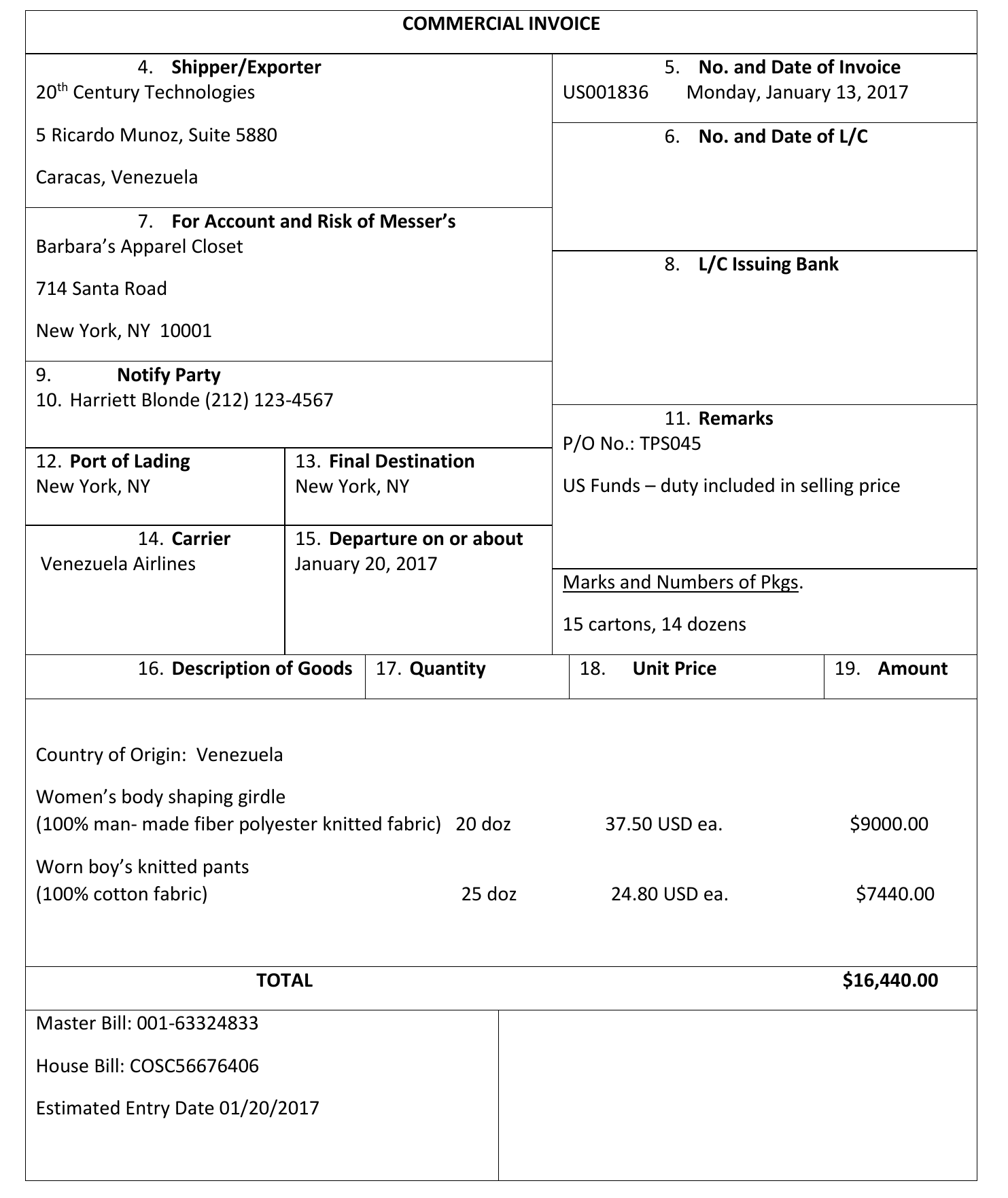
Exhibit — the document this question is answered from
Text version
COMMERCIAL INVOICE
4. Shipper/Exporter 20th Century Technologies US001836 5 Ricardo Munoz, Suite 5880
5. No. and Date of Invoice Monday, January 13, 2017
6. No. and Date of L/C Caracas, Venezuela
7. For Account and Risk of Messer’s Barbara’s Apparel Closet
8. L/C Issuing Bank 714 Santa Road New York, NY 10001
9. Notify Party
10. Harriett Blonde (212) 123-4567
11. Remarks P/O No.: TPS045
12. Port of Lading New York, NY
13. Final Destination New York, NY
14. Carrier Venezuela Airlines
15. Departure on or about January 20, 2017 US Funds – duty included in selling price Marks and Numbers of Pkgs. 15 cartons, 14 dozens
16. Description of Goods
17. Quantity Unit Price
19. Amount Women’s body shaping girdle (100% man- made fiber polyester knitted fabric) 20 doz 37.50 USD ea. $9000.00 Worn boy’s knitted pants (100% cotton fabric) 24.80 USD ea. $7440.00
18. Country of Origin: Venezuela 25 doz
TOTAL $16,440.00
Master Bill: 001-63324833 House Bill: COSC56676406 Estimated Entry Date 01/20/2017
A VNCENTEC5 CAR
B VACENTEC5VEN
C VE20TCEN5CAR
D VE20TCEN5880CAR
E VECENTEC5CAR
Show the official answer
Answer: D — VE20TCEN5880CAR
CBP's official answer: D
The answer key gives the controlling authority as Appendix 2 to Prep of 7501.
Why there is no walkthrough here
This question is from the October 2018 exam, which was sat against the 2018 Basic Edition HTSUS and the 2017 Annual Edition of Title 19 CFR. We check every walkthrough against the references we hold — the editions designated for the current sitting — and for this question we could not confirm the official answer from that text closely enough to walk you through it honestly.
This one does not turn on a tariff number, so the answer has most likely not changed. The cited text is either not in the corpus we check against, or is there in a form our verifier could not match to the answer. We would rather show you CBP's answer with that caveat than invent a walkthrough.
Read the cited source yourself. It is short, and confirming the answer from the text is the same exercise the exam asks of you.
What is the CLASSIFICATION of women’s knitted body shaping garments made of 100% man-made fiber polyester?
Exhibit — the document this question is answered from
Text version
COMMERCIAL INVOICE
4. Shipper/Exporter 20th Century Technologies US001836 5 Ricardo Munoz, Suite 5880
5. No. and Date of Invoice Monday, January 13, 2017
6. No. and Date of L/C Caracas, Venezuela
7. For Account and Risk of Messer’s Barbara’s Apparel Closet
8. L/C Issuing Bank 714 Santa Road New York, NY 10001
9. Notify Party
10. Harriett Blonde (212) 123-4567
11. Remarks P/O No.: TPS045
12. Port of Lading New York, NY
13. Final Destination New York, NY
14. Carrier Venezuela Airlines
15. Departure on or about January 20, 2017 US Funds – duty included in selling price Marks and Numbers of Pkgs. 15 cartons, 14 dozens
16. Description of Goods
17. Quantity Unit Price
19. Amount Women’s body shaping girdle (100% man- made fiber polyester knitted fabric) 20 doz 37.50 USD ea. $9000.00 Worn boy’s knitted pants (100% cotton fabric) 24.80 USD ea. $7440.00
18. Country of Origin: Venezuela 25 doz
TOTAL $16,440.00
Master Bill: 001-63324833 House Bill: COSC56676406 Estimated Entry Date 01/20/2017
A 6108.91.0015
B 6108.92.0015
C 6212.20.0010
D 6212.20.0020
E 6212.90.0030
Show the official answer
Answer: D — 6212.20.0020
CBP's official answer: D
The answer key gives the controlling authority as HTSUS 6212.20.0020.
Why there is no walkthrough here
This question is from the October 2018 exam, which was sat against the 2018 Basic Edition HTSUS and the 2017 Annual Edition of Title 19 CFR. We check every walkthrough against the references we hold — the editions designated for the current sitting — and for this question we could not confirm the official answer from that text closely enough to walk you through it honestly.
The likely reason is edition drift rather than a mistake by anyone: tariff subheadings are split and renumbered between HTSUS editions, General Notes are re-lettered, and rates change every year. The answer was right for its exam. It may not be right today.
Use this question for the reasoning, not the number. The structure of the problem is still exactly what the current exam tests; the specific code or figure should be re-derived from the current tariff.
What is the CLASSIFICATION of boys’ knitted pants made of 100% cotton fabric?
Exhibit — the document this question is answered from
Text version
COMMERCIAL INVOICE
4. Shipper/Exporter 20th Century Technologies US001836 5 Ricardo Munoz, Suite 5880
5. No. and Date of Invoice Monday, January 13, 2017
6. No. and Date of L/C Caracas, Venezuela
7. For Account and Risk of Messer’s Barbara’s Apparel Closet
8. L/C Issuing Bank 714 Santa Road New York, NY 10001
9. Notify Party
10. Harriett Blonde (212) 123-4567
11. Remarks P/O No.: TPS045
12. Port of Lading New York, NY
13. Final Destination New York, NY
14. Carrier Venezuela Airlines
15. Departure on or about January 20, 2017 US Funds – duty included in selling price Marks and Numbers of Pkgs. 15 cartons, 14 dozens
16. Description of Goods
17. Quantity Unit Price
19. Amount Women’s body shaping girdle (100% man- made fiber polyester knitted fabric) 20 doz 37.50 USD ea. $9000.00 Worn boy’s knitted pants (100% cotton fabric) 24.80 USD ea. $7440.00
18. Country of Origin: Venezuela 25 doz
TOTAL $16,440.00
Master Bill: 001-63324833 House Bill: COSC56676406 Estimated Entry Date 01/20/2017
A 6103.42.1040
B 6103.43.1540
C 6203.42.4546
D 6203.43.1320
E 6309.00.0010
Show the official answer
Answer: A — 6103.42.1040
CBP also accepted E — 6309.00.0010
CBP's official answers: A and E
The answer key gives the controlling authority as HTSUS 6103.42.1040 · HTSUS 6309.00.0010.
Why there is no walkthrough here
This question is from the October 2018 exam, which was sat against the 2018 Basic Edition HTSUS and the 2017 Annual Edition of Title 19 CFR. We check every walkthrough against the references we hold — the editions designated for the current sitting — and for this question we could not confirm the official answer from that text closely enough to walk you through it honestly.
The likely reason is edition drift rather than a mistake by anyone: tariff subheadings are split and renumbered between HTSUS editions, General Notes are re-lettered, and rates change every year. The answer was right for its exam. It may not be right today.
Use this question for the reasoning, not the number. The structure of the problem is still exactly what the current exam tests; the specific code or figure should be re-derived from the current tariff.
________is used for giving power of attorney to transact customs business.
A CBP Form 368
B CBP Form 3347
C CBP Form 4647
D CBP Form 5291
E CBP Form 7501
Show the official answer
Answer: D — CBP Form 5291
CBP's official answer: D
The answer key gives the controlling authority as 19 CFR 141.32 CBPF 5291.
Why there is no walkthrough here
This question is from the October 2018 exam, which was sat against the 2018 Basic Edition HTSUS and the 2017 Annual Edition of Title 19 CFR. We check every walkthrough against the references we hold — the editions designated for the current sitting — and for this question we could not confirm the official answer from that text closely enough to walk you through it honestly.
This one does not turn on a tariff number, so the answer has most likely not changed. The cited text is either not in the corpus we check against, or is there in a form our verifier could not match to the answer. We would rather show you CBP's answer with that caveat than invent a walkthrough.
Read the cited source yourself. It is short, and confirming the answer from the text is the same exercise the exam asks of you.
A At any time when the importer changes his address
B At any time when the guarantor leaves the employment of the importer
C At any time by written notice to the surety
D At any time by written notice given to and received by the Port Director
E It may not be revoked
Show the official answer
Answer: D — At any time by written notice given to and received by the Port Director
CBP's official answer: D
The answer key gives the controlling authority as 19 CFR 141.35.
Why there is no walkthrough here
This question is from the October 2018 exam, which was sat against the 2018 Basic Edition HTSUS and the 2017 Annual Edition of Title 19 CFR. We check every walkthrough against the references we hold — the editions designated for the current sitting — and for this question we could not confirm the official answer from that text closely enough to walk you through it honestly.
This one does not turn on a tariff number, so the answer has most likely not changed. The cited text is either not in the corpus we check against, or is there in a form our verifier could not match to the answer. We would rather show you CBP's answer with that caveat than invent a walkthrough.
Read the cited source yourself. It is short, and confirming the answer from the text is the same exercise the exam asks of you.
Regulation _________ states that “All powers of attorney may be granted for an unlimited period of time with the exception of a partnership power of attorney which is limited to a period not to exceed 2 years from the date of execution.”
A 19 CFR 141.34
B 19 CFR 141.35
C 19 CFR 141.36
D 19 CFR 141.40
E 19 CFR 141.45
Show the official answer
Answer: A — 19 CFR 141.34
CBP's official answer: A
The answer key gives the controlling authority as 19 CFR 141.34.
Why there is no walkthrough here
This question is from the October 2018 exam, which was sat against the 2018 Basic Edition HTSUS and the 2017 Annual Edition of Title 19 CFR. We check every walkthrough against the references we hold — the editions designated for the current sitting — and for this question we could not confirm the official answer from that text closely enough to walk you through it honestly.
This one does not turn on a tariff number, so the answer has most likely not changed. The cited text is either not in the corpus we check against, or is there in a form our verifier could not match to the answer. We would rather show you CBP's answer with that caveat than invent a walkthrough.
Read the cited source yourself. It is short, and confirming the answer from the text is the same exercise the exam asks of you.
There are specific examples of merchandise that are exempted from the marking rule. This merchandise is a part of what is called the “J” list. Although the merchandise is exempt from marking, the outermost container must be properly marked. Which of the following are NOT part of the “J” list?
A Eggs
B Feathers
C Christmas trees
D Flowers
E Automotive lug nuts
Show the official answer
Answer: E — Automotive lug nuts
CBP's official answer: E
The answer key gives the controlling authority as 19 CFR 134.33 J-list.
Why there is no walkthrough here
This question is from the October 2018 exam, which was sat against the 2018 Basic Edition HTSUS and the 2017 Annual Edition of Title 19 CFR. We check every walkthrough against the references we hold — the editions designated for the current sitting — and for this question we could not confirm the official answer from that text closely enough to walk you through it honestly.
This one does not turn on a tariff number, so the answer has most likely not changed. The cited text is either not in the corpus we check against, or is there in a form our verifier could not match to the answer. We would rather show you CBP's answer with that caveat than invent a walkthrough.
Read the cited source yourself. It is short, and confirming the answer from the text is the same exercise the exam asks of you.
How much time does CBP have to make a demand for the return to CBP custody of a textile product that was determined after release to have a country of origin that was not accurately represented to CBP upon entry of the merchandise?
A 30 days following the date of release
B CBP cannot demand redelivery once the textile merchandise has been released
C 90 days following the date of release
D 180 days following the date of release
E 314 days following the date of entry
Show the official answer
Answer: D — 180 days following the date of release
CBP's official answer: D
The answer key gives the controlling authority as 19 CFR 141.113(b).
Why there is no walkthrough here
This question is from the October 2018 exam, which was sat against the 2018 Basic Edition HTSUS and the 2017 Annual Edition of Title 19 CFR. We check every walkthrough against the references we hold — the editions designated for the current sitting — and for this question we could not confirm the official answer from that text closely enough to walk you through it honestly.
This one does not turn on a tariff number, so the answer has most likely not changed. The cited text is either not in the corpus we check against, or is there in a form our verifier could not match to the answer. We would rather show you CBP's answer with that caveat than invent a walkthrough.
Read the cited source yourself. It is short, and confirming the answer from the text is the same exercise the exam asks of you.
Which of the following persons is NOT required to maintain records and make them available for examination by CBP?
A A person who imports merchandise into the customs territory of the United States for commercial use
B A person who files a drawback claim
C A person who transports or stores merchandise carried or held under bond
D A person who has cleared the CBP facility after making a declaration upon arrival in the United States with non-commercial merchandise within the traveler’s personal exemptions or which is covered by a flat rate of duty
E A person who knowingly causes the importation or transportation or storage of merchandise carried or held under bond into or from the customs territory of the United States
Show the official answer
Answer: D — A person who has cleared the CBP facility after making a declaration upon arrival in the United States with non-commercial merchandise within the traveler’s personal exemptions or which is covered by a flat rate of duty
CBP's official answer: D
The answer key gives the controlling authority as 19 CFR 163.2(e).
Why there is no walkthrough here
This question is from the October 2018 exam, which was sat against the 2018 Basic Edition HTSUS and the 2017 Annual Edition of Title 19 CFR. We check every walkthrough against the references we hold — the editions designated for the current sitting — and for this question we could not confirm the official answer from that text closely enough to walk you through it honestly.
This one does not turn on a tariff number, so the answer has most likely not changed. The cited text is either not in the corpus we check against, or is there in a form our verifier could not match to the answer. We would rather show you CBP's answer with that caveat than invent a walkthrough.
Read the cited source yourself. It is short, and confirming the answer from the text is the same exercise the exam asks of you.
Each application for a district permit must set forth all the below, EXCEPT:
A The applicant's broker license number and date of issuance
B A copy of a document which reserves the applicant's business name with the state or local government
C A list of all other districts for which the applicant has a permit to transact customs business
D The address where the applicant lives within the district and the telephone number
E The place where the applicant's brokerage records will be retained
Show the official answer
Answer: D — The address where the applicant lives within the district and the telephone number
CBP's official answer: D
The answer key gives the controlling authority as 19 CFR 111.19(b)1, 2, 3, 5 and 6.
Why there is no walkthrough here
This question is from the October 2018 exam, which was sat against the 2018 Basic Edition HTSUS and the 2017 Annual Edition of Title 19 CFR. We check every walkthrough against the references we hold — the editions designated for the current sitting — and for this question we could not confirm the official answer from that text closely enough to walk you through it honestly.
This one does not turn on a tariff number, so the answer has most likely not changed. The cited text is either not in the corpus we check against, or is there in a form our verifier could not match to the answer. We would rather show you CBP's answer with that caveat than invent a walkthrough.
Read the cited source yourself. It is short, and confirming the answer from the text is the same exercise the exam asks of you.
Which is NOT a condition of a basic importation and entry bond?
A An agreement to make or complete entry
B An agreement to redeliver merchandise
C An agreement for examination of merchandise
D An agreement to retain records for at least 3 years
E An agreement to pay duties, taxes, and charges
Show the official answer
Answer: D — An agreement to retain records for at least 3 years
CBP's official answer: D
The answer key gives the controlling authority as 19 CFR 113.62 · 19 CFR 111.23.
Why there is no walkthrough here
This question is from the October 2018 exam, which was sat against the 2018 Basic Edition HTSUS and the 2017 Annual Edition of Title 19 CFR. We check every walkthrough against the references we hold — the editions designated for the current sitting — and for this question we could not confirm the official answer from that text closely enough to walk you through it honestly.
This one does not turn on a tariff number, so the answer has most likely not changed. The cited text is either not in the corpus we check against, or is there in a form our verifier could not match to the answer. We would rather show you CBP's answer with that caveat than invent a walkthrough.
Read the cited source yourself. They are short, and confirming the answer from the text is the same exercise the exam asks of you.
A A licensed broker who is the President of a customs brokerage must exercise responsible supervision and control over his company’s transaction of customs business.
B Payments received by brokers from clients after the due date must transmit payment to the government within 10 working days of receipt.
C A broker may not compensate a freight forward for referring business to him.
D A broker who holds a national permit does not need a filer code.
E Powers of attorney must be retained for 5 years after date of entry.
Show the official answer
Answer: A — A licensed broker who is the President of a customs brokerage must exercise responsible supervision and control over his company’s transaction of customs business.
CBP's official answer: A
The answer key gives the controlling authority as 19 CFR 111.19(f) · 19 CFR 111.23(b) · 19 CFR 111.28(a) · 19 CFR 111.29(a) · 19 CFR 111.36(c).
Why there is no walkthrough here
This question is from the October 2018 exam, which was sat against the 2018 Basic Edition HTSUS and the 2017 Annual Edition of Title 19 CFR. We check every walkthrough against the references we hold — the editions designated for the current sitting — and for this question we could not confirm the official answer from that text closely enough to walk you through it honestly.
This one does not turn on a tariff number, so the answer has most likely not changed. The cited text is either not in the corpus we check against, or is there in a form our verifier could not match to the answer. We would rather show you CBP's answer with that caveat than invent a walkthrough.
Read the cited source yourself. They are short, and confirming the answer from the text is the same exercise the exam asks of you.
A When an employee of a broker acting solely for his employer, where the broker has authorized the employee to sign documents pertaining to customs business on his or her behalf, and has executed a power of attorney for that purpose
B When a person is transacting business in connection with entry or clearance of vessels or other regulation of vessels under the navigation laws
C When a carrier is bringing merchandise to the port of arrival, or any bonded carrier is transporting merchandise for another carrier, they may make entry for that merchandise for transportation in bond
D When a person intends to transact customs business on behalf of others
E When a foreign Trade zone operator engaging in activities within a zone that do not involve the transfer of merchandise to the customs territory of the United States
Show the official answer
Answer: D — When a person intends to transact customs business on behalf of others
CBP's official answer: D
The answer key gives the controlling authority as 19 CFR 111.2(a)(1).
Why there is no walkthrough here
This question is from the October 2018 exam, which was sat against the 2018 Basic Edition HTSUS and the 2017 Annual Edition of Title 19 CFR. We check every walkthrough against the references we hold — the editions designated for the current sitting — and for this question we could not confirm the official answer from that text closely enough to walk you through it honestly.
This one does not turn on a tariff number, so the answer has most likely not changed. The cited text is either not in the corpus we check against, or is there in a form our verifier could not match to the answer. We would rather show you CBP's answer with that caveat than invent a walkthrough.
Read the cited source yourself. It is short, and confirming the answer from the text is the same exercise the exam asks of you.
How long does a successful examinee have to submit a license application to CBP?
A The application must be submitted within 6 months of the exam.
B The application must be submitted within 1 year of the exam.
C The application must be submitted within 1 year of passing the exam.
D The application must be submitted within 3 years of exam.
E The application must be submitted within 3 years of passing the exam.
Show the official answer
Answer: E — The application must be submitted within 3 years of passing the exam.
The worked walkthrough for this one — why the right answer is right, why each distractor fails, and where to find it in the crippled viewer — comes with the pass. The citation above is the source it’s built on; you can read it yourself in our 19 CFR navigator.
When a licensed broker hires a new employee, the broker must submit the required employee information to the port _________________________________.
A Within 10 calendar days following completion of first 30 consecutive days of employment by the broker
B Within 10 calendar days of fulltime employment by the broker
C No later than at the annual update to the port director, or upon issuance of a permit for an additional district, whichever comes first
D No later than within 30 calendar days of employment by the broker
E Within 10 calendar days of the request by the port director, or designated representative
Show the official answer
Answer: A — Within 10 calendar days following completion of first 30 consecutive days of employment by the broker
CBP's official answer: A
The answer key gives the controlling authority as 19 CFR 111.25(b)(1)(ii).
Why there is no walkthrough here
This question is from the October 2018 exam, which was sat against the 2018 Basic Edition HTSUS and the 2017 Annual Edition of Title 19 CFR. We check every walkthrough against the references we hold — the editions designated for the current sitting — and for this question we could not confirm the official answer from that text closely enough to walk you through it honestly.
This one does not turn on a tariff number, so the answer has most likely not changed. The cited text is either not in the corpus we check against, or is there in a form our verifier could not match to the answer. We would rather show you CBP's answer with that caveat than invent a walkthrough.
Read the cited source yourself. It is short, and confirming the answer from the text is the same exercise the exam asks of you.
A Following the receipt of a broker application, the port director shall post a notice that the application has been filed. This notice will be posted for a least 2 consecutive weeks in the customhouse at the port and similarly at any other port where the applicant also proposes to maintain an office.
B An appeal of a failing grade on the Customs Broker Exam must be submitted within 30 working days after the date printed on the results notification letter.
C When merchandise is withdrawn from a bonded warehouse, a customs broker is required to retain records relating to the withdrawal for 5 years from the date of the last withdrawal under the entry.
D Payments received by a broker from a client after the due date must be transmitted to government within 5 working days from receipt by the broker.
E An application for an individual license must be submitted within the 3 year period after the applicant passed the customs broker examination.
Show the official answer
Answer: B — An appeal of a failing grade on the Customs Broker Exam must be submitted within 30 working days after the date printed on the results notification letter.
The worked walkthrough for this one — why the right answer is right, why each distractor fails, and where to find it in the crippled viewer — comes with the pass. The citation above is the source it’s built on; you can read it yourself in our 19 CFR navigator.
The Enforce and Protect Act of 2015 (EAPA) provides for:
A Formal procedures for evaluating an e-allegation of an IPR violation
B Formal procedures for calculating the proper antidumping duty rates
C Formal procedures for submitting and investigating antidumping or countervailing allegations of evasion against U.S. Importers
D A determination as to what interim measures should be taken within 300 days from the date of initiation of the investigation
E An increase in the de minimis value exemption
Show the official answer
Answer: C — Formal procedures for submitting and investigating antidumping or countervailing allegations of evasion against U.S. Importers
CBP's official answer: C
The answer key gives the controlling authority as 19 CFR 165.0 Scope.
Why there is no walkthrough here
This question is from the October 2018 exam, which was sat against the 2018 Basic Edition HTSUS and the 2017 Annual Edition of Title 19 CFR. We check every walkthrough against the references we hold — the editions designated for the current sitting — and for this question we could not confirm the official answer from that text closely enough to walk you through it honestly.
This one does not turn on a tariff number, so the answer has most likely not changed. The cited text is either not in the corpus we check against, or is there in a form our verifier could not match to the answer. We would rather show you CBP's answer with that caveat than invent a walkthrough.
Read the cited source yourself. It is short, and confirming the answer from the text is the same exercise the exam asks of you.
Blaster Corporation imported 8 ball bearings with integral shafts from Germany, which are classified under subheading 8482.10.1080, Harmonized Tariff Schedule of the United States. The duty rate for these bearings is 2.4% ad valorem. The bearings are also subject to antidumping duties. The ball bearings are shipped from Germany to the U.S. via ocean container and formally entered in Charleston, South Carolina. The total value of the shipment of ball bearings is $7,785.00. The applicable antidumping duty cash deposit rate is 39.40%. What is the total amount of fees and estimated duties that should be reported on CBP Form 7501?
A $186.84
B $213.81
C $3,067.29
D $3,281.10
E $3,290.83
Show the official answer
Answer: E — $3,290.83
CBP's official answer: E
The answer key gives the controlling authority as 19 CFR 24.24.
Why there is no walkthrough here
This question is from the October 2018 exam, which was sat against the 2018 Basic Edition HTSUS and the 2017 Annual Edition of Title 19 CFR. We check every walkthrough against the references we hold — the editions designated for the current sitting — and for this question we could not confirm the official answer from that text closely enough to walk you through it honestly.
This one does not turn on a tariff number, so the answer has most likely not changed. The cited text is either not in the corpus we check against, or is there in a form our verifier could not match to the answer. We would rather show you CBP's answer with that caveat than invent a walkthrough.
Read the cited source yourself. It is short, and confirming the answer from the text is the same exercise the exam asks of you.
Westbay Clothing Company imported 1200 wire hangers from China, which are classified under subheading 7326.20.0020, Harmonized Tariff Schedule of the United States, at a 3.9% ad valorem duty rate and are subject to antidumping duties. The wire hangers are shipped via air and formally entered at the port of John F. Kennedy International Airport. The total value of the shipment is $9,655.00. The applicable antidumping duty cash deposit rate is 200%. What is the total amount of fees and estimated duties that Westbay should report on CBP Form 7501?
A $424.48
B $19,686.55
C $19,701.03
D $19,719.99
E $20,102.55
Show the official answer
Answer: D — $19,719.99
CBP's official answer: D
The answer key gives no citation for this question.
Why there is no walkthrough here
This question is from the October 2018 exam, which was sat against the 2018 Basic Edition HTSUS and the 2017 Annual Edition of Title 19 CFR. We check every walkthrough against the references we hold — the editions designated for the current sitting — and for this question we could not confirm the official answer from that text closely enough to walk you through it honestly.
The answer key gives no citation for this one, so we cannot tell whether the underlying text has moved since the exam or our verifier simply could not locate it. Treat CBP's answer as correct for its exam and confirm it against the current references before relying on it.
Baxter Brown imported sodium nitrate from Germany, which is classified under 2834.10.10 Harmonized Tariff Schedule of the United States, at a 5.5% ad valorem duty rate and is subject to antidumping duties under Antidumping Order A-428-841-000. The sodium nitrate is shipped by air and formally entered at the port of John F. Kennedy International Airport. The total value of the shipment is $8,432.00. The applicable antidumping duty cash deposit is 150.82%. What is the total amount of estimated duties and fees that should be reported on CBP Form 7501?
A $463.76
B $492.97
C $503.51
D $12,717.14
E $13,210.11
Show the official answer
Answer: E — $13,210.11
The worked walkthrough for this one — why the right answer is right, why each distractor fails, and where to find it in the crippled viewer — comes with the pass.
Intergraded Circuits imported 10 solar cells from Argentina, which are classified under 8501.31.800 Harmonized Tariff Schedule of the United States, at a 2.5% ad valorem duty rate and are subject to antidumping duties and countervailing duties. The solar cells are shipped by ocean and formally entered at the port of Savannah, GA. The total value of the shipment is $15,201.00. The applicable antidumping duty cash deposit is 28.25% and the applicable countervailing duties rate is 13.76%. What is the total amount of estimated duties and fees that should be reported on CBP Form 7501?
A $451.69
B $4,674.31
C $6,385.94
D $6,818.63
E $6,837.63
Show the official answer
Answer: E — $6,837.63
The worked walkthrough for this one — why the right answer is right, why each distractor fails, and where to find it in the crippled viewer — comes with the pass.
The _____________, as well as the principal, remains liable on a terminated bond for obligations incurred prior to termination.
A Broker
B Consignee
C Customs Port
D Nominal Consignee
E Surety
Show the official answer
Answer: E — Surety
The worked walkthrough for this one — why the right answer is right, why each distractor fails, and where to find it in the crippled viewer — comes with the pass. The citation above is the source it’s built on; you can read it yourself in our 19 CFR navigator.
Whose bond is liable when merchandise is in the process of delivery directly from an importing carrier (boat, plane, train, or truck) directly to a container station?
A Importer
B Broker
C Container Station
D Importing Carrier
E Bonded Warehouse
Show the official answer
Answer: D — Importing Carrier
The worked walkthrough for this one — why the right answer is right, why each distractor fails, and where to find it in the crippled viewer — comes with the pass. The citation above is the source it’s built on; you can read it yourself in our 19 CFR navigator.
A basic importation and entry bond must contain each agreement below, EXCEPT:
A An agreement to pay duties, taxes, and charges, including all additional duties, taxes, and charges assessed by U.S. Customs and Border Protection (CBP)
B An agreement to timely redeliver released merchandise upon demand by CBP
C An agreement to file documentation to enable CBP to collect accurate statistics with respect to the merchandise
D An agreement to transfer the merchandise to a place on receipt of instructions from CBP, before release, to allow examination of the merchandise
E An agreement to file timely any report required by CBP Regulations
Show the official answer
Answer: E — An agreement to file timely any report required by CBP Regulations
CBP's official answer: E
The answer key gives the controlling authority as 19 CFR 113.63(c)(4).
Why there is no walkthrough here
This question is from the October 2018 exam, which was sat against the 2018 Basic Edition HTSUS and the 2017 Annual Edition of Title 19 CFR. We check every walkthrough against the references we hold — the editions designated for the current sitting — and for this question we could not confirm the official answer from that text closely enough to walk you through it honestly.
This one does not turn on a tariff number, so the answer has most likely not changed. The cited text is either not in the corpus we check against, or is there in a form our verifier could not match to the answer. We would rather show you CBP's answer with that caveat than invent a walkthrough.
Read the cited source yourself. It is short, and confirming the answer from the text is the same exercise the exam asks of you.
Which scenario regarding Customs Bond processing timeframes is NOT correct?
A A continuous bond, and any associated application, or rider, may be filed up to 60 days prior to the effective date requested for the continuous bond or rider.
B A written request by a principal or co-principal to terminate a bond must be mailed, faxed, or emailed to the Revenue Division or, in the case of a bond relating to repayment of erroneous drawback payment, to the drawback office where the bond was approved. The termination will take effect on the date requested if that date is at least 10 business days after the date CBP receives the request.
C Corporate surety powers of attorney will continue in force and effect until revoked. Any surety desiring that a designated agent or attorney be divested of a power of attorney must execute a revocation on CBP Form 5297. The revocation will take effect on the close of business on the date requested provided the corporate surety power of attorney is received 5 days before the date requested; otherwise the revocation will be effective at the close of business 5 days after the request is received at the port office.
D Any decision not to accept a given surety's bond shall remain in effect for a minimum of five days or until all outstanding delinquencies are resolved, whichever is later.
E CBP will periodically review each bond on file to determine whether the bond is adequate to protect the revenue and ensure compliance with applicable law and regulations. If CBP determines that a bond is inadequate, the principal and surety will be promptly notified in writing. The principal will have 30 days from the date of notification to remedy the deficiency.
Show the official answer
Answer: E — CBP will periodically review each bond on file to determine whether the bond is adequate to protect the revenue and ensure compliance with applicable law and regulations. If CBP determines that a bond is inadequate, the principal and surety will be promptly notified in writing. The principal will have 30 days from the date of notification to remedy the deficiency.
The worked walkthrough for this one — why the right answer is right, why each distractor fails, and where to find it in the crippled viewer — comes with the pass. The citation above is the source it’s built on; you can read it yourself in our 19 CFR navigator.
Petition for relief on seizure cases must be filed within:
A 10 days from the date of mailing of the Notice of Detention
B 10 days from the date of mailing of the Notice of Seizure
C 30 days from the date of mailing of the Notice of Detention
D 30 days from the date of mailing of the Notice of Seizure
E 60 days from the date of mailing of the Notice of Seizure
Show the official answer
Answer: D — 30 days from the date of mailing of the Notice of Seizure
The worked walkthrough for this one — why the right answer is right, why each distractor fails, and where to find it in the crippled viewer — comes with the pass. The citation above is the source it’s built on; you can read it yourself in our 19 CFR navigator.
A petition for restoration of proceeds of sale under section 613, Tariff Act of 1930, as amended (19 U.S.C. 1613) must be filed within ______ after the date of sale.
A One month
B Two months
C Three months
D Six months
E One year
Show the official answer
Answer: C — Three months
CBP's official answer: C
The answer key gives the controlling authority as 19 CFR 171.42.
Why there is no walkthrough here
This question is from the October 2018 exam, which was sat against the 2018 Basic Edition HTSUS and the 2017 Annual Edition of Title 19 CFR. We check every walkthrough against the references we hold — the editions designated for the current sitting — and for this question we could not confirm the official answer from that text closely enough to walk you through it honestly.
This one does not turn on a tariff number, so the answer has most likely not changed. The cited text is either not in the corpus we check against, or is there in a form our verifier could not match to the answer. We would rather show you CBP's answer with that caveat than invent a walkthrough.
Read the cited source yourself. It is short, and confirming the answer from the text is the same exercise the exam asks of you.
What is the regulation that defines matters subject to protest?
A 19 CFR 101.1
B 19 CFR 146.0
C 19 CFR 171.0
D 19 CFR 174.11
E 19 CFR 191.0
Show the official answer
Answer: D — 19 CFR 174.11
The worked walkthrough for this one — why the right answer is right, why each distractor fails, and where to find it in the crippled viewer — comes with the pass. The citation above is the source it’s built on; you can read it yourself in our 19 CFR navigator.
What is the monetary penalty per transaction when a broker fails to properly instruct employees, resulting in the filing of incorrect entries or the mishandling of transactions related to Customs business?
A $1,000
B $5,000
C $10,000
D $50,000
E $25,000
Show the official answer
Answer: A — $1,000
CBP's official answer: A
The answer key gives the controlling authority as 19 CFR 171, Appendix C. Part XI(B)(1)(b).
Why there is no walkthrough here
This question is from the October 2018 exam, which was sat against the 2018 Basic Edition HTSUS and the 2017 Annual Edition of Title 19 CFR. We check every walkthrough against the references we hold — the editions designated for the current sitting — and for this question we could not confirm the official answer from that text closely enough to walk you through it honestly.
This one does not turn on a tariff number, so the answer has most likely not changed. The cited text is either not in the corpus we check against, or is there in a form our verifier could not match to the answer. We would rather show you CBP's answer with that caveat than invent a walkthrough.
Read the cited source yourself. It is short, and confirming the answer from the text is the same exercise the exam asks of you.
All of the following are considered “material” for the purposes of applying for a license, and may result in liability for a 19 U.S.C. 1641 penalty of $5000 to $30,000 if found to be false or omitted after the license is issued, EXCEPT:
A Legal name and date of birth
B Citizenship status
C Criminal history
D License status of the officer qualifying the corporation
E All of the above
Show the official answer
Answer: E — All of the above
CBP's official answer: E
The answer key gives the controlling authority as 19 CFR 171, Appendix C to Part 171.
Why there is no walkthrough here
This question is from the October 2018 exam, which was sat against the 2018 Basic Edition HTSUS and the 2017 Annual Edition of Title 19 CFR. We check every walkthrough against the references we hold — the editions designated for the current sitting — and for this question we could not confirm the official answer from that text closely enough to walk you through it honestly.
This one does not turn on a tariff number, so the answer has most likely not changed. The cited text is either not in the corpus we check against, or is there in a form our verifier could not match to the answer. We would rather show you CBP's answer with that caveat than invent a walkthrough.
Read the cited source yourself. It is short, and confirming the answer from the text is the same exercise the exam asks of you.
Which of the following is NOT one of the 4 originating criteria for NAFTA, as defined in Article 401 of the agreement?
A Goods wholly obtained or produced entirely in the territory of Canada, Mexico, and/or the United States contains no foreign materials or parts from outside the NAFTA territory
B Goods that meet origin criterion such as Tariff shift
C Goods that meet origin criterion such as regional value content
D Goods produced in the NAFTA territory wholly of originating materials
E Goods marked as Made in Canada or Mexico of wholly originating materials and produced in China
Show the official answer
Answer: E — Goods marked as Made in Canada or Mexico of wholly originating materials and produced in China
The worked walkthrough for this one — why the right answer is right, why each distractor fails, and where to find it in the crippled viewer — comes with the pass. The citation above is the source it’s built on; you can read it yourself in our 19 CFR navigator.
For textile goods classified in Chapters 50 through 63, the NAFTA de minimis provision allows for non-originating fibers or yarns that are used in the production of a component of the good that determines the tariff classification of the good and do not undergo the required tariff shift as a result of the production occurring entirely in the territory of one or more of the NAFTA countries, to be disregarded when determining whether the good is eligible for preference under NAFTA if:
A The value of the non-originating fibers or yarns is not more than 7% of the value of the good.
B The total weight of the non-originating fibers or yarns is not more than 7% of the total weight of that component.
C The value of the non-originating fibers or yarns is more than 7% of the value of the good.
D The total weight of the component incorporating the non-originating fibers or yarns is more than 7% of the total weight of the good.
E The value of the non-originating fibers or yarns is more than 15% of the value of the good.
Show the official answer
Answer: B — The total weight of the non-originating fibers or yarns is not more than 7% of the total weight of that component.
CBP's official answer: B
The answer key gives the controlling authority as 19 CFR 102.13(c) · GN 12(f)(vi) HTSUS.
Why there is no walkthrough here
This question is from the October 2018 exam, which was sat against the 2018 Basic Edition HTSUS and the 2017 Annual Edition of Title 19 CFR. We check every walkthrough against the references we hold — the editions designated for the current sitting — and for this question we could not confirm the official answer from that text closely enough to walk you through it honestly.
The likely reason is edition drift rather than a mistake by anyone: tariff subheadings are split and renumbered between HTSUS editions, General Notes are re-lettered, and rates change every year. The answer was right for its exam. It may not be right today.
Use this question for the reasoning, not the number. The structure of the problem is still exactly what the current exam tests; the specific code or figure should be re-derived from the current tariff.
Merchandise processing fees are NOT collected from which one of these Free Trade Agreements?
A Jordan JOFTA
B Australia AUFTA
C Morocco MAFTA
D China CHFTA
E Egypt QIZ
Show the official answer
Answer: B — Australia AUFTA
The worked walkthrough for this one — why the right answer is right, why each distractor fails, and where to find it in the crippled viewer — comes with the pass. The citation above is the source it’s built on; you can read it yourself in our 19 CFR navigator.
The Request for Basis of Adverse Marking Decision letter shall set forth the following information, EXCEPT:
A The name and address of the exporter or producer of the merchandise and the name and address of any authorized agent filing the request on behalf of such principal
B A statement that the inquirer is the exporter or producer of the merchandise that was the subject of the adverse marking decision
C The number and date of each entry involved in the request
D A specific description of the merchandise which is the subject of the adverse marking decision
E In the case of the U.S. exporter or producer, the employer number assigned by Revenue Canada, Customs and Excise
Show the official answer
Answer: E — In the case of the U.S. exporter or producer, the employer number assigned by Revenue Canada, Customs and Excise
The worked walkthrough for this one — why the right answer is right, why each distractor fails, and where to find it in the crippled viewer — comes with the pass. The citation above is the source it’s built on; you can read it yourself in our 19 CFR navigator.
What is the CLASSIFICATION of Latex condoms with spermicide or lubricant? Condoms are individually wrapped in foil and packed in small boxes of 12. These two enhancements serve different purposes. The spermicide enhances the contraceptive quality of the condom while the lubricant gives it a smoother surface. The spermicide and lubricant add value to the condoms.
A 3926.90.2100
B 4014.10.0000
C 4016.99.3550
D 4016.99.6050
E 9505.90.2000
Show the official answer
Answer: B — 4014.10.0000
The worked walkthrough for this one — why the right answer is right, why each distractor fails, and where to find it in the crippled viewer — comes with the pass. The citation above is the source it’s built on; you can read it yourself in our 19 CFR navigator.
What is the CLASSIFICATION of a 35 mm format film-style camera with a multiviewfinder, which has the ability to capture and record both moving images and still images internally onto semiconductor media, such as smart cards and flash drives?
A 8525.80.40
B 8525.80.50
C 9006.30.00
D 9006.40.60
E 9006.52.91
Show the official answer
Answer: A — 8525.80.40
The worked walkthrough for this one — why the right answer is right, why each distractor fails, and where to find it in the crippled viewer — comes with the pass. The citation above is the source it’s built on; you can read it yourself in our 19 CFR navigator.
What is the CLASSIFICATION of an assembled, multilayer, wood flooring panel with a 2mm- thick face ply of oak wood and a substrate of poplar plywood? Both oak and poplar are non-coniferous, non-tropical woods. The complete panel meets the Explanatory Notes definition of plywood, and consists of five plies, none exceeding 6mm in thickness. The panel is sanded, but is not finished with any coating or other covering. The panel is tongued and grooved on its edges and ends.
A 4412.31.0640
B 4412.32.3225
C 4412.32.5700
D 4418.73.4000
E 4418.75.7000
Show the official answer
Answer: B — 4412.32.3225
CBP's official answer: B
The answer key gives the controlling authority as HTSUS 4412.32.3225.
Why there is no walkthrough here
This question is from the October 2018 exam, which was sat against the 2018 Basic Edition HTSUS and the 2017 Annual Edition of Title 19 CFR. We check every walkthrough against the references we hold — the editions designated for the current sitting — and for this question we could not confirm the official answer from that text closely enough to walk you through it honestly.
The likely reason is edition drift rather than a mistake by anyone: tariff subheadings are split and renumbered between HTSUS editions, General Notes are re-lettered, and rates change every year. The answer was right for its exam. It may not be right today.
Use this question for the reasoning, not the number. The structure of the problem is still exactly what the current exam tests; the specific code or figure should be re-derived from the current tariff.
What is the CLASSIFICATION of shrimp that are peeled, headless, of count size (headless weight) 33-45 per kilogram, “dusted” with wheat flour, and immediately quick frozen?
A 0306.16.0006
B 0306.35.0040
C 1605.20.0500
D 1605.21.1030
E 1605.69.0000
Show the official answer
Answer: D — 1605.21.1030
The worked walkthrough for this one — why the right answer is right, why each distractor fails, and where to find it in the crippled viewer — comes with the pass. The citation above is the source it’s built on; you can read it yourself in our 19 CFR navigator.
What is the CLASSIFICATION for a U.S. origin hanger, designed not for repetitive use, shipped to a foreign country and imported with knitted infant garment sets hung on them under 6111.20.6020?
A 3923.90.0080
B 6111.20.6020
C 9801.00.1098
D 9802.00.8068
E 9803.00.50
Show the official answer
Answer: C — 9801.00.1098
The worked walkthrough for this one — why the right answer is right, why each distractor fails, and where to find it in the crippled viewer — comes with the pass. The citation above is the source it’s built on; you can read it yourself in our 19 CFR navigator.
A “leaky coaxial sensor cable” consists of a central conductor surrounded by an insulator, which is then surrounded by a secondary conductor. A low voltage power wire is located within the assembly. The secondary conductor has apertures that allow radio frequency (RF) energy to escape from one of the cables and are received by the corresponding parallel cable. This leaky cable device creates an electromagnetic detection field, which activates an audible and visual alarm when the amount of RF energy is disturbed. What is the CLASSIFICATION of this “Leaky coaxial sensor cable”, which functions as an outdoor intrusion detection sensor?
A 8504.40.9580
B 8518.21.0000
C 8531.10.0035
D 8531.90.9001
E 8544.20.0000
Show the official answer
Answer: E — 8544.20.0000
The worked walkthrough for this one — why the right answer is right, why each distractor fails, and where to find it in the crippled viewer — comes with the pass. The citation above is the source it’s built on; you can read it yourself in our 19 CFR navigator.
What is the CLASSIFICATION of an electrically-powered tabletop machine used to count and stack U.S. Dollar bills? The machine also incorporates magnetic and infrared ink detection sensors for identifying counterfeit bills.
A 8205.59.8000
B 8472.90.9040
C 8479.89.9499
D 8543.70.4500
E 9031.49.9000
Show the official answer
Answer: B — 8472.90.9040
The worked walkthrough for this one — why the right answer is right, why each distractor fails, and where to find it in the crippled viewer — comes with the pass. The citation above is the source it’s built on; you can read it yourself in our 19 CFR navigator.
What is the CLASSIFICATION of petroleum based lubricating (cutting) oil for use on aluminum tubes consisting of 84.8% mineral oil and 15.2% additives?
A 2710.19.3070
B 2712.10.0000
C 3304.99.1000
D 3403.19.0000
E 3403.99.0000
Show the official answer
Answer: A — 2710.19.3070
The worked walkthrough for this one — why the right answer is right, why each distractor fails, and where to find it in the crippled viewer — comes with the pass. The citation above is the source it’s built on; you can read it yourself in our 19 CFR navigator.
What is the CLASSIFICATION and duty rate for pigment green 7, CAS # 1328-53-6, made in Malaysia and retail packaged and exported out of South Korea?
A 3204.17.9010/free with “L” preference claim
B 3204.17.9010/free with “KR” preference claim
C 3204.17.9010/2.6% with “KR” preference claim
D 3204.17.9010/free with “MA” preference claim
E 3204.17.9010/6.5%
Show the official answer
Answer: E — 3204.17.9010/6.5%
CBP's official answer: E
The answer key gives the controlling authority as HTSUS 3201.17.9010.
Why there is no walkthrough here
This question is from the October 2018 exam, which was sat against the 2018 Basic Edition HTSUS and the 2017 Annual Edition of Title 19 CFR. We check every walkthrough against the references we hold — the editions designated for the current sitting — and for this question we could not confirm the official answer from that text closely enough to walk you through it honestly.
The likely reason is edition drift rather than a mistake by anyone: tariff subheadings are split and renumbered between HTSUS editions, General Notes are re-lettered, and rates change every year. The answer was right for its exam. It may not be right today.
Use this question for the reasoning, not the number. The structure of the problem is still exactly what the current exam tests; the specific code or figure should be re-derived from the current tariff.
What is the best CLASSIFICATION of a men’s woven solid color dress shirt composed of 45% cotton, 40% polyester and 15% spandex?
A 6205.20.2026
B 6205.30.2010
C 6205.30.2030
D 6205.90.4010
E 6205.90.4030
Show the official answer
Answer: C — 6205.30.2030
CBP's official answer: C
The answer key gives the controlling authority as HTSUS 6205.30.2030.
Why there is no walkthrough here
This question is from the October 2018 exam, which was sat against the 2018 Basic Edition HTSUS and the 2017 Annual Edition of Title 19 CFR. We check every walkthrough against the references we hold — the editions designated for the current sitting — and for this question we could not confirm the official answer from that text closely enough to walk you through it honestly.
The likely reason is edition drift rather than a mistake by anyone: tariff subheadings are split and renumbered between HTSUS editions, General Notes are re-lettered, and rates change every year. The answer was right for its exam. It may not be right today.
Use this question for the reasoning, not the number. The structure of the problem is still exactly what the current exam tests; the specific code or figure should be re-derived from the current tariff.
What is the CLASSIFICATION of a men’s knit two-button polo shirt composed of 100% cotton with 8 stitches per linear centimeter in each direction?
A 6105.10
B 6105.20
C 6105.90
D 6110.20
E 6110.90
Show the official answer
Answer: D — 6110.20
The worked walkthrough for this one — why the right answer is right, why each distractor fails, and where to find it in the crippled viewer — comes with the pass. The citation above is the source it’s built on; you can read it yourself in our 19 CFR navigator.
What is the CLASSIFICATION of a single dinnerware plate that is made of stoneware, measures 15.3 cm in diameter, is offered for sale in the same pattern as all of the other articles listed in Chapter 69 Additional U.S. Note 6(b), with the aggregate value of all those articles listed in that note being $37?
A 6911.10.3710
B 6911.10.5200
C 6912.00.3510
D 6912.00.4500
E 6912.00.4810
Show the official answer
Answer: C — 6912.00.3510
The worked walkthrough for this one — why the right answer is right, why each distractor fails, and where to find it in the crippled viewer — comes with the pass. The citation above is the source it’s built on; you can read it yourself in our 19 CFR navigator.
A men’s lightweight upper body garment is cut and sewn from 45% cotton, 35% polyester, 20% linen, pique knitted fabric. The fabric measures 12 stitches per linear centimeter counted in the horizontal direction and 14 stitches per linear centimeter counted in the vertical direction. The garment is designed for wear over the skin or underwear and has a rib knit spread collar. It has a partial front opening at the neck with a three button placket, short sleeves with rib knit cuffs, and a ribbed knit waistband. What is the CLASSIFICATION of this garment?
A 6105.10.0010
B 6106.10.0010
C 6109.10.0004
D 6110.20.2067
E 6110.20.2069
Show the official answer
Answer: E — 6110.20.2069
The worked walkthrough for this one — why the right answer is right, why each distractor fails, and where to find it in the crippled viewer — comes with the pass. The citation above is the source it’s built on; you can read it yourself in our 19 CFR navigator.
Which of the following records may the broker dispose of prior to 5 years from date of entry?
A Packing lists
B An Informal entry
C CBPF 7501
D A Partnership POA
E Commercial Invoice
Show the official answer
Answer: A — Packing lists
The worked walkthrough for this one — why the right answer is right, why each distractor fails, and where to find it in the crippled viewer — comes with the pass. The citation above is the source it’s built on; you can read it yourself in our 19 CFR navigator.
When may a $10,000 recordkeeping penalty be assessed?
A When the broker has been involved in larceny, theft, robbery, extortion, forgery, counterfeiting fraudulent concealment, embezzlement, or misappropriation of funds
B When the failure to comply with a CBP records request is a result of negligence in maintaining, storing, or retrieving the demanded record
C When the failure to comply with a CBP records request is a result of an Act of God
D When the entry is not filed within 10 days of importation
E When the broker does not maintain the record of the POA on a corporation for 5 years after the date of written separation
Show the official answer
Answer: B — When the failure to comply with a CBP records request is a result of negligence in maintaining, storing, or retrieving the demanded record
CBP's official answer: B
The answer key gives the controlling authority as 19 CFR 163.6(b)(ii).
Why there is no walkthrough here
This question is from the October 2018 exam, which was sat against the 2018 Basic Edition HTSUS and the 2017 Annual Edition of Title 19 CFR. We check every walkthrough against the references we hold — the editions designated for the current sitting — and for this question we could not confirm the official answer from that text closely enough to walk you through it honestly.
This one does not turn on a tariff number, so the answer has most likely not changed. The cited text is either not in the corpus we check against, or is there in a form our verifier could not match to the answer. We would rather show you CBP's answer with that caveat than invent a walkthrough.
Read the cited source yourself. It is short, and confirming the answer from the text is the same exercise the exam asks of you.
Under subheading 9802.00.80 HTSUS, the following operation may be performed to allow fabricated components, the product of the United States, to be deducted from the full value of articles assembled abroad:
A Trimming small amounts of excess materials
B Cutting arms for a blouse
C Showerproofing
D Case hardening
E Melting of exported ingots & pouring of metal into molds to produce cast metal parts
Show the official answer
Answer: A — Trimming small amounts of excess materials
The worked walkthrough for this one — why the right answer is right, why each distractor fails, and where to find it in the crippled viewer — comes with the pass. The citation above is the source it’s built on; you can read it yourself in our 19 CFR navigator.
Which of the following entries and withdrawals may NOT be made for merchandise to be transported in bond?
A Entry for immediate transportation without appraisement
B Entry for consumption
C Warehouse or re-warehouse withdrawal for exportation or for transportation and exportation
D Entry for transportation and exportation
E Entry for exportation
Show the official answer
Answer: B — Entry for consumption
The worked walkthrough for this one — why the right answer is right, why each distractor fails, and where to find it in the crippled viewer — comes with the pass. The citation above is the source it’s built on; you can read it yourself in our 19 CFR navigator.
What is the result of CBP’s failure to make a final determination with respect to the admissibility of detained merchandise within 30 days after it has been presented for CBP exam (or such longer period, if authorized by law)?
A The detained merchandise is deemed excluded.
B The detained merchandise is automatically forfeited.
C The detained merchandise is redelivered.
D The detained merchandise is released.
E The detained merchandise is conditionally released.
Show the official answer
Answer: A — The detained merchandise is deemed excluded.
The worked walkthrough for this one — why the right answer is right, why each distractor fails, and where to find it in the crippled viewer — comes with the pass. The citation above is the source it’s built on; you can read it yourself in our 19 CFR navigator.
Excessive deposits of Alcohol or Tobacco taxes cannot be refunded in cases where:
A The tax was paid or collected on an imported article seized and forfeited, or destroyed as contraband.
B The tax was paid or collected on an article imported for the personal or household use of the importer.
C The tax was paid or collected on an article refused admission to Customs territory and exported or destroyed in accordance with section 558, Tariff Act of 1930, as amended.
D The tax was over paid due to misclassification of the article.
E The refund of tax is pursuant to a claim based solely on errors of computation of the quantity of the imported article, or on mathematical errors in computation of the tax due.
Show the official answer
Answer: D — The tax was over paid due to misclassification of the article.
CBP's official answer: D
The answer key gives the controlling authority as 19 CFR 24.36(d).
Why there is no walkthrough here
This question is from the October 2018 exam, which was sat against the 2018 Basic Edition HTSUS and the 2017 Annual Edition of Title 19 CFR. We check every walkthrough against the references we hold — the editions designated for the current sitting — and for this question we could not confirm the official answer from that text closely enough to walk you through it honestly.
This one does not turn on a tariff number, so the answer has most likely not changed. The cited text is either not in the corpus we check against, or is there in a form our verifier could not match to the answer. We would rather show you CBP's answer with that caveat than invent a walkthrough.
Read the cited source yourself. It is short, and confirming the answer from the text is the same exercise the exam asks of you.
Under which situation below would HTSUS General Notes 3(e)(v) apply?
A Merchandise was exported from Houston, TX on December 30, 2014, and arrived in Panama City, Republic of Panama, on January 10, 2015. The merchandise was released by the Panamanian National Customs Authority and moved to the consignee’s warehouse, where the sale was canceled by the purchaser. The merchandise was returned to the carrier and returned to Houston, TX on January 25, 2015.
B Merchandise was exported from Houston, TX on December 30, 2014, and arrived in Panama City, Republic of Panama, on January 10, 2015. The merchandise remained in possession of the carrier at the shipping terminal where the sale was canceled. The merchandise was returned to Houston, TX on February 20, 2015.
C Merchandise was exported from Houston, TX on December 30, 2014, and arrived in Panama City, Republic of Panama, on January 10, 2015. The merchandise remained in possession of the carrier at the shipping terminal where the sale was canceled. The merchandise was returned to Houston, TX on February 6, 2015.
D Merchandise was exported from Houston, TX on December 30, 2014, and arrived in Panama City, Republic of Panama, on January 10, 2015. The merchandise was released by the Panamanian National Customs Authority and delivered to the buyer at the buyer’s storage facility. The carrier realized that the wrong merchandise was delivered to the buyer and immediately notified the buyer of the error. The buyer returned the merchandise to the carrier with the original seal intact. The carrier shipped the merchandise back to Houston, TX on February 6, 2015.
E Merchandise was exported from Houston, TX on December 30, 2014, and arrived in Panama City, Republic of Panama, on January 10, 2015. The merchandise was held by Panamanian National Customs Authority and determined to be inadmissible into Panama. The container was returned by Panamanian Customs directly to the carrier and shipped back to Houston, TX on February 26, 2015.
Show the official answer
Answer: C — Merchandise was exported from Houston, TX on December 30, 2014, and arrived in Panama City, Republic of Panama, on January 10, 2015. The merchandise remained in possession of the carrier at the shipping terminal where the sale was canceled. The merchandise was returned to Houston, TX on February 6, 2015.
The worked walkthrough for this one — why the right answer is right, why each distractor fails, and where to find it in the crippled viewer — comes with the pass. The citation above is the source it’s built on; you can read it yourself in our 19 CFR navigator.
Which of the following is the correct Manufacturer Identification Code for commercial importations of textile garments manufactured in the following factory? Factory Name: Fabrica de Artigos de Vestuario JUMP HIGH Limited Address: 232 Main Street, Suite 1234 City-state: Macau Country: Macau
A MOFABDE232MAC
B MOFABART232MAC
C MOFABART1234MAC
D MOJUMHIG1234MAC
E MOJUMHIG232MAC
Show the official answer
Answer: D — MOJUMHIG1234MAC
CBP's official answer: D
The answer key gives the controlling authority as 19 CFR 102 Appendix.
Why there is no walkthrough here
This question is from the October 2018 exam, which was sat against the 2018 Basic Edition HTSUS and the 2017 Annual Edition of Title 19 CFR. We check every walkthrough against the references we hold — the editions designated for the current sitting — and for this question we could not confirm the official answer from that text closely enough to walk you through it honestly.
This one does not turn on a tariff number, so the answer has most likely not changed. The cited text is either not in the corpus we check against, or is there in a form our verifier could not match to the answer. We would rather show you CBP's answer with that caveat than invent a walkthrough.
Read the cited source yourself. It is short, and confirming the answer from the text is the same exercise the exam asks of you.
A motor vehicle or item of motor vehicle equipment, manufactured on or after January 1, 1968, is not permitted entry into the Customs territory of the United States unless it is in conformity with applicable safety standards in effect at the time the vehicle or equipment was manufactured and falls under which of the following exceptions?
A The vehicle or equipment item was manufactured on a date when no applicable safety standards were in effect.
B The vehicle was not manufactured in conformity to all applicable safety standards, but it has been or will be brought into conformity within the regulatory time limit.
C The vehicle or equipment item is intended solely for export, and the vehicle or equipment item, and the outside of the container of the equipment item, if any, bears a label or tag to that effect.
D The vehicle is an “incomplete vehicle.”
E All of the above.
Show the official answer
Answer: E — All of the above.
The worked walkthrough for this one — why the right answer is right, why each distractor fails, and where to find it in the crippled viewer — comes with the pass. The citation above is the source it’s built on; you can read it yourself in our 19 CFR navigator.
Which of the following is NOT subject to the provisions of the Harmonized Tariff Schedule of the United States?
A Postage stamps
B Human hair
C Feathers
D Telecommunication transmissions
E Spent electric storage batteries
Show the official answer
Answer: D — Telecommunication transmissions
CBP's official answer: D
The answer key gives the controlling authority as HTSUS GN 3(e)(ii).
Why there is no walkthrough here
This question is from the October 2018 exam, which was sat against the 2018 Basic Edition HTSUS and the 2017 Annual Edition of Title 19 CFR. We check every walkthrough against the references we hold — the editions designated for the current sitting — and for this question we could not confirm the official answer from that text closely enough to walk you through it honestly.
The likely reason is edition drift rather than a mistake by anyone: tariff subheadings are split and renumbered between HTSUS editions, General Notes are re-lettered, and rates change every year. The answer was right for its exam. It may not be right today.
Use this question for the reasoning, not the number. The structure of the problem is still exactly what the current exam tests; the specific code or figure should be re-derived from the current tariff.
A When the overpayments or over-declarations were not made by the same acts, statements, or omissions that caused the underpayments or under-declarations, and is not limited to the same entries that evidence the underpayments or underdeclarations, provided they are within the time period and scope of the audit
B When specific overpayments or over-declarations are made for the purpose of violating any provision of law, including laws other than customs laws
C When a private party submits a prior disclosure, provided that the prior disclosure is in accordance with 19 CFR 162163.11(d)(6).74 and CBP approves the private party’s self-review, including its execution and results
D When self-testing is conducted by an audited person under CBP supervision, and, CBP approves the self-testing in advance and, upon review of the self-testing, CBP approves its execution and results
E All of the above
Show the official answer
Answer: B — When specific overpayments or over-declarations are made for the purpose of violating any provision of law, including laws other than customs laws
The worked walkthrough for this one — why the right answer is right, why each distractor fails, and where to find it in the crippled viewer — comes with the pass. The citation above is the source it’s built on; you can read it yourself in our 19 CFR navigator.
A U.S. importer purchased automobile tires from a manufacturer located in Seoul, South Korea. The importer paid $47,780 ex-factory. The price does not include U.S. duty (2.5 % ad valorem for the tires), MPF (.3464%), HMF (.125%), and inland freight from Seoul to the Port of Busan, South Korea ($3,075). What is the entered value?
A $ 43,285
B $ 44,705
C $ 46,360
D $ 47,780
E $ 50,855
Show the official answer
Answer: D — $ 47,780
The worked walkthrough for this one — why the right answer is right, why each distractor fails, and where to find it in the crippled viewer — comes with the pass. The citation above is the source it’s built on; you can read it yourself in our 19 CFR navigator.
Mary’s Motor speedway in Buffalo, NY purchased 1 BMW car from Everything Foreign Auto dealers in London. The invoice that was prepared for the sale and the shipment of the car listed the total price paid or payable of 100,000 British pounds. The sales contract did not include an agreed upon currency exchange rate. The car was shipped by vessel from Liverpool, England on March 25, 2018 and arrived in Newark, NJ on April 3, 2018. The certified quarterly rate of exchange for the British pound on March 25, 2018 was $1.50. However, the certified quarterly rate of exchange for the pound on April 3, 2018 was $2.00. Which of the following is the value to be declared for entry purposes?
A $100,000
B $150,000
C $200,000
D $250,000
E $300,000
Show the official answer
Answer: B — $150,000
The worked walkthrough for this one — why the right answer is right, why each distractor fails, and where to find it in the crippled viewer — comes with the pass. The citation above is the source it’s built on; you can read it yourself in our 19 CFR navigator.
Which of the following statements concerning customs valuation is FALSE?
A Imported merchandise will be appraised on the basis of transaction value, unless transaction value cannot be determined, or can be determined but cannot be used because of the limitations provided for in § 152.103(j).
B The word “payable” refers to a situation in which the price has been agreed upon, but actual payment has not been made at the time of importation. Payment may be made by letters of credit or negotiable instruments and may be made directly or indirectly.
C If the Center director believes that the entered rate or value of any merchandise is too low, or if he finds that the quantity imported exceeds the entered quantity, and the estimated aggregate of the increase in duties on that entry exceeds $15, he shall promptly notify the importer on Customs Form 28.
D Any rebate of, or other decrease in, the price actually paid or payable made or otherwise effected between the buyer and seller after the date of importation of the merchandise will be disregarded in determining the transaction value.
E When appraising imported merchandise on the basis of the transaction value of similar merchandise, the quality of the merchandise, its reputation, and the existence of a trademark will be factors considered to determine whether merchandise is “similar.”
Show the official answer
Answer: C — If the Center director believes that the entered rate or value of any merchandise is too low, or if he finds that the quantity imported exceeds the entered quantity, and the estimated aggregate of the increase in duties on that entry exceeds $15, he shall promptly notify the importer on Customs Form 28.
The worked walkthrough for this one — why the right answer is right, why each distractor fails, and where to find it in the crippled viewer — comes with the pass. The citation above is the source it’s built on; you can read it yourself in our 19 CFR navigator.
Which of the following is NOT an acceptable basis of appraisement for imported merchandise?
A Contract value
B Computed value
C Value of identical merchandise
D Transaction value of similar merchandise
E Deductive value
Show the official answer
Answer: A — Contract value
The worked walkthrough for this one — why the right answer is right, why each distractor fails, and where to find it in the crippled viewer — comes with the pass. The citation above is the source it’s built on; you can read it yourself in our 19 CFR navigator.
Which of the following documents is an acceptable proof of export for drawback purposes?
A Notice of Intent to Export
B Certificate of Delivery
C Certificate of Manufacture and Delivery
D Bill of lading with laden on board date
E Waiver of Prior Notice of Intent to Export
Show the official answer
Answer: D — Bill of lading with laden on board date
The worked walkthrough for this one — why the right answer is right, why each distractor fails, and where to find it in the crippled viewer — comes with the pass. The citation above is the source it’s built on; you can read it yourself in our 19 CFR navigator.
Drawback claimants are required to provide HTSUS numbers or schedule B commodity numbers on all drawback claims filed. The HTSUS numbers and Schedule B commodity numbers must be stated to at least ____ digits.
A Two
B Four
C Six
D Eight
E Ten
Show the official answer
Answer: C — Six
CBP's official answer: C
The answer key gives the controlling authority as 19 CFR 191.51(c)(4).
Why there is no walkthrough here
This question is from the October 2018 exam, which was sat against the 2018 Basic Edition HTSUS and the 2017 Annual Edition of Title 19 CFR. We check every walkthrough against the references we hold — the editions designated for the current sitting — and for this question we could not confirm the official answer from that text closely enough to walk you through it honestly.
This one does not turn on a tariff number, so the answer has most likely not changed. The cited text is either not in the corpus we check against, or is there in a form our verifier could not match to the answer. We would rather show you CBP's answer with that caveat than invent a walkthrough.
Read the cited source yourself. It is short, and confirming the answer from the text is the same exercise the exam asks of you.
To obtain a general manufacturing drawback ruling, an applicant may submit a letter of notification of intent (“LOI”) to the drawback office where drawback entries will be filed and liquidated. A variety of information concerning the applicant’s identity and the manufacturing or production process must be included in the LOI. Which of the following information is NOT required to be included in the LOI?
A The name and address of the manufacturer or producer
B The locations of the factories which will operate under the LOI
C A description of the merchandise and articles, unless they are specifically described in the general manufacturing drawback ruling
D The origin of the imported merchandise used in manufacturing or production
E A description of the manufacturing or production process, unless it is specifically described in the general manufacturing drawback ruling
Show the official answer
Answer: D — The origin of the imported merchandise used in manufacturing or production
CBP's official answer: D
The answer key gives the controlling authority as 19 CFR 191.7(b)(3).
Why there is no walkthrough here
This question is from the October 2018 exam, which was sat against the 2018 Basic Edition HTSUS and the 2017 Annual Edition of Title 19 CFR. We check every walkthrough against the references we hold — the editions designated for the current sitting — and for this question we could not confirm the official answer from that text closely enough to walk you through it honestly.
This one does not turn on a tariff number, so the answer has most likely not changed. The cited text is either not in the corpus we check against, or is there in a form our verifier could not match to the answer. We would rather show you CBP's answer with that caveat than invent a walkthrough.
Read the cited source yourself. It is short, and confirming the answer from the text is the same exercise the exam asks of you.
A The claimant, or the exporter, must file at the port of intended examination a Notice of Intent to Export, Destroy, or Return Merchandise for Purposes of Drawback on Customs Form 7553 at least 5 working days prior to the date of intended exportation unless Customs approves another filing period or the claimant has been granted a waiver of prior notice.
B If Customs gives timely notice of its decision to examine the export merchandise, the merchandise to be examined shall be promptly presented to Customs. Customs shall examine the merchandise within seven (7) working days after presentation of the merchandise.
C If Customs denies the drawback application, the applicant may file a written appeal with the drawback office which issued the denial, provided that the applicant files this appeal within 30 days of the date of denial.
D At least 60 working days before the intended date of destruction of merchandise or articles upon which drawback is intended to be claimed, a Notice of Intent to Export, Destroy, or Return Merchandise for Purposes of Drawback on Customs Form 7553 shall be filed by the claimant with the Customs port where the destruction is to take place, giving notification of the date and specific location where the destruction is to occur.
E Merchandise not exported or destroyed within 120 days from the date of notification of acceptance of the drawback entry shall be considered unclaimed, unless upon written request by the importer, prior to the expiration of the 120-day period, the drawback office grants an extension of not more than 120 days.
Show the official answer
Answer: C — If Customs denies the drawback application, the applicant may file a written appeal with the drawback office which issued the denial, provided that the applicant files this appeal within 30 days of the date of denial.
The worked walkthrough for this one — why the right answer is right, why each distractor fails, and where to find it in the crippled viewer — comes with the pass. The citation above is the source it’s built on; you can read it yourself in our 19 CFR navigator.
How many days can CBP detain merchandise bearing a counterfeit version of a trademark prior to determination as whether or not it shall be seized?
A 5 days from the date on which the merchandise is presented for Customs examination
B 15 days from the date of entry
C 30 days from the date on which the merchandise is presented for Customs examination
D 60 days from the date on which the merchandise is presented for Customs examination
E 90 days from the date of entry
Show the official answer
Answer: C — 30 days from the date on which the merchandise is presented for Customs examination
The worked walkthrough for this one — why the right answer is right, why each distractor fails, and where to find it in the crippled viewer — comes with the pass. The citation above is the source it’s built on; you can read it yourself in our 19 CFR navigator.
What is the fee for recording a trademark with CBP for a United States Patent and Trademark Office (USPTO) registration that includes four classes of goods?
A $0
B $190
C $300
D $380
E $760
Show the official answer
Answer: E — $760
The worked walkthrough for this one — why the right answer is right, why each distractor fails, and where to find it in the crippled viewer — comes with the pass. The citation above is the source it’s built on; you can read it yourself in our 19 CFR navigator.
In regard to “prohibited or restricted importations” relative to “articles involved in unfair competition,” after the U.S. International Trade Commission issues an exclusion order pursuant to 19 U.S.C. 1337, an importer of record has the following option(s) with respect to the entry of merchandise subject to that exclusion order:
A The importer may enter merchandise subject to an exclusion order if the importer’s basic importation bond contains a provision authorizing such action.
B The importer may enter merchandise subject to an exclusion order for thirty days after the exclusion order issues, at which point the Commission’s exclusion order becomes final and entry is no longer permitted.
C Until the time the Commission’s exclusion order becomes final, the importer may enter merchandise subject to the exclusion order by filing a single entry bond with CBP in an amount determined by the U.S International Trade Commission to be sufficient to protect the complainant from any injury.
D Until the time the Commission’s exclusion order becomes final, the importer may enter merchandise subject to the exclusion order by filing a single entry bond with CBP in an amount set by the port director to ensure compliance with the customs and related laws.
E None of the above because an exclusion order is effective on the date it is issued and merchandise subject to that exclusion order cannot be entered lawfully after this point.
Show the official answer
Answer: C — Until the time the Commission’s exclusion order becomes final, the importer may enter merchandise subject to the exclusion order by filing a single entry bond with CBP in an amount determined by the U.S International Trade Commission to be sufficient to protect the complainant from any injury.
The worked walkthrough for this one — why the right answer is right, why each distractor fails, and where to find it in the crippled viewer — comes with the pass. The citation above is the source it’s built on; you can read it yourself in our 19 CFR navigator.
A mail shipment consisting of one handbag valued at $900, bearing a spurious mark identical with, or substantially indistinguishable from, a mark registered on the Principal Register of the U.S. Patent and Trademark Office and recorded with CBP, is NOT subject to seizure under 19 C.F.R. § 133.21(e) because:
A The handbag is intended for personal use, and the exemption for the same type of article has not been taken within the 30-day detention period.
B The handbag is intended for personal use, and the quantity does not exceed the exemption of one article of the type bearing the protected trademark.
C The circumstances allowing trademark or trade name restriction(s) set forth in 19 C.F.R. § 133.22(c) or 19 C.F.R. § 133.23(d) are established.
D The addressee appears in person at the appropriate CBP office and, at the time, removes or obliterates the mark on the handbag in a manner acceptable to CBP.
E None of the above.
Show the official answer
Answer: E — None of the above.
The worked walkthrough for this one — why the right answer is right, why each distractor fails, and where to find it in the crippled viewer — comes with the pass. The citation above is the source it’s built on; you can read it yourself in our 19 CFR navigator.
The operator of a Foreign Trade Zone shall record all shortages and overages as required on ________________________.
A The annual reconciliation report
B A blanket application form for admission of merchandise
C CBP Form 214
D CBP Form 301
E CBP Form 214-A
Show the official answer
Answer: A — The annual reconciliation report
The worked walkthrough for this one — why the right answer is right, why each distractor fails, and where to find it in the crippled viewer — comes with the pass. The citation above is the source it’s built on; you can read it yourself in our 19 CFR navigator.
With regards to a Foreign Trade Zone, the term ______________ refers to a person or firm using a zone or subzone for storage, handling, or processing of merchandise.
A Unique identifier
B Guard service
C User
D Bonded carrier
E Operator
Show the official answer
Answer: C — User
The worked walkthrough for this one — why the right answer is right, why each distractor fails, and where to find it in the crippled viewer — comes with the pass. The citation above is the source it’s built on; you can read it yourself in our 19 CFR navigator.
________________ allows for delivery of merchandise to a Foreign Trade Zone without prior application and approval on CBP form 214.
A A Temporary Importation Bond
B CBP Form 7501
C A weekly permit
D FIFO
E Direct delivery
Show the official answer
Answer: E — Direct delivery
The worked walkthrough for this one — why the right answer is right, why each distractor fails, and where to find it in the crippled viewer — comes with the pass. The citation above is the source it’s built on; you can read it yourself in our 19 CFR navigator.
The non-Reimbursement blanket statement allows up to _______Manufacturer Identification numbers.
A 10
B 20
C 30
D 40
E 50
Show the official answer
Answer: E — 50
The worked walkthrough for this one — why the right answer is right, why each distractor fails, and where to find it in the crippled viewer — comes with the pass. The citation above is the source it’s built on; you can read it yourself in our 19 CFR navigator.
Ace Business Rules & Process Document Page 16 11.2.1
Which statement is TRUE regarding Post Summary Correction?
A Brokers are permitted to file only 3 PSC per entry.
B The entry summary can be included on a reconciliation entry.
C If CBP rejects the PSC submission, the system will send the filer a rejection message. The filer has 10 business days to replace the rejected PSC by filing another PSC.
D An entry summary must be paid in order for the PSC to be successfully submitted.
E All entry types are eligible for PSC’s.
Show the official answer
Answer: D — An entry summary must be paid in order for the PSC to be successfully submitted.
The worked walkthrough for this one — why the right answer is right, why each distractor fails, and where to find it in the crippled viewer — comes with the pass. The citation above is the source it’s built on; you can read it yourself in our 19 CFR navigator.
You just read the answers. On exam day you have to find them, under a clock, in a search box with no jump-to-next. Drill these same questions — with a free account, the ones you get wrong come back on a schedule.