78 usable questions with CBP’s official answer and answer-key sources where supplied. Worked walkthroughs are free for the first 10; the rest come with the pass. Answers are collapsed so you can try first.
Questions 20 are retained in our audit trail but unavailable for practice because the published copy is missing an exhibit or cannot be rendered answerably. They are not counted in the total above.
Designated references
Right to Make Entry (RTME) Directive 3530-002A — 3530-002A
ACE Entry Summary Business Process Document — Version 12 (Ch 1-24, Dec 2023)
ACE Entry Summary Instructions — Version 2.4a
Title 19, Code of Federal Regulations — 2024 Annual Edition (revised January 1)
Harmonized Tariff Schedule of the United States — 2025 Basic Edition
A broker fails to file the triennial status report by March 1 of the reporting year which results in the suspension of their license by operation of law. In addition to filing the triennial status report, what must the broker do to reinstate their license?
A Pay a fine of $500 within 90 calendar days from the date the original report was due.
B File a protest with CBP within 180 days showing just cause as to why their license should be reinstated.
C File an appeal with CBP within three months of the date of the notice of suspension.
D Pay the required fee within 60 calendar days of the date of the notice of suspension.
Show the official answer
Answer: D — Pay the required fee within 60 calendar days of the date of the notice of suspension.
Why D is Correct
Under 19 CFR 111.30(d)(4), if a broker fails to file the triennial status report by March 1 of the reporting year, the license is suspended by operation of law on that date. To reinstate the license, the broker must do two things:
File the required triennial status report, AND
Pay the required fee within 60 calendar days of the date of the notice of suspension.
The regulation states: 'If the broker files the required report and pays the required fee within 60 calendar days of the date of the notice of suspension, the license will be reinstated.'
This makes Choice D the correct answer.
Why the Closest Distractor (A) is Wrong
Choice A is wrong on two counts: (1) the regulation does not specify a $500 fine — the fee referenced is the triennial status report fee under 19 CFR 111.96(d), not a penalty fine; and (2) the timeframe is 60 calendar days from the notice of suspension, not 90 calendar days from when the report was originally due.
Choice B is wrong because there is no protest mechanism described in 19 CFR 111.30(d)(4) for reinstatement, nor is 180 days mentioned.
Choice C is wrong because no three-month appeal process is described; the correct remedy is simply filing the report and paying the fee within 60 days of the suspension notice.
Find it fast: Search '111.30' then scroll to subsection '(d)(4)' — look for the phrase 'suspended by operation of law' to locate the reinstatement requirements quickly.
Which ONE of the following activities may qualify for one credit of continuing broker education?
A Viewing a one-hour recording of a CBP webinar offered to prepare registered CBLE examinees for exam-day procedures.
B Attending a one-hour discussion session on the potential use of artificial intelligence in tariff classification. The session is offered during an in-person trade workshop near the Port of Baltimore and is attended by several CBP employees. The discussion leader has stated that the event organizers intend to seek approval for continuing broker education credit for the discussion session after the session concludes.
C Giving a one-hour lecture on duty refund opportunities for educational institutions at a convention for educators and university procurement officers. The lecture and the convention have been approved for continuing broker education credit by a CBP-selected accreditor, prior to being held.
D One hour spent preparing subject matter for a self-guided, five-month long online course on valuation that commenced at the start of the year. The course culminates in a retention test and has been approved for continuing broker education credit by a CBP-selected accreditor.
Show the official answer
Answer: C — Giving a one-hour lecture on duty refund opportunities for educational institutions at a convention for educators and university procurement officers. The lecture and the convention have been approved for continuing broker education credit by a CBP-selected accreditor, prior to being held.
Why C is Correct
Option C satisfies both requirements under 19 CFR 111.103(a):
The lecture and convention have been approved for continuing broker education credit by a CBP-selected accreditor prior to being held. This satisfies § 111.103(a)(1)(ii), which requires that any non-government provider obtain accreditor approval before the training or educational activity is provided.
The regulation recognizes qualifying activities to include seminars, webinars, workshops, and — critically — giving a lecture at such an event. A one-hour lecture at an approved convention constitutes a recognized training or educational activity.
Why Each Distractor Fails
Option A – A CBP webinar offered to prepare examinees for exam-day procedures is government-sponsored, so accreditation is not required (§ 111.103(a)(1)(i)). However, the content must be relevant to customs business as identified by CBP. Exam-day procedures (logistics, timing, etc.) are not customs business content — they relate to test administration, not trade or broker practice. This activity would not qualify.
Option B – This is the closest distractor. The session touches on tariff classification (customs business content) and is near CBP employees. However, it fails § 111.103(a)(1)(ii) because the organizers intend to seek accreditor approval after the session concludes. The regulation is explicit: approval must occur before the training or educational activity is provided. Post-hoc approval cannot retroactively qualify the activity.
Option D – Preparing subject matter for a course is not the same as attending or delivering the course itself. The regulation covers participation in or delivery of recognized educational activities (seminars, webinars, workshops, lectures, etc.), not time spent developing course content. Preparation time does not constitute a qualifying continuing broker education activity under § 111.103(a)(2).
Bottom line: Only C satisfies both the provider requirement (pre-approved by a CBP-selected accreditor) and the activity requirement (giving a lecture at an approved convention).
Find it fast: Search '111.103' in the CFR reference viewer to land directly on the continuing broker education requirements; scan for '(a)(1)(ii)' to locate the pre-approval and accreditor language, then '(a)(2)' for recognized activity types.
Smith Logistics LLC ("Smith Logistics") is a freight forwarder and licensed customs broker. Smith Logistics has executed a valid power of attorney to authorize its unlicensed employee, Erin Johnson, to sign documents pertaining to customs business on its behalf. Which ONE of the following statements is TRUE for this scenario?
A Smith Logistics must provide proof of the existence of the power of attorney to CBP upon CBP's request.
B Smith Logistics must file a statement with the processing Center identifying Erin Johnson as a party authorized to sign documents pertaining to customs business on its behalf.
C Smith Logistics must file a copy of the power of attorney with CBP before Erin Johnson may begin signing documents pertaining to customs business on its behalf.
D Smith Logistics must provide CBP with proof that Erin Johnson is at least 21 years old and is a citizen of the United States before she may begin signing documents pertaining to customs business on its behalf.
Show the official answer
Answer: A — Smith Logistics must provide proof of the existence of the power of attorney to CBP upon CBP's request.
Why A is Correct
Under 19 CFR 111.2(a)(2)(ii)(A)(1), when a licensed broker authorizes an unlicensed employee to sign documents pertaining to customs business on its behalf, two things are required:
The broker must execute a power of attorney for that purpose.
The broker is not required to file the power of attorney with CBP, but must provide proof of its existence to CBP upon request.
The regulation states explicitly:
"The broker is not required to file the power of attorney with CBP, but must provide proof of its existence to CBP upon request."
Smith Logistics has already executed a valid power of attorney for Erin Johnson to sign customs documents. Therefore, Choice A is the correct and complete statement of the legal obligation.
Why the Closest Distractor (C) is Wrong
Choice C states that Smith Logistics must file a copy of the power of attorney with CBPbefore Erin Johnson may begin signing. This directly contradicts 19 CFR 111.2(a)(2)(ii)(A)(1), which explicitly says the broker is not required to file the power of attorney with CBP. Filing is not a prerequisite — only proof of existence upon CBP's request is required.
Why B is Wrong
Choice B describes the procedure under 19 CFR 111.2(a)(2)(ii)(A)(2) — filing a statement with the processing Center identifying the employee as authorized to transact customs business (a broader category). That provision applies when the employee is authorized for general customs business transactions, not specifically for document signing covered under subsection (A)(1). The two pathways are distinct alternatives; Smith Logistics used the power of attorney route under (A)(1), so filing a statement is not required here.
Why D is Wrong
Choice D invents requirements (age 21, U.S. citizenship) that appear nowhere in 19 CFR 111.2 or any related provision for unlicensed employees signing documents on a broker's behalf. No such conditions exist in the regulation.
Find it fast: Search '111.2' → scroll to '(a)(2)(ii)(A)(1)' — look for the phrase 'not required to file the power of attorney with CBP, but must provide proof of its existence to CBP upon request.'
Torres & Sons, a partnership, executed a power of attorney (POA) with Kent Customs Brokers (KCB) on May 1, 2024. Torres and Sons ended its business relationship with KCB on April 20, 2026, and wishes to also end KCB's POA. Any of the following measures would terminate the POA between Torres and Sons and KCB EXCEPT :
A Providing a written notice of the POA's revocation to CBP electronically and receiving confirmation of the notice's receipt.
B Waiting until the POA expires on May 1, 2026.
C Executing a new POA with a different customs broker.
D Forming a new firm by adding an additional member to the partnership.
Show the official answer
Answer: C — Executing a new POA with a different customs broker.
Why C is the EXCEPT answer (correct choice)
The question asks which measure would NOT terminate the POA. Let's evaluate each option:
✅ A — WOULD terminate the POA
19 CFR 141.35 states: "Any power of attorney shall be subject to revocation at any time by written notice given to and received by CBP, either at the port of entry or electronically."
Providing written notice electronically and receiving confirmation of receipt satisfies both requirements of §141.35. This would terminate the POA. ✓
✅ B — WOULD terminate the POA
19 CFR 141.34 states: *"Powers of attorney issued by a partnership shall be limited to a period not to exceed 2 years from the date of execution."
The POA was executed on May 1, 2024. It therefore expires by operation of law on May 1, 2026 — at most 2 years later. Waiting until that date means the POA expires automatically. This would terminate the POA. ✓
❌ C — Would NOT terminate the POA ← CORRECT EXCEPT ANSWER
Neither 19 CFR 141.34, 141.35, nor 141.39 provides that executing a new POA with a different broker revokes an existing POA. A grantor may have multiple POAs with different brokers simultaneously. Only written notice to CBP (§141.35), natural expiration (§141.34), or a change in partnership membership (§141.39(b)) terminates the existing POA. Simply signing a new POA elsewhere does nothing to revoke the old one with KCB.
✅ D — WOULD terminate the POA
19 CFR 141.39(b) states: *"When a new firm is formed by a change in membership, no power of attorney filed by the antecedent firm shall thereafter be recognized for any Customs purpose."
Adding a new member creates a new firm; the old POA from the antecedent partnership is no longer recognized. This would terminate the POA. ✓
Summary Table
Option
Effect
Regulation
A
Terminates POA
19 CFR 141.35
B
Terminates POA (expiration)
19 CFR 141.34
C
Does NOT terminate POA
No regulation supports this
D
Terminates POA
19 CFR 141.39(b)
Find it fast: In the CFR reference viewer, search '141.34' to find the 2-year partnership POA limit; search '141.35' for revocation by written notice; search '141.39' and scroll to subsection (b) for the change-in-membership rule.
Which ONE of the four choices below correctly identifies how long a customs broker must retain the speficied type of record?
A An entry summary document, or CBP Form 7501, must be retained for three years after the date of entry.
B Records concerning the filing of a drawback claim must be retained for three years after liquidation of the claim or for a longer period if required by law.
C Records relating to the withdrawal of merchandise from a bonded warehouse must be retained for five years after the date of entry into the bonded warehouse.
D A document or letter by which an importer revokes a previously granted power of attorney to a customs broker must be retained for five years after the execution date of the subject power of attorney.
Show the official answer
Answer: B — Records concerning the filing of a drawback claim must be retained for three years after liquidation of the claim or for a longer period if required by law.
Why B is Correct
Choice B accurately states the retention rule for drawback claim records. Under 19 CFR 190.15, all records pertaining to the filing of a drawback claim or to the information required in connection with such a claim must be retained for 3 years after liquidation of the claim, or a longer period if required by law. This is also consistent with 19 CFR 163.4(b)(1), which states that any record relating to a drawback claim shall be kept until the third anniversary of the date of payment of the claim. Both provisions align to confirm Choice B is correct.
Why the Closest Distractor (D) is Wrong
Choice D states that a revocation letter must be retained for five years after the execution date of the subject power of attorney. This is incorrect. Under 19 CFR 111.23(b), revoked powers of attorney and letters of revocation must be retained for 5 years after the date of revocation OR 5 years after the date the client ceases to be an "active client" as defined in § 111.29(b)(2)(ii), whichever is later — not five years from when the original power of attorney was signed.
Why the Other Choices are Wrong
Choice A: The CBP Form 7501 (entry summary) is a record relating to an entry and must be retained for 5 years after the date of entry per 19 CFR 163.4(a) and 19 CFR 111.23(b) — not three years.
Choice C: Records relating to the withdrawal of merchandise from a bonded warehouse must be retained for 5 years from the date of withdrawal of the last merchandise withdrawn under the entry per 19 CFR 111.23(b) — not five years from the date of entry into the bonded warehouse.
Find it fast: Search '190.15' to confirm the drawback 3-year-after-liquidation rule; then search '111.23' to verify the bonded warehouse withdrawal and power-of-attorney retention periods.
Which ONE of the following four scenarios best demonstrates proper compliance with a record examination request? Assume that duly accredited representatives of the U.S. Department of Homeland Security (DHS) made each of the requests below.
A A customs broker receives a request to inspect records relating to a client that the broker stopped working with over five years ago. The broker has maintained the requested records but informs DHS that they will not make the records available for inspection because the period of retention has ended.
B A customs broker receives a request to inspect records relating to a particular entry of merchandise from an entry made two years ago. The broker mails the original paper version of the requested records to DHS, postmarked 60 calendar days after the request was made.
C A customs broker receives reasonable notice of a site visit. The notice includes a request to inspect records pertaining to a client of the brokerage. During the site visit, the broker informs DHS that the records are kept off-site and will not be available for inspection during the visit. The broker states that they will send the records electronically within 30 calendar days of the visit.
D A customs broker receives a request to inspect a customs broker’s records relating to an unused merchandise drawback claim. The request specifies that the broker has up to 120 calendar days to provide the requested records. On the 45th calendar day from the request, the broker sends the original electronic version of the requested records to DHS.
Show the official answer
Answer: D — A customs broker receives a request to inspect a customs broker’s records relating to an unused merchandise drawback claim. The request specifies that the broker has up to 120 calendar days to provide the requested records. On the 45th calendar day from the request, the broker sends the original electronic version of the requested records to DHS.
Why D is Correct
19 CFR 111.25(b) states:
"Upon request by DHS to examine records, the designated recordkeeping contact must make all records available to DHS within thirty (30) calendar days, or such longer time as specified by DHS, at the location specified by DHS."
In Scenario D, DHS itself specified a 120-calendar-day window. The broker provided the records on Day 45 — well within that DHS-specified extended period. The records are described as the "original electronic version," which is permissible under 19 CFR 111.23(a), which explicitly includes "records stored in electronic formats." The broker retained the records (drawback records must be kept 5 years after date of entry per 19 CFR 111.23(b)) and delivered them within the time and manner DHS specified. This is textbook compliance.
Why Each Distractor Fails
❌ A — Incorrect
The broker refuses to provide records because it believes the retention period has ended. However, 19 CFR 111.25(a) requires records to be made available "within the prescribed period of retention or within any longer period of time during which they remain in the possession of the broker." The broker has the records — it explicitly states it has maintained them. Since the broker still possesses them, it must make them available. Refusal is non-compliant.
❌ B — Incorrect
The broker mails records 60 calendar days after the request. Under 19 CFR 111.25(b), the default deadline is 30 calendar days unless DHS specifies a longer time. No extension by DHS is mentioned in Scenario B. Providing records on Day 60 under a standard (30-day) request is untimely and non-compliant.
❌ C — Incorrect
The broker received reasonable notice of a site visit with a request to inspect records during that visit. Under 19 CFR 111.25(a), records must be maintained "in such a manner that they may readily be examined" and made available "at the location specified by DHS." DHS specified the broker's site. Saying the records are off-site and unavailable during the visit — even while promising electronic delivery within 30 days — fails to comply with the location and availability requirements, particularly when reasonable notice was given in advance.
Find it fast: Search '111.25' to land on the record availability section; then search '111.23' for retention periods. Both are short sections — read (a) and (b) of each in sequence.
No later than _____ calendar days after initiating an investigation under 19 CFR 165.15, CBP will take interim measures if there is _____ that the importer entered covered merchandise into the customs territory of the United States through evasion.
A 15; substantial evidence
B 15; reasonable suspicion
C 90; substantial evidence
D 90; reasonable suspicion
Show the official answer
Answer: D — 90; reasonable suspicion
Correct Answer: D — 90 calendar days; reasonable suspicion
Why D is correct
19 CFR 165.24(a) states verbatim:
*"No later than 90 calendar days after initiating an investigation under § 165.15, CBP will take interim measures if there is a reasonable suspicion that the importer entered covered merchandise into the customs territory of the United States through evasion."
Both elements — 90 days and reasonable suspicion — are directly pulled from the regulation. This is the standard for CBP to impose interim measures (e.g., suspending liquidation, requiring single transaction bonds, or additional security) while the evasion investigation is still ongoing.
Why the closest distractor (C) is wrong
Choice C uses the correct timeframe (90 days) but substitutes "substantial evidence" for the threshold. "Substantial evidence" is a higher evidentiary standard used at a different stage of the process — it is the standard for a final determination of evasion, not for triggering interim measures. Confusing these two standards is a classic CBLE trap: interim measures require only the lower reasonable suspicion threshold, while a final finding of evasion requires substantial evidence.
Summary Table
Stage
Timeframe
Standard
Interim measures (§ 165.24)
≤ 90 days after initiation
Reasonable suspicion
Final determination
Separate provision
Substantial evidence
Find it fast: In the CFR reference viewer, search **165.24** — the answer is in the very first sentence of subsection (a).
What is the maximum civil fine CBP may impose after the seizure of merchandise imported for sale when the merchandise is seized pursuant to 19 USC 1526(e) for bearing a counterfeit mark, has a domestic value of $1,000, and would have a manufacturer’s suggested retail price (MSRP) of $25,000 in the United States at the time of seizure if it had been genuine?
A $1,000 if this seizure is the importer’s first seizure under 19 USC 1526(e)
B $1,000 if this seizure is the importer’s second seizure under 19 USC 1526(e)
C $25,000 if this seizure is the importer’s first seizure under 19 USC 1526(e)
D $25,000 if this seizure is the importer’s second seizure under 19 USC 1526(e)
Show the official answer
Answer: C — $25,000 if this seizure is the importer’s first seizure under 19 USC 1526(e)
Why C is Correct
Under 19 CFR 133.27(a), for a first seizure of merchandise bearing a counterfeit mark imported for sale or public distribution, the maximum civil fine CBP may impose is:
"not more than the value the merchandise would have had if it were genuine, according to the manufacturer's suggested retail price in the United States at the time of seizure."
The operative value is the MSRP of the genuine article — here $25,000 — not the actual domestic value of the counterfeit goods ($1,000). Therefore, on a first violation, the maximum fine is $25,000. This makes Choice C correct.
Why the Closest Distractor (D) is Wrong
Choice D states $25,000 for a second seizure. That is incorrect because:
19 CFR 133.27(b) provides that for a second or subsequent seizure, the fine may be up to twice the MSRP of the genuine merchandise — which would be $50,000 in this scenario, not $25,000.
Using the $25,000 figure for a second violation understates the maximum penalty; the doubled amount ($50,000) would apply.
Why Choices A and B are Wrong
Choices A and B both use $1,000 (the domestic/actual value of the counterfeit goods). The statute and regulation are explicit: the benchmark is the MSRP of the genuine article, not the counterfeit's actual value. The domestic value of the seized merchandise is irrelevant to calculating the civil fine under 19 CFR 133.27.
Find it fast: In your reference viewer, Ctrl+F search for '133.27' — the first hit lands directly on the civil fine provision; scan two short paragraphs for '(a) First violation' and '(b) Subsequent violations' to confirm the MSRP-based penalty formula.
An individually licensed customs broker voluntarily suspends her license on September 1, 2024, and reinstates her license on November 15, 2028. How many continuing education credits must she complete during the 2027-2030 triennial reporting period?
A 13
B 14
C 27
D 36
Show the official answer
Answer: B — 14
Why the Answer is B. 14 Credits
Regulatory Framework
Under 19 CFR § 111.102(b), upon reinstatement of a license following a period of voluntary suspension, the number of continuing education credits required is calculated on a prorated basis of one (1) continuing education credit for each complete remaining month until the end of the triennial period.
The standard requirement of 36 credits does NOT apply upon reinstatement — instead, the prorated formula governs.
Step-by-Step Calculation
1. Identify the triennial period:
The 2027–2030 triennial period runs from January 1, 2027 through December 31, 2029 (triennial periods are typically 3-year cycles ending on December 31 of the last year).
Wait — let's be precise. CBP triennial periods end on June 30 of the applicable year for status reports. However, for this problem, the triennial period referenced is 2027–2030, meaning it ends December 31, 2029 (or the status report date). For exam purposes, the period is treated as ending December 31, 2029.
2. Reinstatement date: November 15, 2028
3. Count complete remaining months after reinstatement through end of triennial period (December 31, 2029):
November 15, 2028 → the month of November 2028 is not complete (reinstatement was mid-month)
Choice A (13) likely results from incorrectly excluding December 2029 (the final month of the triennial period), or from mistakenly counting November 2028 as incomplete and then also not counting December 2028. The regulation says each complete remaining month, and December 2028 through December 2029 yields 14 full months — not 13.
Why 36 (Choice D) is Wrong
36 credits is the standard triennial requirement under § 111.102(b), but that full amount is explicitly displaced upon reinstatement following voluntary suspension — the prorated calculation replaces it.
Why 27 (Choice C) is Wrong
27 would correspond to a different count of remaining months (perhaps miscalculating the start of the triennial period or the reinstatement date).
Key Rule to Remember
1 credit per each complete remaining month after reinstatement through end of the triennial period. Partial months do NOT count.
Find it fast: In the exam viewer, search for '111.102' to land on the continuing education credits section, then scan down to subsection '(b)' for the prorated reinstatement formula — look for the phrase 'prorated basis'.
A customs broker discovers that a client has omitted information from an affidavit. The broker believes the client omitted the information by mistake and advises the client promptly of the omission and the proper corrective actions required. What else must the broker do?
A Provide the client with the monetary penalty associated with making the omission.
B Tell the client the broker can no longer conduct customs transactions on the client's behalf.
C Retain a record of their communication with the client.
D Suspend their customs broker's license until the client resolves their omission on the affidavit.
Show the official answer
Answer: C — Retain a record of their communication with the client.
Correct Answer: C — Retain a record of their communication with the client
Why C is Correct
Under 19 CFR 111.39(c), when a broker discovers that a client has made an error or omission from any document, affidavit, or other record required by law, the broker must:
Advise the client promptly of the noncompliance, error, or omission.
Advise the client on proper corrective actions required.
Retain a record of the broker's communication with the client in accordance with §§ 111.21 and 111.23.
The question states the broker has already done steps 1 and 2. The remaining mandatory obligation is step 3: retaining a record of the communication. This is an explicit, affirmative duty imposed by the regulation — not optional.
Why the Closest Distractor (A) is Wrong
Option A — providing the client with the monetary penalty — is not required anywhere in 19 CFR 111.39. The regulation only requires advising on corrective actions, not calculating or disclosing specific penalty amounts. Inventing a penalty-disclosure requirement would go beyond what the regulation mandates.
Why B and D are Wrong
Option B: 19 CFR 111.39(c) contains no provision requiring the broker to cease conducting customs transactions on the client's behalf due to a mistaken omission.
Option D: There is no regulatory basis in 19 CFR 111.39 — or elsewhere — for a broker to self-suspend their license because a client made an omission. License suspension is an action taken by CBP, not the broker.
Find it fast: Search '111.39' → jump to paragraph (c) → look for 'retain a record' near the end of the paragraph.
Of the four choices below, which business relationship may Tracy, a licensed customs broker and sole proprietor of her brokerage, maintain without violating CBP regulations?
A Tracy transacts customs business on behalf of her client, X-Logistics, a bona fide importer. At the time when she entered into the broker-client relationship, Tracy knew that X-Logistics was a notoriously disreputable importer.
B Tracy has an agreement with Faith, another sole proprietor who had her customs broker license suspended with prejudice. For the duration of Faith’s license suspension, Faith refers her clients to Tracy, and Tracy gives Faith a small percentage of the fees collected from the clients Faith referred to her.
C Tracy befriends an attorney, Margaret, at a trade conference. Margaret works for the Office of Regulations and Rulings at the Department of Homeland Security and authors classification rulings for the type of widgets that Tracy’s clients import. Tracy treats Margaret to a nice dinner in exchange for the opportunity to talk about the classification rulings pending Margaret’s review.
D Tracy hires Paul to help with recordkeeping at her brokerage. Six months after Paul’s start date, Tracy discovers that Paul is a convicted felon. Tracy takes no futher action and continues to employ Paul.
Show the official answer
Answer: A — Tracy transacts customs business on behalf of her client, X-Logistics, a bona fide importer. At the time when she entered into the broker-client relationship, Tracy knew that X-Logistics was a notoriously disreputable importer.
The worked walkthrough for this one — why the right answer is right, why each distractor fails, and where to find it in the crippled viewer — comes with the pass. The citation above is the source it’s built on; you can read it yourself in our 19 CFR navigator.
Which of the following statements regarding national permits is FALSE ?
A A national permit is required for the purpose of transacting customs business throughout the customs territory of the United States.
B Individuals who obtain a passing grade on the Customs Broker License Examination may submit applications for a customs broker license and a national permit at the same time.
C Applicants who receive notification from the appropriate Executive Director, Office of Trade, CBP Headquarters that their national permit application has been denied may appeal the decision to the Court of International Trade directly, provided that the appeal action is commenced within 60 calendar days after the original denial date by the Executive Director.
D The individual broker who qualifies their business entity for a national permit is required to exercise responsible supervision and control over the activities conducted under that national permit.
Show the official answer
Answer: C — Applicants who receive notification from the appropriate Executive Director, Office of Trade, CBP Headquarters that their national permit application has been denied may appeal the decision to the Court of International Trade directly, provided that the appeal action is commenced within 60 calendar days after the original denial date by the Executive Director.
The worked walkthrough for this one — why the right answer is right, why each distractor fails, and where to find it in the crippled viewer — comes with the pass. The citation above is the source it’s built on; you can read it yourself in our 19 CFR navigator.
When must customs brokers notify CBP of a change in address for their office of record?
A Within 10 calendar days of the change
B Within 10 business days of the change
C Within 30 calendar days of the change
D Within 30 business days of the change
Show the official answer
Answer: A — Within 10 calendar days of the change
The worked walkthrough for this one — why the right answer is right, why each distractor fails, and where to find it in the crippled viewer — comes with the pass. The citation above is the source it’s built on; you can read it yourself in our 19 CFR navigator.
As a licensed customs broker and sole proprietor of her business, Janet Martin is responsible for submitting a list of the names of her current employees to the processing Center. Ms. Martin has two employees, Spencer McGill and Logan Sharpe. Ms. Martin submitted Spencer McGill’s relevant information to the processing Center within 30 calendar days of his employment in 2021 and none of Mr. McGill’s information has changed since then. Logan Sharpe is a new employee, and Ms. Martin has not yet notified the processing Center of Ms. Sharpe’s employment. Which ONE of the following lists should Ms. Martin timely provide to the processing Center to best comply with CBP regulations?
A NEW EMPLOYEE: Name: Logan Sharpe SSN: 098-76-5432 Date of Birth: October 29, 1979 Place of Birth: Bentonville, AR Date of Hire: April 8, 2026 Current Home Address: 123 Evening Blvd., St. Louis, MO 12345
B Name: Logan Sharpe SSN: 098-76-5432 Date of Birth: 1979 Place of Birth: Bentonville, AR Date of Hire: April 8, 2026 Current Mailing Address: PO Box 789, St. Louis, MO 12345
C Name: Spencer McGill SSN: 123-45-6789 Date of Birth: July 12, 1990 Date of Hire: September 7, 2021 Current Home Address: 123 Morning Ln., St. Louis, MO 12345 Name: Logan Sharpe (NEW EMPLOYEE) SSN: 098-76-5432 Date of Birth: October 29, 1979 Date of Hire: April 8, 2026 Current Home Address: 123 Evening Blvd., St. Louis, MO 12345
D Name: Spencer McGill; 123-45-6789 Date and Place of Birth: July 12, 1990; Washington, DC Date of Hire: September 7, 2021 Current Mailing Address: 123 Morning Ln., St. Louis, MO 12345 Name: Logan Sharpe; 098-76-5432 Date and Place of Birth: October 29, 1979; Bentonville, AR Date of Hire: April 8, 2026 Current Mailing Address: PO Box 789, St. Louis, MO 12345
Show the official answer
Answer: A — NEW EMPLOYEE: Name: Logan Sharpe SSN: 098-76-5432 Date of Birth: October 29, 1979 Place of Birth: Bentonville, AR Date of Hire: April 8, 2026 Current Home Address: 123 Evening Blvd., St. Louis, MO 12345
The worked walkthrough for this one — why the right answer is right, why each distractor fails, and where to find it in the crippled viewer — comes with the pass. The citation above is the source it’s built on; you can read it yourself in our 19 CFR navigator.
Which of the following documents must be filed with CBP in circumstances where a licensed customs broker's employee is authorized to transact customs business on behalf of the broker?
A Statement identifying an employee as authorized to transact customs business on a licensed broker's behalf
B Power of attorney authorizing an employee to sign documents pertaining to customs business on a licensed broker's behalf
C Evidence of employment by the brokerage, attached to each document signed by the employee
D Power of attorney executed with the client, attached to each document signed by the employee
Show the official answer
Answer: A — Statement identifying an employee as authorized to transact customs business on a licensed broker's behalf
The worked walkthrough for this one — why the right answer is right, why each distractor fails, and where to find it in the crippled viewer — comes with the pass. The citation above is the source it’s built on; you can read it yourself in our 19 CFR navigator.
In the event of a cyberbreach of electronic records relating to customs business, when must the customs broker report the breach to CBP following the discovery of the breach?
A Within 72 hours
B Within 10 calendar days
C Within 10 business days
D Within 30 calendar days
Show the official answer
Answer: A — Within 72 hours
The worked walkthrough for this one — why the right answer is right, why each distractor fails, and where to find it in the crippled viewer — comes with the pass. The citation above is the source it’s built on; you can read it yourself in our 19 CFR navigator.
Jane Smith is a licensed customs broker and a qualifying officer of ABC Broker, Inc. corporation. If ABC Broker, Inc. terminates Jane Smith's employment, which of the following best describes how Jane Smith must report her termination to CBP?
A Jane Smith has no obligation to report the termination of her employment. Her former employer, ABC Broker Inc., is responsible for reporting the termination to CBP.
B Jane Smith has up to 30 calendar days to provide written notice to the Executive Assistant Commissioner and the Court of International Trade.
C Jane Smith has up to 30 business days to provide written notice to the processing Center.
D Jane Smith must immediately provide written notice to the appropriate Executive Director, Office of Trade, and must send a copy of the written notice to the processing Center.
Show the official answer
Answer: D — Jane Smith must immediately provide written notice to the appropriate Executive Director, Office of Trade, and must send a copy of the written notice to the processing Center.
The worked walkthrough for this one — why the right answer is right, why each distractor fails, and where to find it in the crippled viewer — comes with the pass. The citation above is the source it’s built on; you can read it yourself in our 19 CFR navigator.
ACE Entry Summary Instructions · Schedule D of Annex C, HTSUS
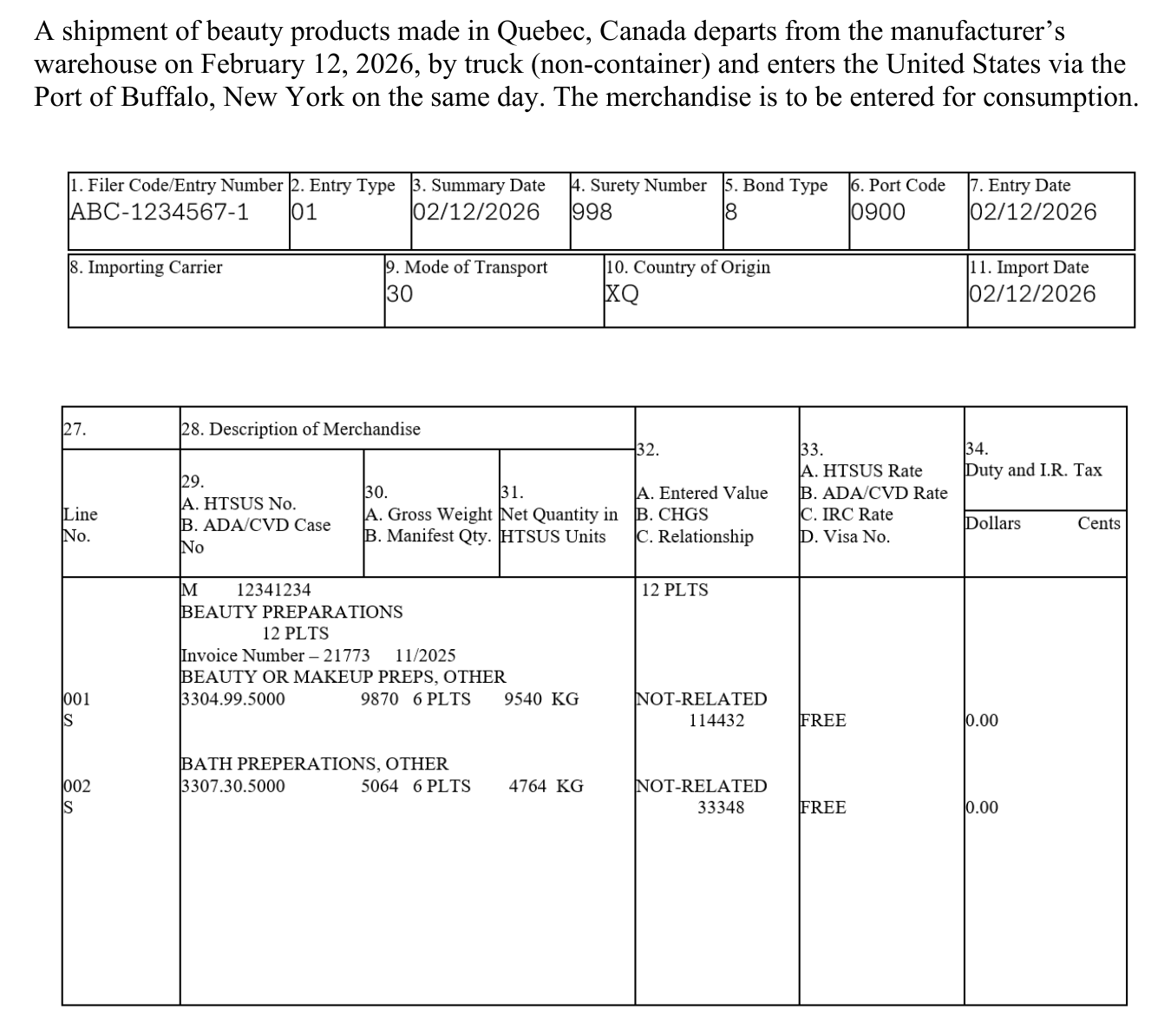
Which ONE of the following blocks of the U.S. Customs and Border Protection (CBP) Form 7501 (Entry Summary) provided contains incorrect information?
Exhibit — the document this question is answered from
Text version
A shipment of beauty products made in Quebec, Canada departs from the manufacturer’s warehouse on February 12, 2026, by truck (non-container) and enters the United States via the Port of Buffalo, New York on the same day. The merchandise is to be entered for consumption.
A Block 6
B Block 8
C Block 9
D Block 10
Show the official answer
Answer: A — Block 6
The worked walkthrough for this one — why the right answer is right, why each distractor fails, and where to find it in the crippled viewer — comes with the pass. The citation above is the source it’s built on; you can read it yourself in our 19 CFR navigator.
If the provided entry summary is to serve as both the entry documentation and entry summary, by what date must the filer indicate to CBP that the estimated duty owed will be paid by statement processing?
Exhibit — the document this question is answered from
Text version
A shipment of beauty products made in Quebec, Canada departs from the manufacturer’s warehouse on February 12, 2026, by truck (non-container) and enters the United States via the Port of Buffalo, New York on the same day. The merchandise is to be entered for consumption.
A February 12, 2026
B February 22, 2026
C February 27, 2026
D March 20, 2026
Show the official answer
Answer: A — February 12, 2026
The worked walkthrough for this one — why the right answer is right, why each distractor fails, and where to find it in the crippled viewer — comes with the pass. The citation above is the source it’s built on; you can read it yourself in our 19 CFR navigator.
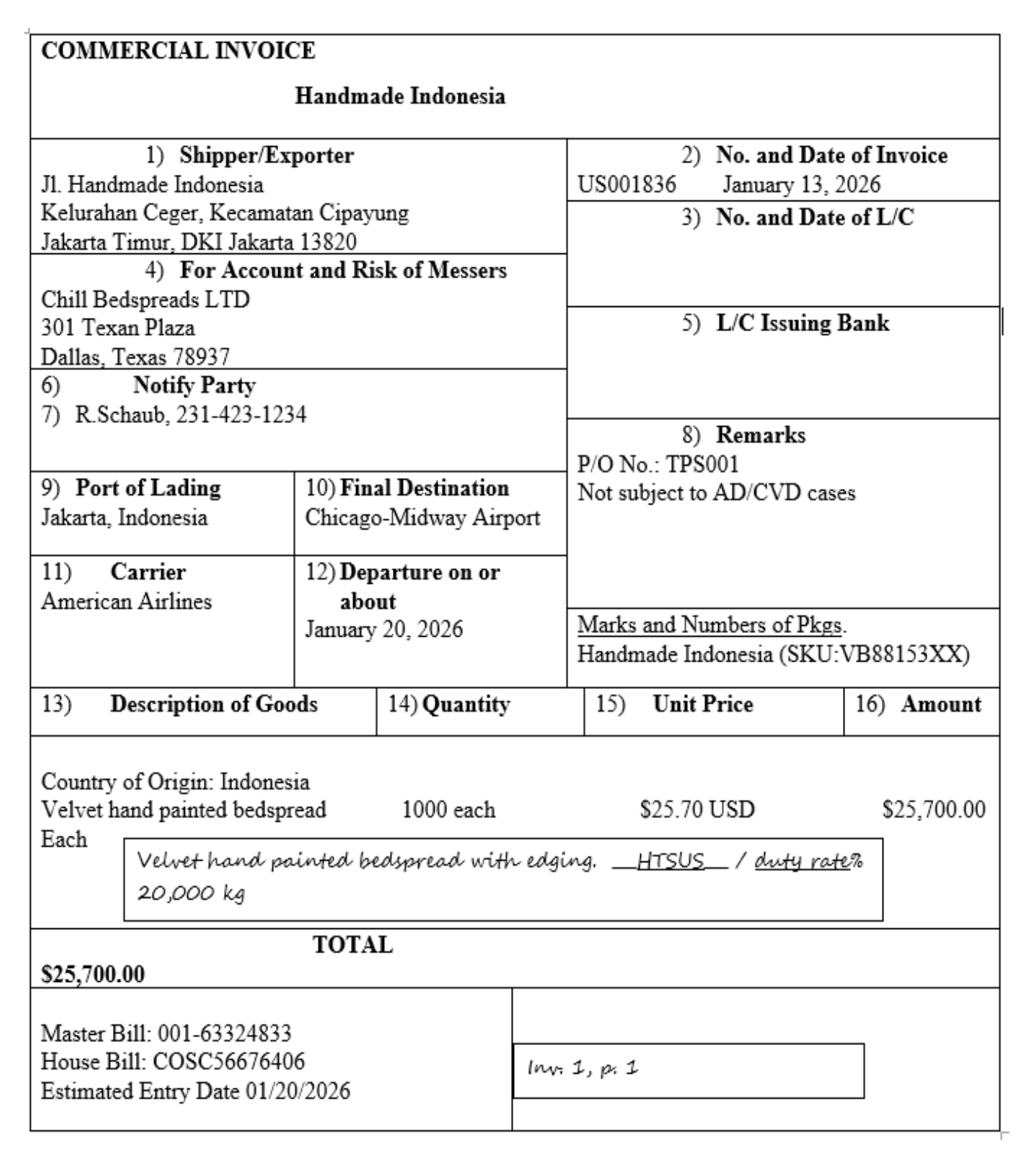
You have received a “documents required” notification after the entry summary was filed. In reviewing the invoice, you handwrite additional information on the invoice to provide all required information, including the addition to the description of the bedspreads that the bedspread contains edging. Which ONE of the regulations listed below contains the requirement that prompted you to change the description as shown on the invoice provided?
Exhibit — the document this question is answered from
Text version
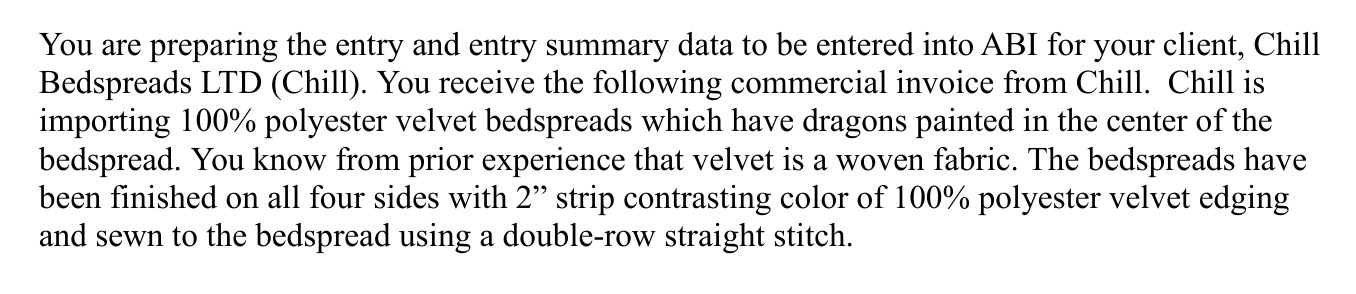
You are preparing the entry and entry summary data to be entered into ABI for your client, Chill Bedspreads LTD (Chill). You receive the following commercial invoice from Chill. Chill is importing 100% polyester velvet bedspreads which have dragons painted in the center of the bedspread. You know from prior experience that velvet is a woven fabric. The bedspreads have been finished on all four sides with 2” strip contrasting color of 100% polyester velvet edging and sewn to the bedspread using a double-row straight stitch.
A 19 CFR 141.86(a)(3)
B 19 CFR 141.86(h)(3)
C 19 CFR 141.89(a)
D 19 CFR 142.6(a)(4)
Show the official answer
Answer: C — 19 CFR 141.89(a)
The worked walkthrough for this one — why the right answer is right, why each distractor fails, and where to find it in the crippled viewer — comes with the pass. The citation above is the source it’s built on; you can read it yourself in our 19 CFR navigator.
The entry documents will be filed at the port for the final destination provided on the invoice. What is the Customs Port code for this intended port?
Exhibit — the document this question is answered from
Text version
You are preparing the entry and entry summary data to be entered into ABI for your client, Chill Bedspreads LTD (Chill). You receive the following commercial invoice from Chill. Chill is importing 100% polyester velvet bedspreads which have dragons painted in the center of the bedspread. You know from prior experience that velvet is a woven fabric. The bedspreads have been finished on all four sides with 2” strip contrasting color of 100% polyester velvet edging and sewn to the bedspread using a double-row straight stitch.
A 3901
B 3910
C 5501
D 5582
Show the official answer
Answer: B — 3910
The worked walkthrough for this one — why the right answer is right, why each distractor fails, and where to find it in the crippled viewer — comes with the pass. The citation above is the source it’s built on; you can read it yourself in our 19 CFR navigator.
When determining the classification of the bedspread, you discover that there are two potential subheadings in two different chapters of the Harmonized Tariff Schedule of the United States. In addition to the information on the commercial invoice, the answer to which ONE of the following questions is necessary to obtain from your client to correctly classify the bedspread?
Exhibit — the document this question is answered from
Text version
You are preparing the entry and entry summary data to be entered into ABI for your client, Chill Bedspreads LTD (Chill). You receive the following commercial invoice from Chill. Chill is importing 100% polyester velvet bedspreads which have dragons painted in the center of the bedspread. You know from prior experience that velvet is a woven fabric. The bedspreads have been finished on all four sides with 2” strip contrasting color of 100% polyester velvet edging and sewn to the bedspread using a double-row straight stitch.
A Does the bedspread have outer layers with a filling between?
B Is polyester a man-made fiber?
C Is the dragon painted by hand or machine?
D How many millimeters is the edging?
Show the official answer
Answer: A — Does the bedspread have outer layers with a filling between?
The worked walkthrough for this one — why the right answer is right, why each distractor fails, and where to find it in the crippled viewer — comes with the pass. The citation above is the source it’s built on; you can read it yourself in our 19 CFR navigator.
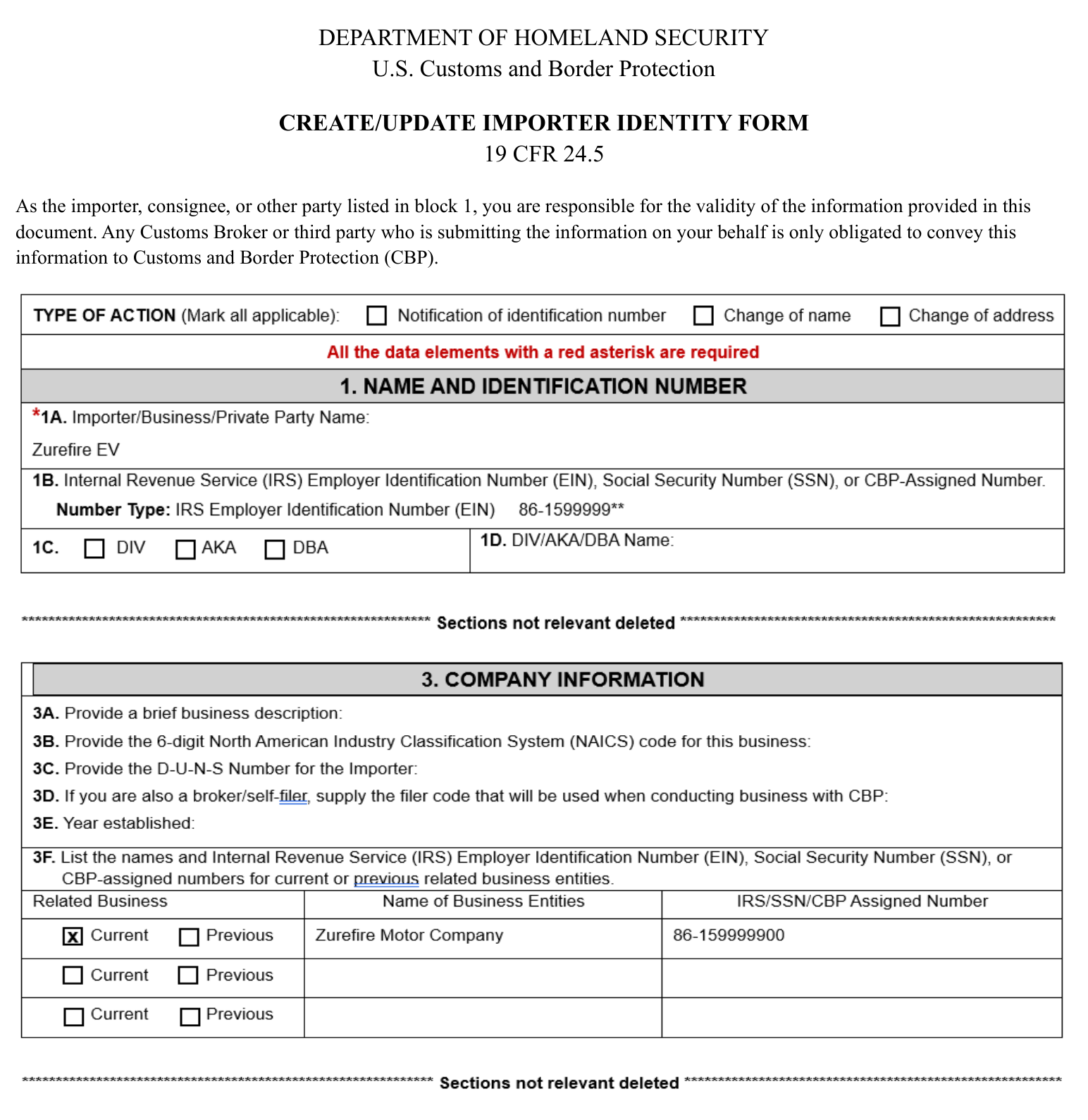
Which ONE of the following two-digit suffixes to the IRS Employer Identification Number (EIN) can Zurefire EV request to use for its importer identification number to replace the "**" in Block 1B?
Exhibit — the document this question is answered from
Text version
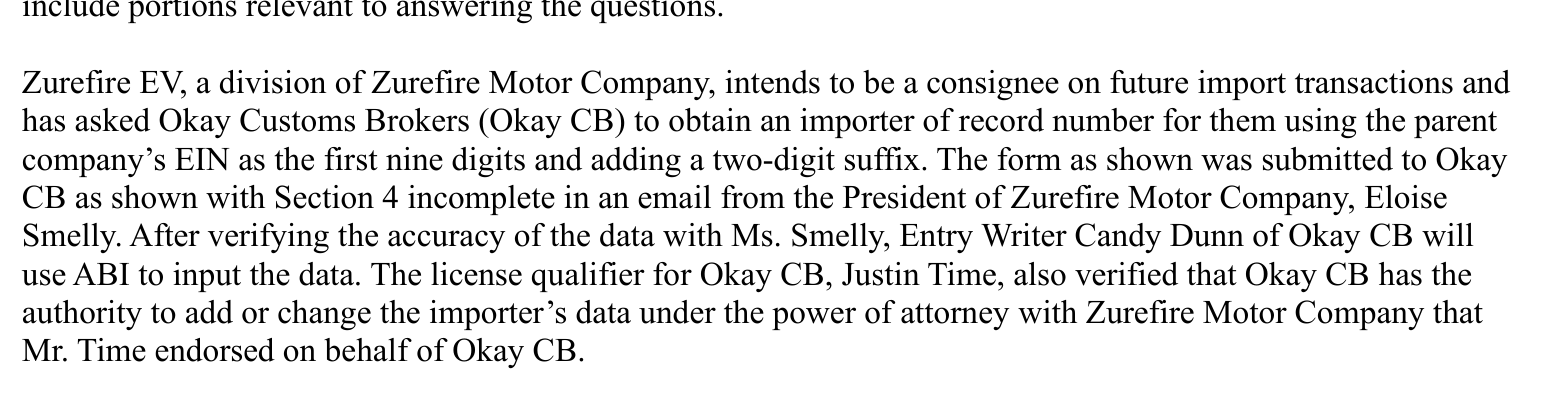
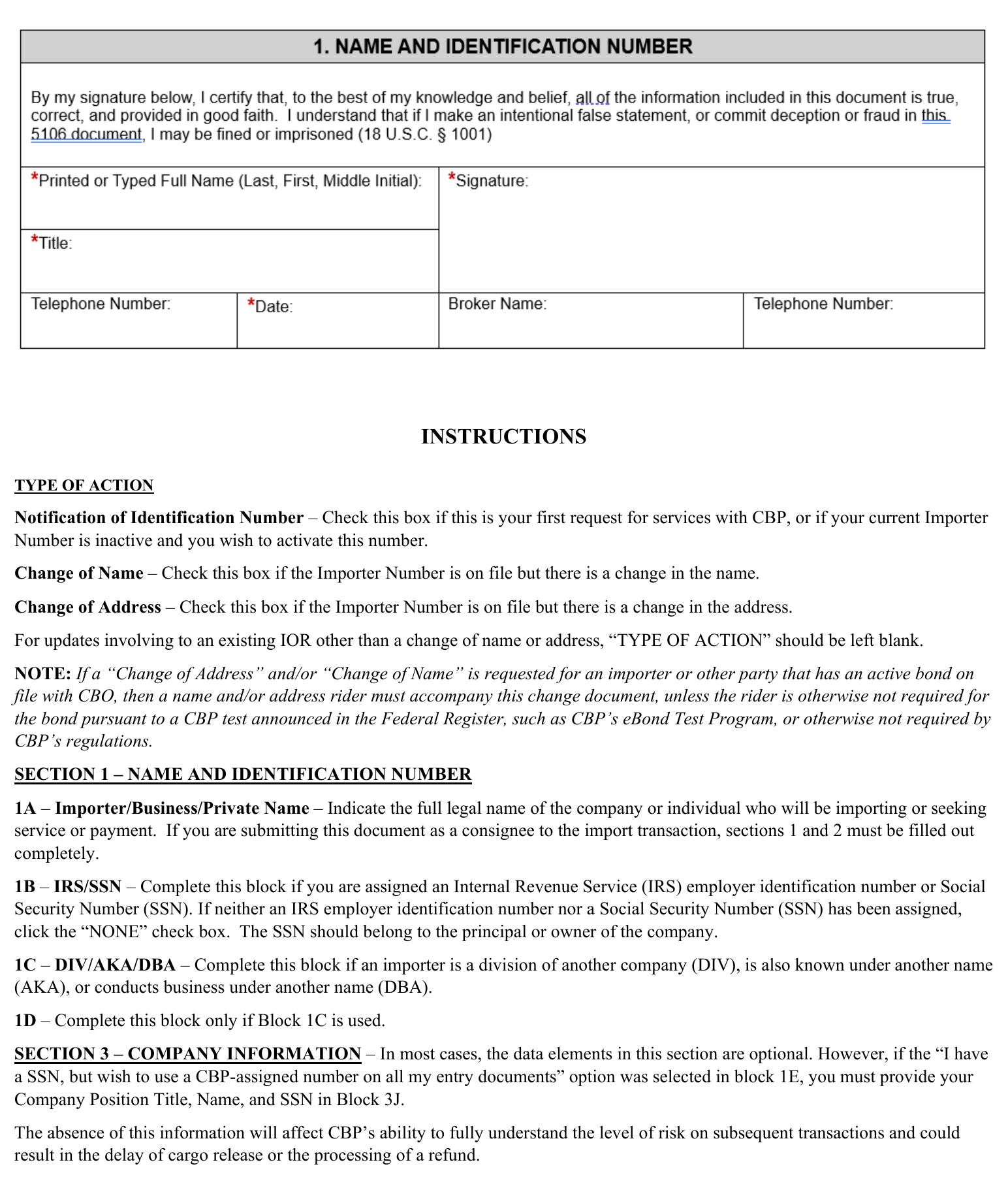
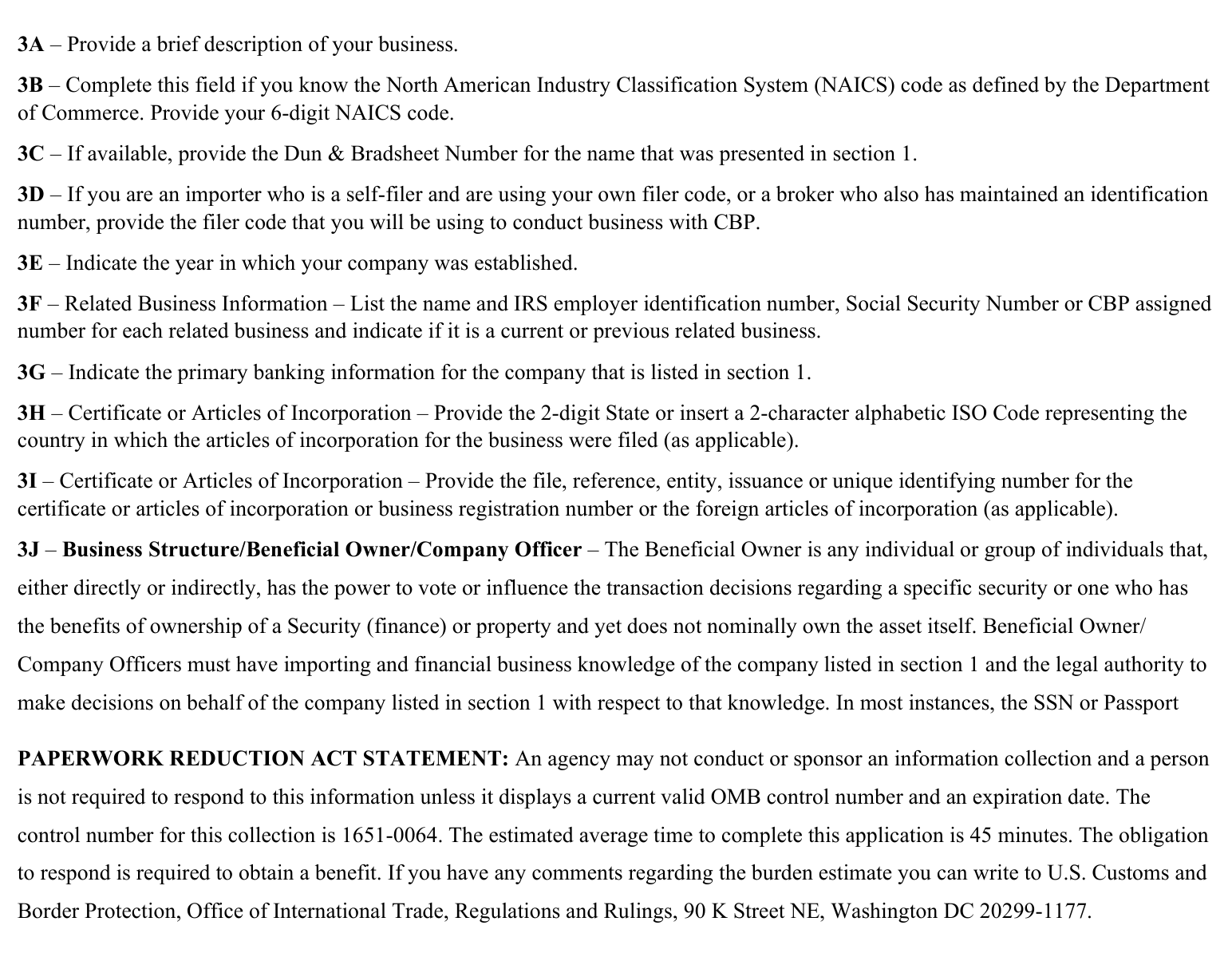
The form has been modified to only include portions relevant to answering the questions. Zurefire EV, a division of Zurefire Motor Company, intends to be a consignee on future import transactions and has asked Okay Customs Brokers (Okay CB) to obtain an importer of record number for them using the parent company’s EIN as the first nine digits and adding a two-digit suffix. The form as shown was submitted to Okay CB as shown with Section 4 incomplete in an email from the President of Zurefire Motor Company, Eloise Smelly. After verifying the accuracy of the data with Ms. Smelly, Entry Writer Candy Dunn of Okay CB will use ABI to input the data. The license qualifier for Okay CB, Justin Time, also verified that Okay CB has the authority to add or change the importer’s data under the power of attorney with Zurefire Motor Company that Mr. Time endorsed on behalf of Okay CB. DEPARTMENT OF HOMELAND SECURITY U.S. Customs and Border Protection CREATE/UPDATE IMPORTER IDENTITY FORM 19 CFR 24.5 As the importer, consignee, or other party listed in block 1, you are responsible for the validity of the information provided in this document. Any Customs Broker or third party who is submitting the information on your behalf is only obligated to convey this information to Customs and Border Protection (CBP). INSTRUCTIONS TYPE OF ACTION Notification of Identification Number – Check this box if this is your first request for services with CBP, or if your current Importer Number is inactive and you wish to activate this number. Change of Name – Check this box if the Importer Number is on file but there is a change in the name. Change of Address – Check this box if the Importer Number is on file but there is a change in the address. For updates involving to an existing IOR other than a change of name or address, “TYPE OF ACTION” should be left blank. NOTE: If a “Change of Address” and/or “Change of Name” is requested for an importer or other party that has an active bond on file with CBO, then a name and/or address rider must accompany this change document, unless the rider is otherwise not required for the bond pursuant to a CBP test announced in the Federal Register, such as CBP’s eBond Test Program, or otherwise not required by CBP’s regulations. SECTION 1 – NAME AND IDENTIFICATION NUMBER 1A – Importer/Business/Private Name – Indicate the full legal name of the company or individual who will be importing or seeking service or payment. If you are submitting this document as a consignee to the import transaction, sections 1 and 2 must be filled out completely. 1B – IRS/SSN – Complete this block if you are assigned an Internal Revenue Service (IRS) employer identification number or Social Security Number (SSN). If neither an IRS employer identification number nor a Social Security Number (SSN) has been assigned, click the “NONE” check box. The SSN should belong to the principal or owner of the company. 1C – DIV/AKA/DBA – Complete this block if an importer is a division of another company (DIV), is also known under another name (AKA), or conducts business under another name (DBA). 1D – Complete this block only if Block 1C is used. SECTION 3 – COMPANY INFORMATION – In most cases, the data elements in this section are optional. However, if the “I have a SSN, but wish to use a CBP-assigned number on all my entry documents” option was selected in block 1E, you must provide your Company Position Title, Name, and SSN in Block 3J. The absence of this information will affect CBP’s ability to fully understand the level of risk on subsequent transactions and could result in the delay of cargo release or the processing of a refund. 3A – Provide a brief description of your business. 3B – Complete this field if you know the North American Industry Classification System (NAICS) code as defined by the Department of Commerce. Provide your 6-digit NAICS code. 3C – If available, provide the Dun & Bradsheet Number for the name that was presented in section
1. 3D – If you are an importer who is a self-filer and are using your own filer code, or a broker who also has maintained an identification number, provide the filer code that you will be using to conduct business with CBP. 3E – Indicate the year in which your company was established. 3F – Related Business Information – List the name and IRS employer identification number, Social Security Number or CBP assigned number for each related business and indicate if it is a current or previous related business. 3G – Indicate the primary banking information for the company that is listed in section
1. 3H – Certificate or Articles of Incorporation – Provide the 2-digit State or insert a 2-character alphabetic ISO Code representing the country in which the articles of incorporation for the business were filed (as applicable). 3I – Certificate or Articles of Incorporation – Provide the file, reference, entity, issuance or unique identifying number for the certificate or articles of incorporation or business registration number or the foreign articles of incorporation (as applicable). 3J – Business Structure/Beneficial Owner/Company Officer – The Beneficial Owner is any individual or group of individuals that, either directly or indirectly, has the power to vote or influence the transaction decisions regarding a specific security or one who has the benefits of ownership of a Security (finance) or property and yet does not nominally own the asset itself. Beneficial Owner/ Company Officers must have importing and financial business knowledge of the company listed in section 1 and the legal authority to make decisions on behalf of the company listed in section 1 with respect to that knowledge. In most instances, the SSN or Passport PAPERWORK REDUCTION ACT STATEMENT: An agency may not conduct or sponsor an information collection and a person is not required to respond to this information unless it displays a current valid OMB control number and an expiration date. The control number for this collection is 1651-0064. The estimated average time to complete this application is 45 minutes. The obligation to respond is required to obtain a benefit. If you have any comments regarding the burden estimate you can write to U.S. Customs and Border Protection, Office of International Trade, Regulations and Rulings, 90 K Street NE, Washington DC 20299-1177.
A ZE
B Z1
C EV
D I0
Show the official answer
Answer: C — EV
The worked walkthrough for this one — why the right answer is right, why each distractor fails, and where to find it in the crippled viewer — comes with the pass. The citation above is the source it’s built on; you can read it yourself in our 19 CFR navigator.
CBP Form 5106 Instructions as provided · ACE Business Rules and Process Document (BRPD) Section 23.10
If data is required in Blocks 1C and 1D, which of the following choices will correctly identify the data needed to complete those Blocks?
Exhibit — the document this question is answered from
Text version
The form has been modified to only include portions relevant to answering the questions. Zurefire EV, a division of Zurefire Motor Company, intends to be a consignee on future import transactions and has asked Okay Customs Brokers (Okay CB) to obtain an importer of record number for them using the parent company’s EIN as the first nine digits and adding a two-digit suffix. The form as shown was submitted to Okay CB as shown with Section 4 incomplete in an email from the President of Zurefire Motor Company, Eloise Smelly. After verifying the accuracy of the data with Ms. Smelly, Entry Writer Candy Dunn of Okay CB will use ABI to input the data. The license qualifier for Okay CB, Justin Time, also verified that Okay CB has the authority to add or change the importer’s data under the power of attorney with Zurefire Motor Company that Mr. Time endorsed on behalf of Okay CB. DEPARTMENT OF HOMELAND SECURITY U.S. Customs and Border Protection CREATE/UPDATE IMPORTER IDENTITY FORM 19 CFR 24.5 As the importer, consignee, or other party listed in block 1, you are responsible for the validity of the information provided in this document. Any Customs Broker or third party who is submitting the information on your behalf is only obligated to convey this information to Customs and Border Protection (CBP). INSTRUCTIONS TYPE OF ACTION Notification of Identification Number – Check this box if this is your first request for services with CBP, or if your current Importer Number is inactive and you wish to activate this number. Change of Name – Check this box if the Importer Number is on file but there is a change in the name. Change of Address – Check this box if the Importer Number is on file but there is a change in the address. For updates involving to an existing IOR other than a change of name or address, “TYPE OF ACTION” should be left blank. NOTE: If a “Change of Address” and/or “Change of Name” is requested for an importer or other party that has an active bond on file with CBO, then a name and/or address rider must accompany this change document, unless the rider is otherwise not required for the bond pursuant to a CBP test announced in the Federal Register, such as CBP’s eBond Test Program, or otherwise not required by CBP’s regulations. SECTION 1 – NAME AND IDENTIFICATION NUMBER 1A – Importer/Business/Private Name – Indicate the full legal name of the company or individual who will be importing or seeking service or payment. If you are submitting this document as a consignee to the import transaction, sections 1 and 2 must be filled out completely. 1B – IRS/SSN – Complete this block if you are assigned an Internal Revenue Service (IRS) employer identification number or Social Security Number (SSN). If neither an IRS employer identification number nor a Social Security Number (SSN) has been assigned, click the “NONE” check box. The SSN should belong to the principal or owner of the company. 1C – DIV/AKA/DBA – Complete this block if an importer is a division of another company (DIV), is also known under another name (AKA), or conducts business under another name (DBA). 1D – Complete this block only if Block 1C is used. SECTION 3 – COMPANY INFORMATION – In most cases, the data elements in this section are optional. However, if the “I have a SSN, but wish to use a CBP-assigned number on all my entry documents” option was selected in block 1E, you must provide your Company Position Title, Name, and SSN in Block 3J. The absence of this information will affect CBP’s ability to fully understand the level of risk on subsequent transactions and could result in the delay of cargo release or the processing of a refund. 3A – Provide a brief description of your business. 3B – Complete this field if you know the North American Industry Classification System (NAICS) code as defined by the Department of Commerce. Provide your 6-digit NAICS code. 3C – If available, provide the Dun & Bradsheet Number for the name that was presented in section
1. 3D – If you are an importer who is a self-filer and are using your own filer code, or a broker who also has maintained an identification number, provide the filer code that you will be using to conduct business with CBP. 3E – Indicate the year in which your company was established. 3F – Related Business Information – List the name and IRS employer identification number, Social Security Number or CBP assigned number for each related business and indicate if it is a current or previous related business. 3G – Indicate the primary banking information for the company that is listed in section
1. 3H – Certificate or Articles of Incorporation – Provide the 2-digit State or insert a 2-character alphabetic ISO Code representing the country in which the articles of incorporation for the business were filed (as applicable). 3I – Certificate or Articles of Incorporation – Provide the file, reference, entity, issuance or unique identifying number for the certificate or articles of incorporation or business registration number or the foreign articles of incorporation (as applicable). 3J – Business Structure/Beneficial Owner/Company Officer – The Beneficial Owner is any individual or group of individuals that, either directly or indirectly, has the power to vote or influence the transaction decisions regarding a specific security or one who has the benefits of ownership of a Security (finance) or property and yet does not nominally own the asset itself. Beneficial Owner/ Company Officers must have importing and financial business knowledge of the company listed in section 1 and the legal authority to make decisions on behalf of the company listed in section 1 with respect to that knowledge. In most instances, the SSN or Passport PAPERWORK REDUCTION ACT STATEMENT: An agency may not conduct or sponsor an information collection and a person is not required to respond to this information unless it displays a current valid OMB control number and an expiration date. The control number for this collection is 1651-0064. The estimated average time to complete this application is 45 minutes. The obligation to respond is required to obtain a benefit. If you have any comments regarding the burden estimate you can write to U.S. Customs and Border Protection, Office of International Trade, Regulations and Rulings, 90 K Street NE, Washington DC 20299-1177.
A Data is not required in Blocks 1C and 1D because there is no red asterisk next to the block number.
B Mark DIV in 1C and type Zurefire Motor Company in 1D.
C Mark DIV in 1C and type Zurefire EV in 1D
D Mark DBA in 1C and type Zurefire Motor Company DBA Zurefire EV in 1D
Show the official answer
Answer: B — Mark DIV in 1C and type Zurefire Motor Company in 1D.
The worked walkthrough for this one — why the right answer is right, why each distractor fails, and where to find it in the crippled viewer — comes with the pass. The citation above is the source it’s built on; you can read it yourself in our 19 CFR navigator.
Whose name should be transmitted as the certifier in ABI?
Exhibit — the document this question is answered from
Text version
The form has been modified to only include portions relevant to answering the questions. Zurefire EV, a division of Zurefire Motor Company, intends to be a consignee on future import transactions and has asked Okay Customs Brokers (Okay CB) to obtain an importer of record number for them using the parent company’s EIN as the first nine digits and adding a two-digit suffix. The form as shown was submitted to Okay CB as shown with Section 4 incomplete in an email from the President of Zurefire Motor Company, Eloise Smelly. After verifying the accuracy of the data with Ms. Smelly, Entry Writer Candy Dunn of Okay CB will use ABI to input the data. The license qualifier for Okay CB, Justin Time, also verified that Okay CB has the authority to add or change the importer’s data under the power of attorney with Zurefire Motor Company that Mr. Time endorsed on behalf of Okay CB. DEPARTMENT OF HOMELAND SECURITY U.S. Customs and Border Protection CREATE/UPDATE IMPORTER IDENTITY FORM 19 CFR 24.5 As the importer, consignee, or other party listed in block 1, you are responsible for the validity of the information provided in this document. Any Customs Broker or third party who is submitting the information on your behalf is only obligated to convey this information to Customs and Border Protection (CBP). INSTRUCTIONS TYPE OF ACTION Notification of Identification Number – Check this box if this is your first request for services with CBP, or if your current Importer Number is inactive and you wish to activate this number. Change of Name – Check this box if the Importer Number is on file but there is a change in the name. Change of Address – Check this box if the Importer Number is on file but there is a change in the address. For updates involving to an existing IOR other than a change of name or address, “TYPE OF ACTION” should be left blank. NOTE: If a “Change of Address” and/or “Change of Name” is requested for an importer or other party that has an active bond on file with CBO, then a name and/or address rider must accompany this change document, unless the rider is otherwise not required for the bond pursuant to a CBP test announced in the Federal Register, such as CBP’s eBond Test Program, or otherwise not required by CBP’s regulations. SECTION 1 – NAME AND IDENTIFICATION NUMBER 1A – Importer/Business/Private Name – Indicate the full legal name of the company or individual who will be importing or seeking service or payment. If you are submitting this document as a consignee to the import transaction, sections 1 and 2 must be filled out completely. 1B – IRS/SSN – Complete this block if you are assigned an Internal Revenue Service (IRS) employer identification number or Social Security Number (SSN). If neither an IRS employer identification number nor a Social Security Number (SSN) has been assigned, click the “NONE” check box. The SSN should belong to the principal or owner of the company. 1C – DIV/AKA/DBA – Complete this block if an importer is a division of another company (DIV), is also known under another name (AKA), or conducts business under another name (DBA). 1D – Complete this block only if Block 1C is used. SECTION 3 – COMPANY INFORMATION – In most cases, the data elements in this section are optional. However, if the “I have a SSN, but wish to use a CBP-assigned number on all my entry documents” option was selected in block 1E, you must provide your Company Position Title, Name, and SSN in Block 3J. The absence of this information will affect CBP’s ability to fully understand the level of risk on subsequent transactions and could result in the delay of cargo release or the processing of a refund. 3A – Provide a brief description of your business. 3B – Complete this field if you know the North American Industry Classification System (NAICS) code as defined by the Department of Commerce. Provide your 6-digit NAICS code. 3C – If available, provide the Dun & Bradsheet Number for the name that was presented in section
1. 3D – If you are an importer who is a self-filer and are using your own filer code, or a broker who also has maintained an identification number, provide the filer code that you will be using to conduct business with CBP. 3E – Indicate the year in which your company was established. 3F – Related Business Information – List the name and IRS employer identification number, Social Security Number or CBP assigned number for each related business and indicate if it is a current or previous related business. 3G – Indicate the primary banking information for the company that is listed in section
1. 3H – Certificate or Articles of Incorporation – Provide the 2-digit State or insert a 2-character alphabetic ISO Code representing the country in which the articles of incorporation for the business were filed (as applicable). 3I – Certificate or Articles of Incorporation – Provide the file, reference, entity, issuance or unique identifying number for the certificate or articles of incorporation or business registration number or the foreign articles of incorporation (as applicable). 3J – Business Structure/Beneficial Owner/Company Officer – The Beneficial Owner is any individual or group of individuals that, either directly or indirectly, has the power to vote or influence the transaction decisions regarding a specific security or one who has the benefits of ownership of a Security (finance) or property and yet does not nominally own the asset itself. Beneficial Owner/ Company Officers must have importing and financial business knowledge of the company listed in section 1 and the legal authority to make decisions on behalf of the company listed in section 1 with respect to that knowledge. In most instances, the SSN or Passport PAPERWORK REDUCTION ACT STATEMENT: An agency may not conduct or sponsor an information collection and a person is not required to respond to this information unless it displays a current valid OMB control number and an expiration date. The control number for this collection is 1651-0064. The estimated average time to complete this application is 45 minutes. The obligation to respond is required to obtain a benefit. If you have any comments regarding the burden estimate you can write to U.S. Customs and Border Protection, Office of International Trade, Regulations and Rulings, 90 K Street NE, Washington DC 20299-1177.
A Zurefire EV
B Eloise Smelly
C Candy Dunn
D Justin Time
Show the official answer
Answer: D — Justin Time
The worked walkthrough for this one — why the right answer is right, why each distractor fails, and where to find it in the crippled viewer — comes with the pass. The citation above is the source it’s built on; you can read it yourself in our 19 CFR navigator.
Bake 4U, Inc.(B4U) imports bulk pastry dough. The dough is subject to a tariff-rate quota, with an annual aggregate limit of 3,500,000 kg. The 2026 quota period runs from April 1, 2026, through March 30, 2027. B4U sources its pastry dough from the Netherlands, and at importation admits the dough into a Foreign Trade Zone (FTZ) in Texas. The dough is admitted in privileged foreigh status. Within its subzone, B4U operates commercial baking machines in temperature controlled facilities wherein the dough is used to create individually portioned baked pastries that are packaged into designer cartons for bulk sale to hotel and restaurant groups across Texas. B4U files the requisite entry for consumption in order to withdraw the baked pastries from the FTZ. Today, an emergency arose in B4U's subzone due to a failure of the temperature controlled refrigerators. To prevent the dough in those refrigerators from becoming unuseable, B4U decided to immediately bake all of the affected dough in its commercial baking machines. Since this will result in B4U producing a greater amount of pastries than it can package into designer cartons for bulk sale to restaurant and hotel groups, B4U has decided to sell its excess pastries at retail on-site to all persons who work at the FTZ. As of today, the annual dough quota has not yet filled. Under these facts, which of the following answer choices is a TRUE statement?
A The dough B4U imports is eligible to obtain quota status upon submission of CBP Form 214 in proper form, to achieve admission in privileged foreign status.
B Due to the emergency, B4U may elect nonprivileged foreign status for the affected dough, which is baked into pastries for retail sale within the FTZ.
C The pastries B4U withdraws from an FTZ for bulk sale are only eligible for the higher non-quota duty rate in effect on the date privileged foreign status was granted.
D The pastries B4U withdraws from an FTZ for bulk sale are eligible to obtain a lower in-quota duty rate upon presentation of an entry summary in proper form, and will be dutiable in accordance with their condition at withdrawal from the FTZ.
Show the official answer
Answer: C — The pastries B4U withdraws from an FTZ for bulk sale are only eligible for the higher non-quota duty rate in effect on the date privileged foreign status was granted.
The worked walkthrough for this one — why the right answer is right, why each distractor fails, and where to find it in the crippled viewer — comes with the pass. The citation above is the source it’s built on; you can read it yourself in our 19 CFR navigator.
A&M Industries entered one entry of peanut butter from India as a type 01 consumption entry on May 1, 2024. Peanut butter from India is subject to a tariff rate quota with an in-quota tariff rate of 0%. The 2024 quota period is January 1, 2024, to December 31, 2024. The quota for this period has closed but it did not fill. On January 31, 2025, A&M Industries wishes to amend the entry summary to change the entry to a type 02 quota entry. Can A&M Industries claim quota for the 2024 quota period?
A No, but A&M Industries can file a post summary correction amending the entry summary to change the entry to a type 02 quota entry and claim quota for the 2025 quota period.
B No, the 2024 quota period has closed.
C Yes, A&M Industries should request that CBP cancel the entry so that a replacement quota entry type may be submitted.
D Yes, A&M Industries should contact HQ Quota to arrange for quota reservation in the 2024 quota period.
Show the official answer
Answer: B — No, the 2024 quota period has closed.
The worked walkthrough for this one — why the right answer is right, why each distractor fails, and where to find it in the crippled viewer — comes with the pass. The citation above is the source it’s built on; you can read it yourself in our 19 CFR navigator.
You are a licensed customs broker and have submitted Entry Summary data through the Automated Broker Interface (ABI). After performing preliminary data validations, the system sends you an "AX" type message with a REJECT status. Which of the following could NOT have resulted in this rejection?
A The merchandise licenses, visas, or certificates are incorrect.
B The quota is full, expired, or closed.
C The entry type is for quota and there is at least one line listing quota goods and the quota is available.
D The quota is not yet opened.
Show the official answer
Answer: C — The entry type is for quota and there is at least one line listing quota goods and the quota is available.
The worked walkthrough for this one — why the right answer is right, why each distractor fails, and where to find it in the crippled viewer — comes with the pass. The citation above is the source it’s built on; you can read it yourself in our 19 CFR navigator.
Which of the following is NOT a method for establishing tariff-rate and absolute quotas?
A Executive orders
B Presidential proclamations
C U.S. Trade Representative orders
D Legislative enactments
Show the official answer
Answer: C — U.S. Trade Representative orders
The worked walkthrough for this one — why the right answer is right, why each distractor fails, and where to find it in the crippled viewer — comes with the pass. The citation above is the source it’s built on; you can read it yourself in our 19 CFR navigator.
Of the four choices below, which is the best CLASSIFICATION for dried pineapples that are reduced in size, suitable for immediate consumption, and imported in small packages rather than in bulk?
A 0801.19.01
B 0804.30.60
C 0812.90.40
D 0813.40.90
Show the official answer
Answer: B — 0804.30.60
The worked walkthrough for this one — why the right answer is right, why each distractor fails, and where to find it in the crippled viewer — comes with the pass. The citation above is the source it’s built on; you can read it yourself in our 19 CFR navigator.
Of the four choices below, which is the best CLASSIFICATION of alloy steel coils? The cold-rolled steel is successively superimposed in coils and measures 1220 mm in width and 3.75 mm in thickness. The steel chemistry consists of 0.15% Carbon, 0.7 % Titanium, and 25% Nickel. The coils have not been further worked than cold-rolled.
A 7209.15.0000
B 7219.32.0035
C 7225.50.8010
D 7226.99.0130
Show the official answer
Answer: C — 7225.50.8010
The worked walkthrough for this one — why the right answer is right, why each distractor fails, and where to find it in the crippled viewer — comes with the pass. The citation above is the source it’s built on; you can read it yourself in our 19 CFR navigator.
Of the four choices below, which is the best CLASSIFICATION of a solenoid valve used to control the airflow within the suspension system of a motor vehicle?
A 8479.89.9599
B 8481.80.9005
C 8481.20.0060
D 8708.99.8180
Show the official answer
Answer: B — 8481.80.9005
The worked walkthrough for this one — why the right answer is right, why each distractor fails, and where to find it in the crippled viewer — comes with the pass. The citation above is the source it’s built on; you can read it yourself in our 19 CFR navigator.
6215.90.0015, HTSUS · Note 1 to Chapter 61 · Note 1 to Chapter 62 · Note 7(b) to Section XI
Of the four choices below, which is the best CLASSIFICATION of a men's bow tie constructed of 100% cotton woven black fabric with gray polka dots?
A 6117.80.2000
B 6117.80.8710
C 6215.10.0025
D 6215.90.0015
Show the official answer
Answer: D — 6215.90.0015
The worked walkthrough for this one — why the right answer is right, why each distractor fails, and where to find it in the crippled viewer — comes with the pass. The citation above is the source it’s built on; you can read it yourself in our 19 CFR navigator.
Which of the following is NOT a requirement with respect to additional articles or classes of articles designated Instruments of International Traffic?
A Generally, a container that has been designated an Instrument of International Traffic must exit the United States within 365 days of the date on which it was admitted for it to be deemed to remain in international traffic.
B Normal accessories and equipment must be imported with a “container” that qualifies as an Instrument of International Traffic to, themselves, be included in “instruments of international traffic.”
C Entry or the payment of duty prior to release, subject to the provisions of the relevant CBP regulation.
D Filing of a bond on CBP Form 301, or its electronic equivalent in ACE eBond, containing the bond conditions set forth in 19 CFR 113.66, prior to release.
Show the official answer
Answer: C — Entry or the payment of duty prior to release, subject to the provisions of the relevant CBP regulation.
The worked walkthrough for this one — why the right answer is right, why each distractor fails, and where to find it in the crippled viewer — comes with the pass. The citation above is the source it’s built on; you can read it yourself in our 19 CFR navigator.
9504.20.6000, HTSUS · Note 1(l) to Chapter 94, HTSUS
Of the four choices below, what is the CLASSIFICATION of a miniature billiards table designed for children from 8 to 12 years of age. It is composed of rosewood with cherry wood veneers and resin. The playing surface is a green synthetic mat.
A 9403.30.8005
B 9403.60.8081
C 9503.00.0071
D 9504.20.6000
Show the official answer
Answer: D — 9504.20.6000
The worked walkthrough for this one — why the right answer is right, why each distractor fails, and where to find it in the crippled viewer — comes with the pass. The citation above is the source it’s built on; you can read it yourself in our 19 CFR navigator.
Of the four choices below, which is the best CLASSIFICATION of linoleum tiles? The tiles are composed of solidified linseed oil, pine resin, ground cork dust, sawdust, calcium carbonate (limestone powder), and have a felted synthetic fiber backing. The linoleum layer is two millimeters thick, the felted synthetic fiber backing is four millimeters thick, and the tiles are square in shape with each side measuring 24 centimeters in length.
A 4504.10.3000
B 5704.10.0090
C 5904.10.0000
D 6806.00.0000
Show the official answer
Answer: C — 5904.10.0000
The worked walkthrough for this one — why the right answer is right, why each distractor fails, and where to find it in the crippled viewer — comes with the pass. The citation above is the source it’s built on; you can read it yourself in our 19 CFR navigator.
Of the four choices below, which is the best CLASSIFICATION of sound insulating panels? The panels are two centimeters thick and imported in one by one half meter sections. They are composed of wood shavings agglomerated with a cement binder and are sanded but otherwise unfinished. To a casual observer, the panels look like a collection of randomly oriented wood slivers pressed together into a flat, rigid board. The intended use is for acoustic sound absorption for the construction of areas such as music studios.
A 4411.14.1000
B 4418.92.0000
C 6806.90.0010
D 6808.00.0000
Show the official answer
Answer: D — 6808.00.0000
The worked walkthrough for this one — why the right answer is right, why each distractor fails, and where to find it in the crippled viewer — comes with the pass. The citation above is the source it’s built on; you can read it yourself in our 19 CFR navigator.
Of the four choices below, which is the best CLASSIFICATION for a plastic brush with metal bristles used to groom a dog or cat that at time of importation is valued at $3.64?
A 9603.29.8010
B 9603.29.8090
C 9603.90.8050
D 9615.11.3000
Show the official answer
Answer: C — 9603.90.8050
The worked walkthrough for this one — why the right answer is right, why each distractor fails, and where to find it in the crippled viewer — comes with the pass. The citation above is the source it’s built on; you can read it yourself in our 19 CFR navigator.
Of the four choices below, which is the best CLASSIFICATION of pure silver (99.99%) coins that are minted in South Africa, have legal tender status, and are valued at $25,000.00 U.S. Dollars (USD)?
A 7106.91.1010
B 7115.90.4000
C 7118.10.0000
D 7118.90.0055
Show the official answer
Answer: D — 7118.90.0055
The worked walkthrough for this one — why the right answer is right, why each distractor fails, and where to find it in the crippled viewer — comes with the pass. The citation above is the source it’s built on; you can read it yourself in our 19 CFR navigator.
Which of the following statements is TRUE about the procedure after detention of shipments under the Toxic Substances Control Act (TSCA) of a covered commodity?
A The importer of the detained shipment must bring the shipment into compliance with Toxic Substances Control Act or export the shipment from the customs territory of the United States within 90 days after notice of detention or 30 days of demand for redelivery, whichever comes first.
B The importer of the detained shipment must submit written documentation to the Administrator with a copy to the port director within 90 days from the date of notice of detention, to show why the shipment should not be refused entry.
C The importer of the detained shipment must bring the shipment into compliance with Toxic Substances Control Act or export the shipment from the customs territory of the United States within 120 days after notice of detention or 60 days of demand for redelivery, whichever comes first.
D The importer of the detained shipment must submit written documentation to the Administrator with a copy to the port director within 120 days from the date of notice of detention, to show why the shipment should not be refused entry.
Show the official answer
Answer: A — The importer of the detained shipment must bring the shipment into compliance with Toxic Substances Control Act or export the shipment from the customs territory of the United States within 90 days after notice of detention or 30 days of demand for redelivery, whichever comes first.
The worked walkthrough for this one — why the right answer is right, why each distractor fails, and where to find it in the crippled viewer — comes with the pass. The citation above is the source it’s built on; you can read it yourself in our 19 CFR navigator.
Which Federal agencies will notify CBP that a covered import does not comply with an applicable energy labeling standard?
A Department of Energy (DOE) and Federal Trade Commission (FTC)
B U.S. Information Agency (USIA) and the U.S. Energy Information Administration (EIA)
C Environmental Protection Agency (EPA) and the Air Quality National Commission
D Department of Transportation (DOT) and the National Highway Traffic Safety Administration (NHTSA)
Show the official answer
Answer: A — Department of Energy (DOE) and Federal Trade Commission (FTC)
The worked walkthrough for this one — why the right answer is right, why each distractor fails, and where to find it in the crippled viewer — comes with the pass. The citation above is the source it’s built on; you can read it yourself in our 19 CFR navigator.
When evaluating an application for Lever-rule protection against gray market articles in accordance with 19 CFR 133.2(e), which of the following is NOT a physical and material difference that CBP may consider between articles authorized for importation or sale in the United States and those not so authorized?
A Differences resulting from legal or regulatory requirements, certification, etc.
B Differences in the formulation, product construction, structure, or composite product components, of both the authorized and gray market product.
C The retail price of the product authorized for sale in the United States and the retail price of the unauthorized gray market product.
D Performance and/or operational characteristics of both the authorized and gray product.
Show the official answer
Answer: C — The retail price of the product authorized for sale in the United States and the retail price of the unauthorized gray market product.
The worked walkthrough for this one — why the right answer is right, why each distractor fails, and where to find it in the crippled viewer — comes with the pass. The citation above is the source it’s built on; you can read it yourself in our 19 CFR navigator.
Which of the following imported articles are subject to seizure pursuant to the Digital Millenium Copyright Act (17 USC 1201)? Assume all trademarks and copyrights referenced in the answers are recorded with CBP.
A Authentic DVDs for copyrighted Marvel movies that the importer manifested as blank CDs.
B A memory card primarily designed to circumvent the copyright protection measures on the Nintendo Switch and enable the user to copy Nintendo’s copyrighted videogames for redistribution.
C A computer with a logo confusingly similar to a Dell trademark.
D An arcade machine with videogames substantially similar to Star Wars copyrights, and Disney has stated that the use of its copyrights is unauthorized.
Show the official answer
Answer: B — A memory card primarily designed to circumvent the copyright protection measures on the Nintendo Switch and enable the user to copy Nintendo’s copyrighted videogames for redistribution.
The worked walkthrough for this one — why the right answer is right, why each distractor fails, and where to find it in the crippled viewer — comes with the pass. The citation above is the source it’s built on; you can read it yourself in our 19 CFR navigator.
A drawback claimant must furnish a properly executed drawback bond if approved for _____ privilege.
A Waiver of prior notice of intent to export
B Accelerated payment
C Exporters summary procedure
D One time waiver of prior notice for past exports
Show the official answer
Answer: B — Accelerated payment
The worked walkthrough for this one — why the right answer is right, why each distractor fails, and where to find it in the crippled viewer — comes with the pass. The citation above is the source it’s built on; you can read it yourself in our 19 CFR navigator.
What type of rejected merchandise is eligible for substitution drawback under 19 CFR 190.45?
A Merchandise that did not conform to sample or specifications.
B Merchandise that was shipped without the consent of the consignee.
C Merchandise that was determined to be defective as of the time of importation.
D Merchandise that was ultimately sold at retail and returned for any reason.
Show the official answer
Answer: D — Merchandise that was ultimately sold at retail and returned for any reason.
The worked walkthrough for this one — why the right answer is right, why each distractor fails, and where to find it in the crippled viewer — comes with the pass. The citation above is the source it’s built on; you can read it yourself in our 19 CFR navigator.
If an Activity Code 1- Basic Importation and Entry continuous bond will be transmitted to U.S. Customs and Border Protection (CBP) pursuant to the Automated Commercial Environment (ACE) electronic bond system (eBond) test, using a CBP-approved Electronic Data Interchange (EDI), who must transmit it?
A Port Director
B Importer
C Filer
D Surety or Surety Agent
Show the official answer
Answer: D — Surety or Surety Agent
The worked walkthrough for this one — why the right answer is right, why each distractor fails, and where to find it in the crippled viewer — comes with the pass. The citation above is the source it’s built on; you can read it yourself in our 19 CFR navigator.
HK Importers, Inc. (HKI) has a continuous basic importation and entry bond in the amount of $200,000.00 with Total Country Surety. HKI is a client of Best CHB (Best). Best has a continuous basic importation and entry bond with Thrift Surety in the amount of $200,000.00. Best filed entry on January 13, 2026, on behalf of HKI, with HKI listed as the importer of record, for a shipment of wooden chairs with an entered value of $40,000.00. The shipment was released on the same day. Best scheduled the duties, taxes and fees owed on the shipment for ACH payment to CBP nine business days after the date of entry. Best also prepared the entry summary information for transmission to CBP. Due to a computer error at Best, the entry summary information was not transmitted, nor was the payment made. CBP issued a liquidated damages demand in the amount of $100.00 for the failure to file the entry summary information. Which of the following statements is FALSE ?
A Best is liable to CBP for the payment of the liquidated damage demand amount because Best’s computer error caused the failure to file the entry summary data.
B HKI is liable for the payment of the liquidated damage demand amount because it is the importer of record.
C If the liquidated damage amount is not paid within 60 days of the demand and the principal has not filed a petition for relief, CBP will make a demand for payment on Total Country Surety.
D Thrift Surety has legal responsibility as a surety for the importation of the wooden chairs and may be notified by CBP if the duties owed are not tendered by HKI.
Show the official answer
Answer: A — Best is liable to CBP for the payment of the liquidated damage demand amount because Best’s computer error caused the failure to file the entry summary data.
The worked walkthrough for this one — why the right answer is right, why each distractor fails, and where to find it in the crippled viewer — comes with the pass. The citation above is the source it’s built on; you can read it yourself in our 19 CFR navigator.
Which entry type code indicates a re-warehouse entry?
A Entry type code 21
B Entry type code 22
C Entry type code 31
D Entry type code 32
Show the official answer
Answer: B — Entry type code 22
The worked walkthrough for this one — why the right answer is right, why each distractor fails, and where to find it in the crippled viewer — comes with the pass. The citation above is the source it’s built on; you can read it yourself in our 19 CFR navigator.
Merchandise arrived at a port of entry and has been unladen from a vessel. No entry or entry summary has been filed. The merchandise can remain on the dock before it is deemed not timely entered for _____ days and the carrier has to give notice of unentered merchandise to a bonded warehouse certified by the port director as qualified to receive general order merchandise no later than _____ calendar days after landing.
A 20; 20
B 15; 20
C 30; 60
D 10; 30
Show the official answer
Answer: B — 15; 20
The worked walkthrough for this one — why the right answer is right, why each distractor fails, and where to find it in the crippled viewer — comes with the pass. The citation above is the source it’s built on; you can read it yourself in our 19 CFR navigator.
Absent the grant of an extension by the port director for reasonable cause, when must the operator of a Foreign Trade Zone or Subzone prepare their annual reconciliation report?
A Within 30 days after the end of the zone/subzone year
B Within 45 days after the end of the zone/subzone year
C Within 90 days after the end of the zone/subzone year
D Within 120 days after the end of the zone/subzone year
Show the official answer
Answer: C — Within 90 days after the end of the zone/subzone year
The worked walkthrough for this one — why the right answer is right, why each distractor fails, and where to find it in the crippled viewer — comes with the pass. The citation above is the source it’s built on; you can read it yourself in our 19 CFR navigator.
To which of the following actions may merchandise admitted to a Foreign Trade Zone in zone-restricted status be subjected?
A Transfer to customs territory for domestic consumption upon obtaining approval from a Center Director
B Modify zone status to domestic status
C Manipulation or manufacture into a distinct article of commerce
D Exportation from the United States
Show the official answer
Answer: D — Exportation from the United States
The worked walkthrough for this one — why the right answer is right, why each distractor fails, and where to find it in the crippled viewer — comes with the pass. The citation above is the source it’s built on; you can read it yourself in our 19 CFR navigator.
Which of the following best defines a domestic material?
A A material whose country of origin is the same as the country in which the good is produced.
B A material used in the production, testing, or inspection of another good.
C A material that is interchangeable for commerical purposes and whose properties are essentially identical.
D A material that is grown or occurs organically rather than being processed or manufactured.
Show the official answer
Answer: A — A material whose country of origin is the same as the country in which the good is produced.
The worked walkthrough for this one — why the right answer is right, why each distractor fails, and where to find it in the crippled viewer — comes with the pass. The citation above is the source it’s built on; you can read it yourself in our 19 CFR navigator.
Which of the following abbreviations or alternate spellings is unacceptable according to regulations found in 19 CFR 134?
A Luxemb for Luxembourg
B Gt. Britain for Great Britain
C Ita for Italy
D Brasil for Brazil
Show the official answer
Answer: C — Ita for Italy
The worked walkthrough for this one — why the right answer is right, why each distractor fails, and where to find it in the crippled viewer — comes with the pass. The citation above is the source it’s built on; you can read it yourself in our 19 CFR navigator.
Unless exported or destroyed under Customs supervision prior to liquidation of the entry, articles without country of origin marking, as required, shall be subject to additional duties in the amount of:
A 20 percent of the final appraised value
B 50 percent of the final appraised value
C 10 percent of the final appraised value
D 200 percent of the final appraised value
Show the official answer
Answer: C — 10 percent of the final appraised value
The worked walkthrough for this one — why the right answer is right, why each distractor fails, and where to find it in the crippled viewer — comes with the pass. The citation above is the source it’s built on; you can read it yourself in our 19 CFR navigator.
ACE Entry Summary Instructions, version 2.4a, page 18
Under ACE Entry Summary Instructions, which of the following is TRUE regarding the reporting of gross shipping weight of goods?
A Gross shipping weight is optional for goods transported by air.
B Gross shipping weight must include the container’s weight if shipped in lift vans.
C Gross shipping weight is optional for each line item in the entry summary.
D Gross shipping weight must be reported in kilograms for all modes of transportation.
Show the official answer
Answer: D — Gross shipping weight must be reported in kilograms for all modes of transportation.
The worked walkthrough for this one — why the right answer is right, why each distractor fails, and where to find it in the crippled viewer — comes with the pass. The citation above is the source it’s built on; you can read it yourself in our 19 CFR navigator.
ACE Entry Summary Instructions, version 2.4a, page 3
Of the following choices, when may the Surety Code "999" appropriately be entered on an entry summary?
A When the bond is waived by regulation
B When a cash deposit is used in place of a bond
C When a single transaction bond amount is unknown
D When a continuous bond is not applicable
Show the official answer
Answer: A — When the bond is waived by regulation
The worked walkthrough for this one — why the right answer is right, why each distractor fails, and where to find it in the crippled viewer — comes with the pass. The citation above is the source it’s built on; you can read it yourself in our 19 CFR navigator.
Under which of the following circumstances would the Automated Commercial Environment (ACE) Cargo Release system generate a "documents required" message upon entry submission?
A The merchandise is ready for release from Customs custody.
B The filer should correct or override the census warning and retransmit.
C CBP is issuing CBP Form 29, Notice of Action, to change the classification and/or value of the merchandise.
D CBP and/or a partner government agency is requesting supporting documentation for further review.
Show the official answer
Answer: D — CBP and/or a partner government agency is requesting supporting documentation for further review.
The worked walkthrough for this one — why the right answer is right, why each distractor fails, and where to find it in the crippled viewer — comes with the pass. The citation above is the source it’s built on; you can read it yourself in our 19 CFR navigator.
Under which circumstance may an individual who qualifies as an importer of record under 19 USC 1484 authorize an unpaid agent to enter merchandise on their behalf?
A The individual, a known importer in the United States, is receiving in one shipment on one day merchandise that is a bona fide gift from a person in a foreign country and that has an aggregate fair retail value in the country of shipment of less than $100.00.
B The individual, a known importer in the United States not acting on behalf of a corporation, partnership, or association, makes a written request to the agent claiming to be indigent with proof that the individual cannot afford to pay the agent.
C The individual, a regular importer in the United States, appoints the agent to handle an importation of a single article of merchandise and the agent is a relative of the individual.
D The individual, a person in the United States who is not a regular importer, is receiving a non- commercial shipment, and authorizes the unpaid agent in writing using power of attorney language.
Show the official answer
Answer: D — The individual, a person in the United States who is not a regular importer, is receiving a non- commercial shipment, and authorizes the unpaid agent in writing using power of attorney language.
The worked walkthrough for this one — why the right answer is right, why each distractor fails, and where to find it in the crippled viewer — comes with the pass. The citation above is the source it’s built on; you can read it yourself in our 19 CFR navigator.
In ACE, which of the following data elements CANNOT be changed through a Post Summary Correction (PSC) for any entry type?
A Entry Type
B Importer of Record
C Harmonized Tariff Schedule classification
D Commercial Invoice Value
Show the official answer
Answer: B — Importer of Record
The worked walkthrough for this one — why the right answer is right, why each distractor fails, and where to find it in the crippled viewer — comes with the pass. The citation above is the source it’s built on; you can read it yourself in our 19 CFR navigator.
Which of the following is TRUE with respect to an underpayment or overpayment of duties, taxes, and fees determined upon reliquidation of an entry?
A CBP may issue a bill for $14.63 in underpayment of duties, taxes, and fees, within 180 days of the original liquidation.
B CBP must issue a refund for $7.56 in overpayment of duties, taxes, and fees, upon receiving a request from the importer of record in conjunction with a protest reliquidation.
C CBP may issue a bill for underpayment or refund for overpayment of duties, taxes, and fees, irrespective of the sum entailed, upon receipt of a written request within 60 days of the original liquidation.
D CBP will refund a $15.42 overpayment on a reliquidated entry, reliquidated upon approval of a protest filed by the importer of record in which the importer indicated in the protest that it requested refunds of all amounts.
Show the official answer
Answer: B — CBP must issue a refund for $7.56 in overpayment of duties, taxes, and fees, upon receiving a request from the importer of record in conjunction with a protest reliquidation.
CBP also accepted D — CBP will refund a $15.42 overpayment on a reliquidated entry, reliquidated upon approval of a protest filed by the importer of record in which the importer indicated in the protest that it requested refunds of all amounts.
The worked walkthrough for this one — why the right answer is right, why each distractor fails, and where to find it in the crippled viewer — comes with the pass. The citation above is the source it’s built on; you can read it yourself in our 19 CFR navigator.
Jane Doe is filing an entry summary. One line item is for a woman's dress, which is a woven garment of three different colors. In addition to the general information required on the accompanying commercial invoice, what other information that is specific to the dress must be provided on the invoice by regulation?
A Whether the dress contains any embroidery, lace, braid, edging, trimming, piping or applique work
B Whether the dress has pockets sewn in
C The exact dimensions (length and width) of the dress
D Whether there are two or more colors in the warp and/or filling in the dress fabric
Show the official answer
Answer: D — Whether there are two or more colors in the warp and/or filling in the dress fabric
The worked walkthrough for this one — why the right answer is right, why each distractor fails, and where to find it in the crippled viewer — comes with the pass. The citation above is the source it’s built on; you can read it yourself in our 19 CFR navigator.
Right to Make Entry Directive (CD 3530 - 002A) Section 5.1.3 · 19 CFR 141.19 · 19 CFR 141.20
Johnson Consolidated Freight, Inc. (JCF) is the nominal consignee for a shipment of empty glass bottles, consigned to IPA (USA), Inc. (IPA), a beer brewer. JCF has an appropriate power of attorney with IPA. JCF contracts with Knowledgeable Customs Brokers, LLC (Knowledgeable) for Knowledgeable to file the entry and entry summary as the importer of record for the shipment. Knowledgeable obtains power of attorney from IPA and files the entry and entry summary with itself as the importer of record and obligates its basic importation and entry bond. Which one of the steps below is NOT one of the steps Knowledgeable will take to be relieved of liability for increased and additional duties owed under the facts above?
A Knowledgeable will file a declaration within 90 days from the time of entry with CBP made by the actual owner of the merchandise acknowledging that the owner will pay all additional and increased duties along with a bond of the actual owner containing bond conditions set forth in 19 CFR 113.62.
B Knowledgeable will furnish within 90 days from the time of entry copies of the power of attorney documents between Knowledgeable and JCF and Knowledgeable and IPA proving that Knowledgeable had the right to make entry under 19 CFR 141.11.
C Knowledgeable will declare to CBP at the time of filing the entry and entry summary that it is not the actual owner of the goods.
D Knowledgeable will furnish to CBP at the time of filing the entry and entry summary the name and address of the actual owner of the goods.
Show the official answer
Answer: B — Knowledgeable will furnish within 90 days from the time of entry copies of the power of attorney documents between Knowledgeable and JCF and Knowledgeable and IPA proving that Knowledgeable had the right to make entry under 19 CFR 141.11.
The worked walkthrough for this one — why the right answer is right, why each distractor fails, and where to find it in the crippled viewer — comes with the pass. The citation above is the source it’s built on; you can read it yourself in our 19 CFR navigator.
A customs broker timely and properly filed entry documentation (CBP Form 3461) for imported merchandise, without also filing an entry summary (CBP Form 7501), on September 15, 2025, and requested the time of entry to be on that same date. The merchandise, which was transported via vessel, had an estimated date of arrival of September 16, 2025. The merchandise arrived within the port limits on September 17, 2025. The merchandise was offloaded from the vessel on September 18, 2025. What is the time of entry?
A September 15, 2025
B September 16, 2025
C September 17, 2025
D September 18, 2025
Show the official answer
Answer: C — September 17, 2025
The worked walkthrough for this one — why the right answer is right, why each distractor fails, and where to find it in the crippled viewer — comes with the pass. The citation above is the source it’s built on; you can read it yourself in our 19 CFR navigator.
If a Center Director extends the liquidation of an entry, the official notice of extension and reasons for the extension will be posted on www.cbp.gov. What is the minimum timeframe that the notice of extension must be maintained on www.cbp.gov?
A 1 month
B 6 months
C 12 months
D 15 months
Show the official answer
Answer: D — 15 months
The worked walkthrough for this one — why the right answer is right, why each distractor fails, and where to find it in the crippled viewer — comes with the pass. The citation above is the source it’s built on; you can read it yourself in our 19 CFR navigator.
As part of an investigation, CBP has decided that there is reasonable suspicion that an importer entered covered merchandise into the U.S. through evasion of anti-dumping duties under the Enforce and Protect Act of 2015 (EAPA). The entries are unliquidated. What interim measure must CBP take with respect to the entries?
A Schedule oral discussions to occur with the importer within 200 calendar days to continue the investigation.
B Provide a public version of the administrative record of this investigation online within 15 business days after notifying the U.S. Department of Commerce.
C Extend the period for liquidating each unliquidated entry of such covered merchandise that entered after the date the investigation was initiated.
D Suspend the liquidation of each unliquidated entry of such covered merchandise that entered on or after the date of the initiation of the investigation under 19 CFR 165.15.
Show the official answer
Answer: D — Suspend the liquidation of each unliquidated entry of such covered merchandise that entered on or after the date of the initiation of the investigation under 19 CFR 165.15.
The worked walkthrough for this one — why the right answer is right, why each distractor fails, and where to find it in the crippled viewer — comes with the pass. The citation above is the source it’s built on; you can read it yourself in our 19 CFR navigator.
Which of the following is TRUE with respect to imported merchandise after the U.S. International Trade Commission (ITC) finds a violation of section 337 of the Tariff Act of 1930 (19 USC 1337) and issues an exclusion order, as implemented by CBP under 19 CFR 12.39?
A The exclusion order is not effective until 60 days after issuance, at which point merchandise subject to the exclusion order no longer may be entered.
B Merchandise subject to the exclusion order may not be entered under any circumstance after the exclusion order has been issued.
C Merchandise subject to the exclusion order may be entered under a basic importation and entry bond in an amount set by CBP.
D Merchandise subject to the exclusion order may be entered under bond until the determination of a violation becomes final.
Show the official answer
Answer: D — Merchandise subject to the exclusion order may be entered under bond until the determination of a violation becomes final.
The worked walkthrough for this one — why the right answer is right, why each distractor fails, and where to find it in the crippled viewer — comes with the pass. The citation above is the source it’s built on; you can read it yourself in our 19 CFR navigator.
Coffee Inc., a Canadian company, buys raw coffee beans from Colombia classified under the Harmonized Tariff Schedule (HTS) subheading 0901.11. Coffee Inc. then processes the beans into instant coffee classified under 2101.11.21. The instant coffee is then imported into the U.S. for sale. In order for the instant coffee to qualify for preferential tariff treatment under the United States-Mexico- Canada Agreement (USMCA), which of the following statements must be TRUE ?
A The nonoriginating coffee must constitute no more than 60 percent by weight of the good.
B The nonoriginating coffee must constitute no more than 75 percent by weight of the good.
C The nonoriginating coffee must constitute no less than 60 percent by weight of the good.
D The nonoriginating coffee must have a Labor Value Content (LVC) of thirty percent, with at least 15 percentage points of high-wage material.
Show the official answer
Answer: A — The nonoriginating coffee must constitute no more than 60 percent by weight of the good.
The worked walkthrough for this one — why the right answer is right, why each distractor fails, and where to find it in the crippled viewer — comes with the pass. The citation above is the source it’s built on; you can read it yourself in our 19 CFR navigator.
HTSUS General Note 3(c)(i) · HTSUS General Note 11(a)
Which of the following Special Program Indicators (SPI) is NOT valid?
A BU
B S
C S+
D P
Show the official answer
Answer: A — BU
The worked walkthrough for this one — why the right answer is right, why each distractor fails, and where to find it in the crippled viewer — comes with the pass. The citation above is the source it’s built on; you can read it yourself in our 19 CFR navigator.
Which of the following is considered an assist and should be included in the entered value?
A The cost of engineering plans produced in Omaha, Nebraska for switch assemblies that are supplied free of charge by a U.S. importer to a foreign producer of switches in Taipei, Taiwan.
B The cost of printed circuit assemblies that will be integrated into timing switches that are purchased by a foreign producer of switch assemblies produced in Taipei, Taiwan.
C The cost of a factory air conditioning system that was supplied free of charge by a U.S. importer to a foreign producer of switches in Taipei, Taiwan.
D The cost of printed circuit assembly components for switch integration that are supplied free of charge by a U.S. importer to a foreign producer of switches in Taipei, Taiwan.
Show the official answer
Answer: D — The cost of printed circuit assembly components for switch integration that are supplied free of charge by a U.S. importer to a foreign producer of switches in Taipei, Taiwan.
The worked walkthrough for this one — why the right answer is right, why each distractor fails, and where to find it in the crippled viewer — comes with the pass. The citation above is the source it’s built on; you can read it yourself in our 19 CFR navigator.
Of the following importation scenarios, which has a Transaction Value?
A While negotiating business and transaction terms with an intended importer, the foreign manufacturer imports 10,000 refrigerator time switches to a storage facility in an effort to beat pending tariff increases.
B An event operator is hosting a large public aerospace convention and is importing multiple goods from multiple manufacturers for consignment sale. The articles are not samples and will be sold to convention attendees.
C A foreign manufacturer sells merchandise to a related U.S. importer. The foreign seller does not sell identical merchandise or similar merchandise to any unrelated parties. The transaction between the foreign seller and the U.S. importer is determined by Customs to be unaffected by the relationship.
D A foreign manufacturer of industrial drones is importing promotional steel airplane models to be given to each purchaser of a drone as a thank you gift.
Show the official answer
Answer: C — A foreign manufacturer sells merchandise to a related U.S. importer. The foreign seller does not sell identical merchandise or similar merchandise to any unrelated parties. The transaction between the foreign seller and the U.S. importer is determined by Customs to be unaffected by the relationship.
The worked walkthrough for this one — why the right answer is right, why each distractor fails, and where to find it in the crippled viewer — comes with the pass. The citation above is the source it’s built on; you can read it yourself in our 19 CFR navigator.
A shipment of plastic optical fibers manufactured in China is valued at $95,678.00 and imported under HTS 9001.10.0050. What is the total applicable duty amount for this shipment? Note: duties based upon Executive Orders which are not part of the examination references are not inlcuded.
A $6,410.43
B $30,329.93
C $23,919.50
D $15,978.23
Show the official answer
Answer: B — $30,329.93
The worked walkthrough for this one — why the right answer is right, why each distractor fails, and where to find it in the crippled viewer — comes with the pass. The citation above is the source it’s built on; you can read it yourself in our 19 CFR navigator.
A&G, a Minneapolis furniture company, has agreed to purchase 5000 bespoke ironing boards from Kraftsmen, a furniture manufacturer in Slovenia. A&G supplies Kraftsmen with the following inputs to use in the production of the ironing boards, free of charge:
Design specifications created by a Dallas-based furniture designer, purchased for a flat fee of $3200.00.
2500 yards of cotton fabric, which Kraftsmen procured for $2.00 per yard in Slovenia, then shipped to A&G’s screen printer in Mozambique. A&G paid their screen printer to add a design to the fabric for $1.00 per yard, before returning the fabric to Kraftsmen’s factory in Slovenia. A&G imports the ironing boards to the United States in five shipments of 1000 ironing boards each. A&G agrees to pay Kraftsmen $375,000.00 for the entire order of 5000 ironing boards, not including the value of the assists. If A&G chooses for the total assist value to be apportioned over the entire anticipated production of 5000 ironing boards, what is the dutiable value of one shipment of 1000 ironing boards?
A $75,500.00
B $76,000.00
C $76,140.00
D $77,140.00
Show the official answer
Answer: A — $75,500.00
The worked walkthrough for this one — why the right answer is right, why each distractor fails, and where to find it in the crippled viewer — comes with the pass. The citation above is the source it’s built on; you can read it yourself in our 19 CFR navigator.
A foreign subsidiary sells ore to its U.S. parent company. The price of the ore charged by the subsidiary to its parent is the price of ore on the New York Mercantile Exchange on the date the ore arrives in the United States. Select the statement that is TRUE regarding this price.
A The price is acceptable under transaction value as it is based upon a formula which neither party can control.
B The price is not acceptable because it is not known at the time of shipment.
C The price is not acceptable because the parties are related.
D The price is acceptable under deductive value because it is based on the price of ore sold in the United States.
Show the official answer
Answer: A — The price is acceptable under transaction value as it is based upon a formula which neither party can control.
The worked walkthrough for this one — why the right answer is right, why each distractor fails, and where to find it in the crippled viewer — comes with the pass. The citation above is the source it’s built on; you can read it yourself in our 19 CFR navigator.
A U.S. buyer purchased merchandise from an unrelated manufacturer in India. The terms of the sale were ex-factory packed. The U.S. buyer paid the foreign manufacturer $18,344 which included a $1,500 packing fee. The U.S. buyer also paid $4,500 to a freight forwarder to cover expenses for inland freight of $500 and air freight of $4,000. In addition, the U.S. buyer paid a commission of $1,500 to a buying agent who facilitated the purchase of the merchandise. What is the entered value for the imported merchandise?
A $18,344.00
B $12,344.00
C $6,500.00
D $25,844.00
Show the official answer
Answer: A — $18,344.00
The worked walkthrough for this one — why the right answer is right, why each distractor fails, and where to find it in the crippled viewer — comes with the pass. The citation above is the source it’s built on; you can read it yourself in our 19 CFR navigator.
Footwear incorporating a protective metal toe-cap imported on or after July 1, 1981 will be determined in accordance with _____.
A Section 402, Tariff Act of 1930 (19 USC 1401a), as amended by section 201, Trade Agreements Act of 1979.
B Section 402, Tariff Act of 1930 (19 USC 1401a)
C Statement of Administrative Action relating to customs valuation, submitted to and approved by Congress along with the Trade Agreements Act of 1979 (Pub. L. 96-39)
D T.D. 81-7, 46 FR 2600, January 12, 1981, as amended by T.D. 89-1, 53 DR 51270, Dec. 21, 1988
Show the official answer
Answer: A — Section 402, Tariff Act of 1930 (19 USC 1401a), as amended by section 201, Trade Agreements Act of 1979.
The worked walkthrough for this one — why the right answer is right, why each distractor fails, and where to find it in the crippled viewer — comes with the pass. The citation above is the source it’s built on; you can read it yourself in our 19 CFR navigator.
Luxury Resins, a Japanese producer of plastic materials, sold resin to Phone Cases Plus, an unrelated U.S. manufacturer, for $20,000. Later, Phone Cases Plus decides to pay a $2,000 royalty to Disney for the right to manufacture and sell Disney-branded phone cases. It makes these phone cases out of the resin purchased from Luxury Resins. What is the transaction value of the transaction between Luxury Resins and Phone Cases Plus?
A $18,000.00
B $20,000.00
C $22,000.00
D $2,000.00
Show the official answer
Answer: B — $20,000.00
The worked walkthrough for this one — why the right answer is right, why each distractor fails, and where to find it in the crippled viewer — comes with the pass. The citation above is the source it’s built on; you can read it yourself in our 19 CFR navigator.
If the commercial invoice is in a foreign currency, the foreign currency shall be converted to U.S. dollars using the proclaimed rate or certified rate or rates effective on the _____.
A Date of import
B Date of entry
C Date of export
D Date of lading
Show the official answer
Answer: C — Date of export
The worked walkthrough for this one — why the right answer is right, why each distractor fails, and where to find it in the crippled viewer — comes with the pass. The citation above is the source it’s built on; you can read it yourself in our 19 CFR navigator.
During a cargo examination of entered goods, a CBP officer discovered that none of the physical merchandise agrees with the invoice submitted with the entry. The CBP officer determines that there was no evidence of any intent to defraud. The original entry must be replaced by a new entry. How will the estimated duties paid on the original entry be treated?
A The estimated duties paid on the original entry will be transferred to the new entry via ACH transfer.
B The estimated duties paid on the original entry will be refunded on liquidation as in the case of a nonimportation.
C The estimated duties paid on the original entry will be applied to the importer’s next periodic monthly statement as a credit against the amount due on the statement.
D The estimated duties paid on the original entry will be retained by CBP and applied against the forthcoming forfeiture proceedings.
Show the official answer
Answer: B — The estimated duties paid on the original entry will be refunded on liquidation as in the case of a nonimportation.
The worked walkthrough for this one — why the right answer is right, why each distractor fails, and where to find it in the crippled viewer — comes with the pass. The citation above is the source it’s built on; you can read it yourself in our 19 CFR navigator.
You just read the answers. On exam day you have to find them, under a clock, in a search box with no jump-to-next. Drill these same questions — with a free account, the ones you get wrong come back on a schedule.