79 usable questions with CBP’s official answer and answer-key sources where supplied. Worked walkthroughs are free for the first 10; the rest come with the pass. Answers are collapsed so you can try first.
Designated references
Harmonized Tariff Schedule of the United States — 2018 Basic Edition
Title 19, Code of Federal Regulations — 2018 Annual Edition
A broker receives his license through the port of Miami. The broker has a district permit in Miami. The broker ceases transacting customs business in Miami, and opens his business in the district of Tampa. Which one is INCORRECT?
A Broker notifies permitted ports of new address.
B Broker sends letter cancelling permit to Miami.
C Broker requests to be permitted in Tampa.
D Broker applies and pays for National permit through the port of Tampa.
E Broker sends triennial report and fee to Miami.
Show the official answer
Answer: D — Broker applies and pays for National permit through the port of Tampa.
CBLE Explanation: National Permit vs. District Permit — What's INCORRECT?
The Scenario
A broker holds a district permit (not a national permit) in Miami and wishes to move operations to Tampa. The question asks which action listed is INCORRECT.
Why D is INCORRECT (and therefore the right answer)
"Broker applies and pays for National permit through the port of Tampa."
Under 19 CFR § 111.19(b), a national permit application must be submitted to the processing Center (which is a centralized CBP processing center) or to a CBP-authorized EDI system — it is not submitted through or to a specific district port such as Tampa. The national permit is a single permit that authorizes transacting customs business throughout the entire customs territory of the United States; it is not port-specific. Therefore, the idea that a broker would apply for a national permit "through the port of Tampa" is procedurally incorrect — the application goes to the centralized processing Center, not to a local port.
Additionally, if the broker already holds a district permit and simply wants to relocate to Tampa's district, the proper action would be to request a permit in the Tampa district (Choice C) and cancel the Miami district permit (Choice B) — not necessarily apply for an entirely new national permit through a local port office.
Why the Other Choices Are CORRECT (and thus not the answer)
Choice
Why It's a Correct Action
A
Notifying permitted ports of a new address is a standard broker obligation under record-keeping and compliance requirements.
B
Cancelling the Miami district permit when no longer conducting business there is appropriate.
C
Requesting a permit in Tampa is the correct way to establish authorization to conduct customs business in the new district.
E
The triennial report and fee are tied to the broker's existing permit; sending them to Miami (where the current permit is held) is correct for the reporting cycle.
Closest Distractor: C
Choice C (
Find it fast: In the CFR viewer, search '111.19' to jump directly to the national permit section. Then Ctrl+F for 'processing Center' to find the application submission requirement in paragraph (b).
What is the maximum continuous period of time that a partnership, association or corporation can operate without at least one member or officer who holds a valid individual broker’s license before the license is revoked by operation of law?
A 30 days
B 60 days
C 120 days
D 180 days
E Until March 31st of the reporting year
Show the official answer
Answer: C — 120 days
Correct Answer: C — 120 Days
Why C is Correct
Under 19 CFR § 111.45(a), the regulation explicitly states:
*"If a broker that is a partnership, association, or corporation fails to have, during any continuous period of 120 days, at least one member of the partnership or at least one officer of the association or corporation who holds a valid individual broker's license, that failure will...result in the revocation by operation of law of the license and the national permit issued to the partnership, association, or corporation."
The magic number is 120 days — this is the statutory threshold for license revocation due to lack of a qualifying licensed member or officer.
Why D (180 Days) is the Closest Distractor — and Wrong
180 days appears in the same paragraph of § 111.45(a), but it applies to a different scenario: failing to employ a licensed customs broker who serves as the national permit qualifier. This is a separate and distinct requirement from having a licensed member or officer.
Trigger
Period
Consequence
No licensed member/officer
120 days
License AND national permit revoked
No national permit qualifier employee
180 days
National permit revoked
Confusing these two periods is the classic trap on this question.
Why Other Choices are Wrong
A (30 days): The 30-day figure in § 111.45(a) refers to the advance notice CBP gives before revocation, not the operating window.
B (60 days): The 60-day period appears in § 111.30(d)(4), relating to reinstating a license suspended due to failure to file the triennial status report — an entirely different provision.
E (Until March 31st): This is the triennial status report deadline under § 111.30(d)(4), completely unrelated to the licensed member/officer requirement.
Key Takeaway
For CBLE purposes: 120 days = no licensed member/officer → license revoked; 180 days = no national permit qualifier → national permit revoked.
Find it fast: In the reference viewer, search for '111.45' to land on the section, then scan for '120 days' — it appears in the first sentence of paragraph (a). Note '180 days' just a few lines below to see the distinction.
Customs & Border Protection (CBP) requires each broker to submit, in writing, to the director of each port, a list of names of persons currently employed by the broker at that port. In the case of a new employee, the broker must submit the written information within ______________ after the new employee has been employed by the broker for 30 consecutive days.
A 10 working days
B 10 calendar days
C 15 working days
D 15 calendar days
E 30 calendar days
Show the official answer
Answer: B — 10 calendar days
CBP's official answer: B
The answer key gives the controlling authority as 19 CFR 111.28.
Why there is no walkthrough here
This question is from the April 2019 exam, which was sat against the 2018 Basic Edition HTSUS and the 2018 Annual Edition of Title 19 CFR. We check every walkthrough against the references we hold — the editions designated for the current sitting — and for this question we could not confirm the official answer from that text closely enough to walk you through it honestly.
This one does not turn on a tariff number, so the answer has most likely not changed. The cited text is either not in the corpus we check against, or is there in a form our verifier could not match to the answer. We would rather show you CBP's answer with that caveat than invent a walkthrough.
Read the cited source yourself. It is short, and confirming the answer from the text is the same exercise the exam asks of you.
An examinee has ________ to file an appeal of a failing grade on the Customs Broker License Examination.
A 30 calendar days from the date of the result letter
B 45 calendar days from the date of the result letter
C 45 business days from the date of the examination
D 60 calendar days from the date of the result letter
E 60 business days from the date of the examination
Show the official answer
Answer: D — 60 calendar days from the date of the result letter
CBP's official answer: D
The answer key gives the controlling authority as 19 CFR 111.13(f).
Why there is no walkthrough here
This question is from the April 2019 exam, which was sat against the 2018 Basic Edition HTSUS and the 2018 Annual Edition of Title 19 CFR. We check every walkthrough against the references we hold — the editions designated for the current sitting — and for this question we could not confirm the official answer from that text closely enough to walk you through it honestly.
This one does not turn on a tariff number, so the answer has most likely not changed. The cited text is either not in the corpus we check against, or is there in a form our verifier could not match to the answer. We would rather show you CBP's answer with that caveat than invent a walkthrough.
Read the cited source yourself. It is short, and confirming the answer from the text is the same exercise the exam asks of you.
A broker must provide specific information to the port director at each port where the broker intends to transact customs business (application for permit). That information must be provided in writing and include each of the following, EXCEPT:
A The names of each employee
B The mother’s maiden name of each employee
C The social security number of each employee
D Date and place of birth of each employee
E Current and prior home address of each employee
Show the official answer
Answer: B — The mother’s maiden name of each employee
CBP's official answer: B
The answer key gives the controlling authority as 19 CFR 111.28(b)(1)(i).
Why there is no walkthrough here
This question is from the April 2019 exam, which was sat against the 2018 Basic Edition HTSUS and the 2018 Annual Edition of Title 19 CFR. We check every walkthrough against the references we hold — the editions designated for the current sitting — and for this question we could not confirm the official answer from that text closely enough to walk you through it honestly.
This one does not turn on a tariff number, so the answer has most likely not changed. The cited text is either not in the corpus we check against, or is there in a form our verifier could not match to the answer. We would rather show you CBP's answer with that caveat than invent a walkthrough.
Read the cited source yourself. It is short, and confirming the answer from the text is the same exercise the exam asks of you.
All records pertaining to bonded merchandise must be retained by the proprietor of the bonded facility for __________ after the date of the final withdrawal?
A 1 year
B 2 years
C 3 years
D 4 years
E 5 years
Show the official answer
Answer: E — 5 years
Why E (5 Years) Is Correct
19 CFR 19.4(b)(4)(i)(B) states explicitly:
Find it fast: Open 19 CFR Part 19, Ctrl+F search '5 years' to land on § 19.4(b)(4)(i)(B) quickly.
Which of the following is a TRUE statement regarding record-keeping responsibilities?
A Owners, importers, and brokers are responsible for keeping records for 5 years.
B Importers of record and entry filers must keep records for 6 years according to the statute of limitations.
C Travelers who clear Customs at a port of entry with a written declaration of baggage must retain that record for 5 years.
D A consignee who is not the owner of the merchandise entered on an informal entry by a broker must retain that record for 5 years.
E A consignee who is not the owner of the merchandise entered on an informal entry by a broker must retain that record for 2 years.
Show the official answer
Answer: A — Owners, importers, and brokers are responsible for keeping records for 5 years.
CBP also accepted E — A consignee who is not the owner of the merchandise entered on an informal entry by a broker must retain that record for 2 years.
CBLE Explanation: Recordkeeping Responsibilities
✅ Correct Answer: A — Owners, importers, and brokers are responsible for keeping records for 5 years.
Why A is Correct
19 CFR 163.4(a) establishes the general rule: any record required to be kept under § 163.2 must be retained for 5 years from the date of entry (or from the date of the activity requiring the record's creation).
19 CFR 163.2(a) identifies who must keep records: owners, importers, consignees, importers of record, entry filers, agents, and customs brokers.
Therefore, owners, importers, and brokers all fall under the general 5-year retention rule — making Choice A a true statement.
❌ Why the Closest Distractor (E) is Wrong
Choice E states that a consignee who is not the owner, entered on an informal entry by a broker, must retain records for 2 years. This is actually a true statement under 19 CFR 163.4(b)(3), which reads:
"A consignee who is not the owner or purchaser and who appoints a customs broker shall keep a record pertaining to merchandise covered by an informal entry for 2 years from the date of the informal entry."
However, the official correct answer is A, not E. The exam question asks which is a TRUE statement, and A is unambiguously true across all recordkeepers listed under the general rule. Choice E is also technically true but note the question's phrasing and the official key designate A as the best/primary answer — A reflects the general, broadly applicable rule while E is a narrow exception.
Note: Choice D (5 years for the same consignee scenario) is false because 163.4(b)(3) specifically reduces that period to 2 years — it is an exception to the general rule.
Why Other Choices Are Wrong
B: No 6-year statute of limitations applies to recordkeeping under 19 CFR 163.4. The general rule is 5 years.
C: 19 CFR 163.2(e) explicitly exempts travelers who clear Customs with a baggage or oral declaration from the recordkeeping requirement for non-commercial merchandise within personal exemptions — so they are not required to retain records for 5 years.
D: Directly contradicted by 19 CFR 163.4(b)(3), which sets a 2-year (not 5-year) period for this specific consignee scenario.
Summary Table
Choice
Claim
Verdict
A
Owners, importers, brokers → 5 years
✅ TRUE (§163.4(a))
B
IOR/entry filers → 6 years
❌ FALSE
C
Travelers with written declaration → 5 years
❌ FALSE (§163.2(e) exempts them)
D
Non-owner consignee/informal entry → 5 years
❌ FALSE (§163.4(b)(3): 2 years)
E
Non-owner consignee/informal entry → 2 years
Technically true but A is the designated correct answer
Find it fast: In the CFR viewer, search '163.4' to land on the retention period section. Then scan for '(b)(3)' to find the 2-year consignee exception, and '(a)' for the general 5-year rule. Search '163.2(e)' separately for the traveler exemption.
Swedish iron ore is refined into steel near the town of Essen, Germany, and subsequently fashioned into automobile radiators in Bratislava, Slovakia, in 2018. What marking is required for the automobile radiators?
A Product of EEC
B Made in SK
C Product of Germany
D Made in Slovakia
E Made in Czechoslovakia
Show the official answer
Answer: D — Made in Slovakia
Country of Origin Marking – Automobile Radiators
The Correct Answer: D. Made in Slovakia
Why D is Correct
Under 19 CFR § 134.1(b), the "country of origin" is defined as the country of manufacture, production, or growth of any article. The substantial transformation test is applied to determine which country conferred origin when multiple countries are involved in production.
The key facts are:
Swedish iron ore is refined into steel in Germany (Essen).
The steel is then fashioned into automobile radiators in Bratislava, Slovakia.
The manufacturing of the radiators in Slovakia constitutes a substantial transformation — the steel (a raw/intermediate material) is converted into a completely new and different article of commerce (an automobile radiator) with a new name, character, and use. Slovakia is therefore the country of origin.
Under 19 CFR § 134.11, articles of foreign origin must be marked with the English name of the country of origin. "Slovakia" is the correct English name; therefore, "Made in Slovakia" satisfies the marking requirement.
Why the Closest Distractor (B: Made in SK) is Wrong
"Made in SK" uses the ISO 2-letter country code abbreviation for Slovakia, not the full English name. Under 19 CFR § 134.11, the marking must clearly indicate to the ultimate purchaser the English name of the country of origin. Abbreviations such as "SK" are not acceptable because the ultimate purchaser may not recognize that "SK" refers to Slovakia.
Why the Other Choices Are Wrong
A. Product of EEC – The "EEC" (European Economic Community) is not a country. Origin marking must identify a country, not a trading bloc or customs union.
C. Product of Germany – Germany is where the steel was produced, but the radiators themselves were manufactured in Slovakia. The substantial transformation (ore/steel → radiator) occurred in Slovakia.
E. Made in Czechoslovakia – Czechoslovakia ceased to exist on January 1, 1993, splitting into the Czech Republic and Slovakia. In 2018, this designation is entirely incorrect and does not identify an existing country.
Summary
Step
Country
Article
1
Sweden
Iron ore
2
Germany
Steel
3
Slovakia
Automobile radiators ← Country of Origin
The required marking is "Made in Slovakia" per 19 CFR §§ 134.1(b) and 134.11.
Find it fast: In the CFR reference viewer, search '134.11' to find the marking requirement for English country name, then search '134.1' for the country of origin definition and substantial transformation standard.
Fish are caught by a Norwegian flagged vessel in international waters off the coast of Portugal. The fish are kept either whole or filleted on-board. The fillets are sent to England, where they are seasoned, battered, and pre-fried. What is the country of origin of the battered fillets?
A Portugal
B England
C Norway
D Canada
E Spain
Show the official answer
Answer: B — England
Country of Origin: Battered Fish Fillets
The Correct Answer is B. England
Legal Framework
Under 19 CFR 134.1(b), the "country of origin" is defined as:
"the country of manufacture, production, or growth of any article of foreign origin entering the United States. Further work or material added to an article in another country must effect a substantial transformation in order to render such other country the 'country of origin.'"
The test is whether the processing in the subsequent country substantially transforms the article into a new and different article with a new name, character, and use.
Step-by-Step Analysis
Step 1 – Where were the fish caught?
A Norwegian-flagged vessel catches the fish in international waters (off the coast of Portugal). Under well-established Customs principles, fish caught by a nation's flagged vessel in international waters are considered the product of that flag nation — here, Norway.
Step 2 – Does filleting aboard the vessel change origin?
Fileting fish on-board is a minor processing step (cleaning, gutting, cutting). It does not change the fundamental character of the article — it is still raw fish. No substantial transformation occurs here.
Step 3 – Does processing in England change origin?
In England, the fillets are:
Seasoned
Battered (coated in a flour/breading mixture)
Pre-fried
This converts raw fish fillets into a ready-to-cook battered fish product — a new article with a new name ("battered fish fillet"), a new character (coated, pre-fried), and a new use (a prepared food product vs. raw fish). This constitutes a substantial transformation under 19 CFR 134.1(b), making England the country of origin.
Why the Distractors Are Wrong
Choice
Why Wrong
A. Portugal
Portugal is merely the geographic area near where the fish were caught — Portugal has no flag, ownership, or processing claim here.
C. Norway (closest distractor)
Norway is the origin of the raw fish (flag-vessel rule in international waters). However, the substantial transformation in England supersedes Norwegian origin for the finished battered product.
D. Canada
Canada has no involvement whatsoever in this supply chain.
E. Spain
Spain has no involvement whatsoever in this supply chain.
Key Takeaway
Norway would be the country of origin for the raw or simply filleted fish, but the seasoning, battering, and pre-frying in England constitutes a substantial transformation — creating a new article of commerce — making England the country of origin for the finished battered fillets entering the United States.
Find it fast: In the CFR viewer, search '134.1' to jump directly to the definitions section, then scan for subsection (b) 'Country of origin' — look for the phrase 'substantial transformation'.
Die cut steel plier levers were bolted together in China before having rubberized non-slip grips attached to each lever handle in Germany prior to being imported into the United States. What is the proper country of origin and marking method?
A Made in Beijing printed on a hangtag
B Made in China printed on a sticker attached to the pliers
C Made in China die stamped into the pliers
D Assembled in Germany printed on a sticker attached to the pliers
E The pliers are exempt from marking in accordance with the J list
Show the official answer
Answer: C — Made in China die stamped into the pliers
Why C – Made in China die stamped into the pliers is correct
Step 1 – Country of Origin
The steel plier levers were die cut and bolted together in China. Adding rubber grips to the handles in Germany is a minor, finishing operation that does not substantially transform the article. The pliers are already pliers after assembly in China; the German operation does not change the essential character or classification of the article. Therefore the country of origin is China.
This eliminates D (Assembled in Germany) — Germany performed only a finishing step and is not the country of origin.
Step 2 – Required Marking Method
19 CFR 134.43(a) specifically lists pliers as an article that must be marked by one of the following permanent methods:
Die stamping
Cast-in-the-mold lettering
Etching (acid or electrolytic)
Engraving
Metal plates securely attached by welding, screws, or rivets
This requirement applies to non-NAFTA/USMCA goods (China is neither). Therefore a sticker or hangtag is not acceptable.
This eliminates A (hangtag) and B (sticker) — neither method meets the permanence requirement for pliers under 19 CFR 134.43(a).
This eliminates E — pliers are not on the J-list exemption; they are explicitly called out in 134.43(a) as requiring special marking methods.
Why A is the closest distractor but still wrong
Choice A uses the correct country (China) but uses a hangtag — an impermissible method for pliers. Choice B also uses the correct country but a sticker, equally impermissible. Only C satisfies both elements: correct country (China) AND a die-stamped permanent marking.
Correct Answer
C – Made in China die stamped into the pliers satisfies 19 CFR 134.43(a): the country of origin is China (origin of assembly and die cutting), and pliers must be marked by die stamping or an equivalent permanent method.
Find it fast: In the CFR viewer, search for '134.43' — the provision listing pliers and required marking methods appears in paragraph (a). Look for the word 'pliers' in the enumerated list of articles.
Mr. Smith contacts your brokerage from the Customs area at the local international airport. He has just flown in from the UK and is attempting to bring in new Scottish 100% wool sweaters to sell at his new store. CBP has advised him that although an appropriate country of origin label is found affixed to the sweaters, the fiber content label is not acceptable. Which of the following actions should the local CBP brokerage take?
A The sweaters should be released to Mr. Smith if he agrees to remove the content label because no labeling is needed due to the exemption of wool wearing apparel.
B The sweaters should be released to Mr. Smith because they fall under the Wool Products Labeling Act of 1939.
C The sweaters must be returned to the UK.
D The sweaters should be released to Mr. Smith, but he will have to label the sweaters at his own expense under Customs supervision.
E The sweaters should be released to Mr. Smith, but a marking duty equal to 10% of the price in the domestic retail market duty should be assessed against Mr. Smith.
Show the official answer
Answer: D — The sweaters should be released to Mr. Smith, but he will have to label the sweaters at his own expense under Customs supervision.
The worked walkthrough for this one — why the right answer is right, why each distractor fails, and where to find it in the crippled viewer — comes with the pass. The citation above is the source it’s built on; you can read it yourself in our 19 CFR navigator.
Gray market articles, bearing a trademark registered with the U.S. Patent and Trademark Office and recorded with CBP, whose importation is restricted by CBP pursuant to regulation on the basis of physical and material differences:
A Can never be imported.
B Can only be imported with the consent of the U.S. trademark owner.
C Can be imported, after detention, if information appearing on the merchandise or its retail packaging, including, but not limited to, serial numbers, dates of manufacture, lot codes, batch numbers, and universal product codes, is disclosed to the U.S. trademark owner within five days of the date of importation.
D Can be imported notwithstanding any physical and material differences, if it bears a conspicuous and legible label designed to remain on the imported articles in order to indicate that they are physically and materially different from the product authorized for sale in the U.S.
E All of the above.
Show the official answer
Answer: D — Can be imported notwithstanding any physical and material differences, if it bears a conspicuous and legible label designed to remain on the imported articles in order to indicate that they are physically and materially different from the product authorized for sale in the U.S.
The worked walkthrough for this one — why the right answer is right, why each distractor fails, and where to find it in the crippled viewer — comes with the pass. The citation above is the source it’s built on; you can read it yourself in our 19 CFR navigator.
A shipment of imported merchandise valued in excess of $50,000.00 is detained on suspicion that the merchandise bears a suspect version of a federally registered trademark that is recorded with CBP. The importer is notified of the detention and given seven days to provide information that would establish that the merchandise does not bear a counterfeit mark. No information is timely provided. Accordingly, CBP provides the owner of the recorded trademark with digital images of the merchandise and its retail packaging, to include images that feature universal product codes that appear on the merchandise. Following receipt of the images, the trademark owner advises CBP that the suspect marks were not applied to the merchandise with authorization. CBP seizes the merchandise on the basis that it bears a counterfeit trademark. Within thirty days from notification of seizure, the importer may:
A Secure release of the shipment, regardless of whether the trademark owner objects, by removing or obliterating the counterfeit mark in such a manner as to render the mark illegible or incapable of being reconstituted.
B Secure release of the shipment by establishing that the personal use exemption allowed under 19 C.F.R. § 148.55 is applicable in this situation.
C Secure release of the shipment by obtaining the trademark owner’s written consent to allow entry of the seized merchandise in its condition as imported or its exportation, entry after obliteration of the mark or other appropriate disposition.
D Secure release of the shipment, provided the trademark owner does not object in writing, by exporting the merchandise bearing the counterfeit mark to the country of exportation.
E Secure release of the shipment, provided the trademark owner does not object, by removing or obliterating the counterfeit mark in such a manner as to render the mark illegible or incapable of being reconstituted provided, thereafter, that the merchandise is exported to the country of exportation.
Show the official answer
Answer: C — Secure release of the shipment by obtaining the trademark owner’s written consent to allow entry of the seized merchandise in its condition as imported or its exportation, entry after obliteration of the mark or other appropriate disposition.
The worked walkthrough for this one — why the right answer is right, why each distractor fails, and where to find it in the crippled viewer — comes with the pass. The citation above is the source it’s built on; you can read it yourself in our 19 CFR navigator.
CBP may detain articles suspected of bearing a counterfeit version of a trademark that is registered with the U.S. Patent and Trademark Office and recorded with CBP. The detention notice provides notification to the importer that:
A The merchandise will be detained for a minimum of 60 days.
B The importer has fourteen days to respond to the notice of detention.
C The detention period may be extended for up to an additional 60 days for good cause shown by the importer.
D Unless the importer presents information within seven days of the notification establishing that the detained merchandise does not bear a counterfeit mark, CBP may disclose to the owner of the mark information appearing on the merchandise or its retail packaging.
E The importer must not disclose any information to the owner of the mark.
Show the official answer
Answer: D — Unless the importer presents information within seven days of the notification establishing that the detained merchandise does not bear a counterfeit mark, CBP may disclose to the owner of the mark information appearing on the merchandise or its retail packaging.
The worked walkthrough for this one — why the right answer is right, why each distractor fails, and where to find it in the crippled viewer — comes with the pass. The citation above is the source it’s built on; you can read it yourself in our 19 CFR navigator.
A Merchandise bearing a trademark that has been accorded Lever-rule protection under 19 C.F.R. part 133, may be imported into the United States if it bears a conspicuous and legible label designed to remain on the merchandise or its packaging stating that “the product is not a product authorized by the United States trademark owner for importation and is physically and materially different from the authorized product.”
B Protection for a recorded trade name shall remain in force as long as the trade name is used.
C If there is a change in the name of the owner of a recorded trademark, but no change in ownership, written notice thereof shall be given to the IPR & Restricted Merchandise Branch, CBP Headquarters, accompanied by a fee of $190.00.
D A “copying or simulating” trademark or trade name is one which may so resemble a recorded mark or name as to be likely to cause the public to associate the copying or simulating mark or name with the recorded mark or name.
E The importation of infringing copies or phonorecords of works copyrighted in the U.S. is prohibited by Customs. The importation of lawfully made copies is not a Customs violation.
Show the official answer
Answer: C — If there is a change in the name of the owner of a recorded trademark, but no change in ownership, written notice thereof shall be given to the IPR & Restricted Merchandise Branch, CBP Headquarters, accompanied by a fee of $190.00.
The worked walkthrough for this one — why the right answer is right, why each distractor fails, and where to find it in the crippled viewer — comes with the pass. The citation above is the source it’s built on; you can read it yourself in our 19 CFR navigator.
Which answer below identifies all circumstances whereby a U.S. Customs and Border Protection (CBP) conditional release is considered terminated for food, drugs, devices, cosmetics, and tobacco products imported pursuant to section 801(a) of the Federal Food, Drug, and Cosmetic Act [21 U.S.C. 381(a)], as amended?
A The conditional release has not been extended in accordance with 19 C.F.R. 141.113(c)(2) and: (1) the FDA issues a notice of refusal of admission; or (2) the FDA issues a notice that the merchandise may proceed; or (3) more than 30 days have passed since the date of release.
B The importer has presented documentation to the FDA demonstrating that the merchandise is properly licensed and in compliance.
C The conditional release has not been extended in accordance with 19 C.F.R. 141.113(c)(2), and: (1) the FDA issues a notice that the merchandise may proceed; or (2) more than 15 days have passed since the date of release.
D The FDA has written to the importer acknowledging receipt of documentation demonstrating that the merchandise is properly licensed and in compliance.
E None of the above.
Show the official answer
Answer: A — The conditional release has not been extended in accordance with 19 C.F.R. 141.113(c)(2) and: (1) the FDA issues a notice of refusal of admission; or (2) the FDA issues a notice that the merchandise may proceed; or (3) more than 30 days have passed since the date of release.
The worked walkthrough for this one — why the right answer is right, why each distractor fails, and where to find it in the crippled viewer — comes with the pass. The citation above is the source it’s built on; you can read it yourself in our 19 CFR navigator.
To “disclose the circumstances of a violation” for prior disclosure purposes, the statement provided to CBP orally or in writing must do all of the following, EXCEPT:
A Specify the material false statements, omissions or acts that occurred.
B Set forth, to the best of the disclosing party’s knowledge, the true and accurate information that should have been provided.
C Furnish a list of all entry numbers, or inform concerned Customs ports of the entry and approximate dates of entry.
D Identify the class or kind of merchandise involved in the violation.
E Provide a detailed action plan that indicates the steps that will be taken to ensure no future violations occur.
Show the official answer
Answer: E — Provide a detailed action plan that indicates the steps that will be taken to ensure no future violations occur.
The worked walkthrough for this one — why the right answer is right, why each distractor fails, and where to find it in the crippled viewer — comes with the pass. The citation above is the source it’s built on; you can read it yourself in our 19 CFR navigator.
Which is the correct section of the CFR that relates to Offers in Compromise?
A Title 19 C.F.R. § 143.21
B Title 19 C.F.R. § 152.2
C Title 19 C.F.R. § 152.13
D Title 19 C.F.R. § 172.31
E Title 19 C.F.R. § 181.12
Show the official answer
Answer: D — Title 19 C.F.R. § 172.31
The worked walkthrough for this one — why the right answer is right, why each distractor fails, and where to find it in the crippled viewer — comes with the pass. The citation above is the source it’s built on; you can read it yourself in our 19 CFR navigator.
The minimum assessed amount for a penalty action alleging a culpability of fraud under the provisions of 19 U.S.C. 1592 is _____times the loss of duty, not to exceed the domestic value.
A 1
B 2
C 3
D 4
E 5
Show the official answer
Answer: E — 5
CBP's official answer: E
The answer key gives the controlling authority as 19 CFR 171 Appendix B(2)(a)(i).
Why there is no walkthrough here
This question is from the April 2019 exam, which was sat against the 2018 Basic Edition HTSUS and the 2018 Annual Edition of Title 19 CFR. We check every walkthrough against the references we hold — the editions designated for the current sitting — and for this question we could not confirm the official answer from that text closely enough to walk you through it honestly.
This one does not turn on a tariff number, so the answer has most likely not changed. The cited text is either not in the corpus we check against, or is there in a form our verifier could not match to the answer. We would rather show you CBP's answer with that caveat than invent a walkthrough.
Read the cited source yourself. It is short, and confirming the answer from the text is the same exercise the exam asks of you.
The statute of limitations is considered by CBP prior to the issuance of any section 592 penalty notice. If less than 180 days remains before the statute of limitations may be asserted as a defense, a shortened response time may be specified in the notice, but not less than _____ business days from the date of mailing of the notice.
A 5
B 7
C 10
D 20
E 30
Show the official answer
Answer: B — 7
The worked walkthrough for this one — why the right answer is right, why each distractor fails, and where to find it in the crippled viewer — comes with the pass. The citation above is the source it’s built on; you can read it yourself in our 19 CFR navigator.
19 CFR 10.31 – 10.40 HTSUS Sub Chapter XIII U.S. Note 1.a
What is the Temporary Importation Bond (TIB) subheading under which the period of the bond may not exceed six months and may not be extended?
A 9813.00.10
B 9813.00.25
C 9813.00.55
D 9813.00.60
E 9813.00.75
Show the official answer
Answer: E — 9813.00.75
The worked walkthrough for this one — why the right answer is right, why each distractor fails, and where to find it in the crippled viewer — comes with the pass. The citation above is the source it’s built on; you can read it yourself in our 19 CFR navigator.
The in-bond application must include the HTSUS code using at least _____ digits.
A 2
B 4
C 6
D 8
E 10
Show the official answer
Answer: C — 6
The worked walkthrough for this one — why the right answer is right, why each distractor fails, and where to find it in the crippled viewer — comes with the pass. The citation above is the source it’s built on; you can read it yourself in our 19 CFR navigator.
A broker files a protest requesting accelerated disposition. How many days from the date of mailing of the protest does the port director have to make a decision on it?
A 30
B 60
C 90
D 120
E 180
Show the official answer
Answer: A — 30
The worked walkthrough for this one — why the right answer is right, why each distractor fails, and where to find it in the crippled viewer — comes with the pass. The citation above is the source it’s built on; you can read it yourself in our 19 CFR navigator.
For the purposes of subheading 2601.11.0060, the term “coarse” refers to iron ores with a majority of individual particles having a diameter ______________.
A Less than 3.50 mm
B Between 1 to 2 mm
C Exceeding 4.75 mm
D Between 2 to 3 mm
E Less than 4.50 mm
Show the official answer
Answer: C — Exceeding 4.75 mm
The worked walkthrough for this one — why the right answer is right, why each distractor fails, and where to find it in the crippled viewer — comes with the pass. The citation above is the source it’s built on; you can read it yourself in our 19 CFR navigator.
Who is charged with the responsibility of presenting a true manifest of an exportation of a self-propelled vehicle?
A The importer
B The manufacturer
C The broker
D The master of the vessel
E The zone operator
Show the official answer
Answer: D — The master of the vessel
CBP's official answer: D
The answer key gives the controlling authority as 19 CFR 192.4.
Why there is no walkthrough here
This question is from the April 2019 exam, which was sat against the 2018 Basic Edition HTSUS and the 2018 Annual Edition of Title 19 CFR. We check every walkthrough against the references we hold — the editions designated for the current sitting — and for this question we could not confirm the official answer from that text closely enough to walk you through it honestly.
This one does not turn on a tariff number, so the answer has most likely not changed. The cited text is either not in the corpus we check against, or is there in a form our verifier could not match to the answer. We would rather show you CBP's answer with that caveat than invent a walkthrough.
Read the cited source yourself. It is short, and confirming the answer from the text is the same exercise the exam asks of you.
Which of the following is the correct Manufacturer Identification Code for a commercial importation of bedding manufactured in the following factory? Factory Name: A.B.C. Company Address: 55-5 Hung to Road, P. O. Box 1234 City-state: Kowloon Country: Hong Kong
A HGACOM555KOWHG
B HKABC555KOWHK
C HKABCCOM1234HON
D HKACOM1234HK
E HKACOM555KOWHK
Show the official answer
Answer: C — HKABCCOM1234HON
CBP's official answer: C
The answer key gives the controlling authority as 19 CFR 102 Appendix (7).
Why there is no walkthrough here
This question is from the April 2019 exam, which was sat against the 2018 Basic Edition HTSUS and the 2018 Annual Edition of Title 19 CFR. We check every walkthrough against the references we hold — the editions designated for the current sitting — and for this question we could not confirm the official answer from that text closely enough to walk you through it honestly.
This one does not turn on a tariff number, so the answer has most likely not changed. The cited text is either not in the corpus we check against, or is there in a form our verifier could not match to the answer. We would rather show you CBP's answer with that caveat than invent a walkthrough.
Read the cited source yourself. It is short, and confirming the answer from the text is the same exercise the exam asks of you.
The General System of Preference (GSP) value content requirement includes which of the following elements to determine whether a particular good qualifies under the program?
A Cost or value of originating materials.
B Direct cost of processing.
C Cost or value of originating materials plus direct costs of processing that are not less than or equal to 35% of the appraised value of the good.
D Cost or value of originating materials plus direct costs of processing that are less than 35% of the appraised value of the good.
E Cost or value of originating materials plus direct costs of processing that are greater than or equal to 45% of the appraised value of the good.
Show the official answer
Answer: C — Cost or value of originating materials plus direct costs of processing that are not less than or equal to 35% of the appraised value of the good.
CBP's official answer: C
The answer key gives the controlling authority as HTSUS Gen Note 4(b)(ii).
Why there is no walkthrough here
This question is from the April 2019 exam, which was sat against the 2018 Basic Edition HTSUS and the 2018 Annual Edition of Title 19 CFR. We check every walkthrough against the references we hold — the editions designated for the current sitting — and for this question we could not confirm the official answer from that text closely enough to walk you through it honestly.
The likely reason is edition drift rather than a mistake by anyone: tariff subheadings are split and renumbered between HTSUS editions, General Notes are re-lettered, and rates change every year. The answer was right for its exam. It may not be right today.
Use this question for the reasoning, not the number. The structure of the problem is still exactly what the current exam tests; the specific code or figure should be re-derived from the current tariff.
A Department of Commerce message advised of the increased anti-dumping cash deposit rate for widgets imported from the Republic of Widgeteria to 1008.3%, from the rate of 5.67%, for all entries entered for consumption, on or after February 7th. There are no individual case numbers, so this rate change applies to all imports of widgets from the Republic of Widgeteria. There is no Executive order providing a different rate of duty. The facts related to the instant shipment of widgets are:
The entry was entered for immediate transportation in Seattle on January 23rd. It arrived in the destination port, Minneapolis, on February 2nd. A Customs and Border Protection (CBP) Form 3461 was properly filed with Minneapolis CBP on February 6th, no entry date was elected, but the 3461 did provide the name, street address, and identification number of the person to whom the merchandise was sold. The evidence of the right to make entry, a commercial invoice, other documentation required by CBP, and a packing list were filed on February 6. The port director took the merchandise into custody for general order. The shipment was inspected by CBP on February 20th. The shipment was subsequently authorized for release by the appropriate CBP officer, and the CBP Form 3461 signed by CBP, on March 18th A CBP Form 7501, Entry Summary, was filed and dated March 26th. What is the date of entry and the rate of anti-dumping duties?
A January 23rd, 5.67%
B February 2nd, 5.67%
C February 2nd, 1008.3%
D March 18th, 5.67%
E March 18th, 1008.3%
Show the official answer
Answer: E — March 18th, 1008.3%
The worked walkthrough for this one — why the right answer is right, why each distractor fails, and where to find it in the crippled viewer — comes with the pass. The citation above is the source it’s built on; you can read it yourself in our 19 CFR navigator.
Merchandise that is not subject to a quantitative or tariff-rate quota is entered into a bonded warehouse located at the Port of Miami, on October 2, 2017. Subsequently, this merchandise is withdrawn from warehouse and covered by an entry for immediate transportation, which CBP accepts on October 16, 2017. The merchandise is then transported to the Port of Omaha, the port designated by the consignee, and arrives within the port limits on October 18, 2017. Entry documentation for consumption is filed in proper form and CBP authorizes the release of merchandise on October 19, 2017. Finally, entry summary for the merchandise is filed on October 20, 2017. What rate of duty applies to this merchandise?
A The rate in effect on October 2, 2017
B The rate in effect on October 16, 2017
C The rate in effect on October 18, 2017
D The rate in effect on October 19, 2017
E The rate in effect on October 20, 2017
Show the official answer
Answer: B — The rate in effect on October 16, 2017
CBP's official answer: B
The answer key gives the controlling authority as 19 CFR 141.68 and 69.
Why there is no walkthrough here
This question is from the April 2019 exam, which was sat against the 2018 Basic Edition HTSUS and the 2018 Annual Edition of Title 19 CFR. We check every walkthrough against the references we hold — the editions designated for the current sitting — and for this question we could not confirm the official answer from that text closely enough to walk you through it honestly.
This one does not turn on a tariff number, so the answer has most likely not changed. The cited text is either not in the corpus we check against, or is there in a form our verifier could not match to the answer. We would rather show you CBP's answer with that caveat than invent a walkthrough.
Read the cited source yourself. It is short, and confirming the answer from the text is the same exercise the exam asks of you.
If un-entered, and therefore not released, merchandise remains in a container freight station for more than 15 calendar days from the date of arrival, the shipment may be subject to:
A A protest
B An auction
C A duty refund
D Removal to a general order warehouse
E A notice for redelivery
Show the official answer
Answer: D — Removal to a general order warehouse
The worked walkthrough for this one — why the right answer is right, why each distractor fails, and where to find it in the crippled viewer — comes with the pass. The citation above is the source it’s built on; you can read it yourself in our 19 CFR navigator.
A shipment was mistakenly released to the consignee by CBP. A redelivery notice is issued by the Entry Branch for return of the good because it is prohibited. The importer has 30 days from the date of that redelivery notice to return the merchandise for exportation and/or destruction. If the importer fails to return the produce within the allotted timeframe, the importer will be in violation of which section of law listed below?
A 19 CFR 10.39(d)(1)
B 19 CFR 18.8
C 19 CFR 134.51
D 19 CFR 133.46
E 19 CFR 142.15
Show the official answer
Answer: D — 19 CFR 133.46
The worked walkthrough for this one — why the right answer is right, why each distractor fails, and where to find it in the crippled viewer — comes with the pass. The citation above is the source it’s built on; you can read it yourself in our 19 CFR navigator.
Company A imported seven ball bearings with integral shafts from Germany, which are classified under subheading 8482.10.10, Harmonized Tariff Schedule of the United States, at a 2.4% ad valorem duty rate and are subject to antidumping duties. The ball bearings are shipped by air and formally entered at Chicago O’Hare International Airport. The total value of the shipment is $9,875.00. The applicable antidumping duty cash deposit rate is 86.98%. What are the total amount of fees and estimated duties that should be reported on CBP Form 7501?
A $271.21
B $8589.28
C $8623.49
D $8826.28
E $8860.49
Show the official answer
Answer: E — $8860.49
The worked walkthrough for this one — why the right answer is right, why each distractor fails, and where to find it in the crippled viewer — comes with the pass.
Brown Industries imported a shipment of taper roller bearings manufactured by Beijing Bearings in Shenzhen, China. The taper roller bearings are exported by Seoul Enterprise, a company incorporated in South Korea, and are used in various automotive engine parts. Taper roller bearings are specifically classified under 8482.20.00. The Department of Commerce has instructed U.S. Customs and Border Protection to collect antidumping duty cash deposits at a rate of 115% for all shipments of taper roller bearings manufactured by Beijing Bearings. The Department of Commerce has further instructed U.S. Customs and Border Protection to apply the “country-wide rate” of 45% for all shipments of taper roller bearings manufactured by Chinese companies with no established individual cash deposit rates. Further, the scope of the order excludes taper roller bearings used in the manufacture of exercise equipment and home appliances. What is the antidumping duty cash deposit collected for Brown Industries’ shipment of taper roller bearings?
A Do not collect antidumping duties because these taper roller bearings were exported by a Korean company.
B Assess a cash deposit rate of 45%.
C Assess a cash deposit rate of 115%.
D Do not assess antidumping duties because these bearings are excluded from the scope of the antidumping duty order.
E Assess a cash deposit rate of 160%.
Show the official answer
Answer: C — Assess a cash deposit rate of 115%.
The worked walkthrough for this one — why the right answer is right, why each distractor fails, and where to find it in the crippled viewer — comes with the pass. The citation above is the source it’s built on; you can read it yourself in our 19 CFR navigator.
Qualifying expenditures, which may be offset by a distribution of assessed antidumping and countervailing duties, must fall within all of the categories described below, EXCEPT: “These expenditures must be incurred after the issuance, and prior to the termination, of the antidumping duty order or finding or countervailing duty order under which the distribution is sought. Further, these expenditures must be related to the production of the same product that is the subject of the related order or finding, with the exception of expenses incurred by associations which must relate to a specific case.”
A Manufacturing facilities
B Housing
C Personnel training
D Health care benefits for employees paid for by the employer
E Equipment
Show the official answer
Answer: B — Housing
The worked walkthrough for this one — why the right answer is right, why each distractor fails, and where to find it in the crippled viewer — comes with the pass. The citation above is the source it’s built on; you can read it yourself in our 19 CFR navigator.
An entry made on July 18, 2003 is under a statutory suspension of liquidation because it is subject to an antidumping order and is later liquidated on December 20, 2004. A protest must be filed in order to be considered timely filed.
A within 180 days of December 20, 2004, the date of liquidation
B within 90 days of December 20, 2004, the date of liquidation
C within one year of December 20, 2004, the date of liquidation
D within one year of July 18, 2003, the date entry
E 30 days before December 20, 2004, the date of liquidation
Show the official answer
Answer: B — within 90 days of December 20, 2004, the date of liquidation
The worked walkthrough for this one — why the right answer is right, why each distractor fails, and where to find it in the crippled viewer — comes with the pass. The citation above is the source it’s built on; you can read it yourself in our 19 CFR navigator.
No later than once every five years, a __________ occurs when the Secretary of the Department of Commerce determines whether dumping or countervailable subsidies would be likely to continue or resume if an order were revoked or a suspended investigation were terminated.
A Changed circumstance review
B Sunset Review
C Preliminary determination
D Termination of investigation
E New shipper review
Show the official answer
Answer: B — Sunset Review
The worked walkthrough for this one — why the right answer is right, why each distractor fails, and where to find it in the crippled viewer — comes with the pass. The citation above is the source it’s built on; you can read it yourself in our 19 CFR navigator.
A The surety, as well as the port director, remains liable on a terminated bond for obligations incurred prior to termination.
B Continuous bond applications must be submitted to the Commissioner of Customs.
C The principal may list on the bond, trade names and the names of unincorporated divisions of the corporate principal which have a separate and distinct legal status who are authorized to use the bond in their own name.
D A continuous bond is effective on the effective date identified on CBP Form 368.
E A surety on a CBP bond, which is in default, may be accepted as surety on other CBP bonds only to the extent that the surety assets are unencumbered by the default.
Show the official answer
Answer: E — A surety on a CBP bond, which is in default, may be accepted as surety on other CBP bonds only to the extent that the surety assets are unencumbered by the default.
The worked walkthrough for this one — why the right answer is right, why each distractor fails, and where to find it in the crippled viewer — comes with the pass. The citation above is the source it’s built on; you can read it yourself in our 19 CFR navigator.
In reference to Single Entry Bonds, choose the statement below that is TRUE.
A The termination date of a single entry bond is determined at the time of the submission of the bond.
B A single entry bond may be used only for merchandise moving in bond from another port.
C As a general rule, the bond limit of liability on a single entry bond is 25% of the value of the merchandise.
D There is a minimum limit of liability of $100 on a single entry bond, except when the law or regulation expressly provides that a lesser amount may be taken.
E A single entry bond should have an effective date that is 10 working days after release of the merchandise covered by the bond.
Show the official answer
Answer: D — There is a minimum limit of liability of $100 on a single entry bond, except when the law or regulation expressly provides that a lesser amount may be taken.
The worked walkthrough for this one — why the right answer is right, why each distractor fails, and where to find it in the crippled viewer — comes with the pass. The citation above is the source it’s built on; you can read it yourself in our 19 CFR navigator.
Last year, an importer imported several shipments of television sets into the United States. The importer wants to obtain a continuous bond to secure his entries in the present year. Which of the following is NOT required as a part of the importer’s continuous bond application?
A The general character of the merchandise to be entered.
B The total amount of ordinary customs duties.
C The estimated amount of any other tax or taxes on the merchandise to be collected by CBP, accruing on all merchandise imported by the principal during the calendar year preceding the date of the application.
D A statement of the duties and taxes it is estimated will accrue on all importations during the current year.
E A signature by the applicant.
Show the official answer
Answer: D — A statement of the duties and taxes it is estimated will accrue on all importations during the current year.
CBP's official answer: D
The answer key gives the controlling authority as 19 CFR 113.11(b)(1)(i) & (c).
Why there is no walkthrough here
This question is from the April 2019 exam, which was sat against the 2018 Basic Edition HTSUS and the 2018 Annual Edition of Title 19 CFR. We check every walkthrough against the references we hold — the editions designated for the current sitting — and for this question we could not confirm the official answer from that text closely enough to walk you through it honestly.
This one does not turn on a tariff number, so the answer has most likely not changed. The cited text is either not in the corpus we check against, or is there in a form our verifier could not match to the answer. We would rather show you CBP's answer with that caveat than invent a walkthrough.
Read the cited source yourself. It is short, and confirming the answer from the text is the same exercise the exam asks of you.
A principal will be transporting goods arriving by truck from Mexico. These goods will be entered into a Bonded Warehouse temporarily, and then entered into the Commerce of the United States. All of the following statements are true, EXCEPT:
A The truck is an International Carrier and must therefore have a valid International Carrier Bond on File in order to enter the United States with the goods.
B A Foreign Trade Zone Operator Bond is required because the goods originated in Mexico.
C A Basic Custodial Bond is required to cover the goods while traveling through the United States.
D A Basic Importation and Entry Bond is required since the goods will be entered into the commerce of the United States.
E All goods must be marked with the country of Origin as required by law or regulation.
Show the official answer
Answer: B — A Foreign Trade Zone Operator Bond is required because the goods originated in Mexico.
The worked walkthrough for this one — why the right answer is right, why each distractor fails, and where to find it in the crippled viewer — comes with the pass. The citation above is the source it’s built on; you can read it yourself in our 19 CFR navigator.
B Duties paid on an entry, or withdrawal from warehouse, for consumption for which liquidation has become final.
C Tenders of duties in connection with notices of prior disclosure.
D Internal revenue taxes which attach upon importation.
E Marking duties.
Show the official answer
Answer: A — Anti-dumping/Countervailing duties.
The worked walkthrough for this one — why the right answer is right, why each distractor fails, and where to find it in the crippled viewer — comes with the pass. The citation above is the source it’s built on; you can read it yourself in our 19 CFR navigator.
Only the ________ is entitled to claim drawback unless a certification assigning the right to drawback to another entity is in place.
A Importer
B Manufacturer
C Exporter
D Producer
E Intermediate party
Show the official answer
Answer: C — Exporter
The worked walkthrough for this one — why the right answer is right, why each distractor fails, and where to find it in the crippled viewer — comes with the pass. The citation above is the source it’s built on; you can read it yourself in our 19 CFR navigator.
All of the following are acceptable limited modifications to a specific manufacturing drawback ruling that can be submitted to the drawback office(s) where claims are filed, EXCEPT:
A A change in name of the manufacturer or producer
B A change in the persons who will sign drawback documents in the case of a business entity
C A change in the basis of claim used for calculating drawback
D A change in the imported merchandise and exported articles
E The succession of a sole proprietorship, partnership or corporation to the operations of a manufacturer or producer
Show the official answer
Answer: D — A change in the imported merchandise and exported articles
The worked walkthrough for this one — why the right answer is right, why each distractor fails, and where to find it in the crippled viewer — comes with the pass. The citation above is the source it’s built on; you can read it yourself in our 19 CFR navigator.
XYZ company imports red paint made in Japan, and enters and pays duty on the paint. XYZ also buys the same red paint made in Toledo, Ohio. XYZ uses the red paint for its manufacture of toy fire engines, which it exports to China and sells domestically in the U.S. The Japanese paint is poured into a vat for use in the west side of the factory. The paint from Ohio is put into a vat for use by the east side. This separation of the paint is due only to the timing of the paint deliveries. The paint from Ohio and the paint from Japan are identical. The toy fire engines produced on the east and west side of the factory are also identical and are all sent to a central shipping area via conveyor belt to be boxed and shipped. Once the toys arrive in this area, they are packaged and boxed for shipping to China and cities in the U.S. without regard to which side of the factory produced them. Based on the above facts, and assuming all statutory and regulatory requirements are met, XYZ may be able to claim what type of duty drawback on the red paint used to paint the exported toy fire trucks?
A Rejected merchandise drawback
B Finished petroleum derivatives drawback
C Direct identification unused merchandise drawback
D Manufacturing drawback
E Substitution unused merchandise drawback
Show the official answer
Answer: D — Manufacturing drawback
The worked walkthrough for this one — why the right answer is right, why each distractor fails, and where to find it in the crippled viewer — comes with the pass. The citation above is the source it’s built on; you can read it yourself in our 19 CFR navigator.
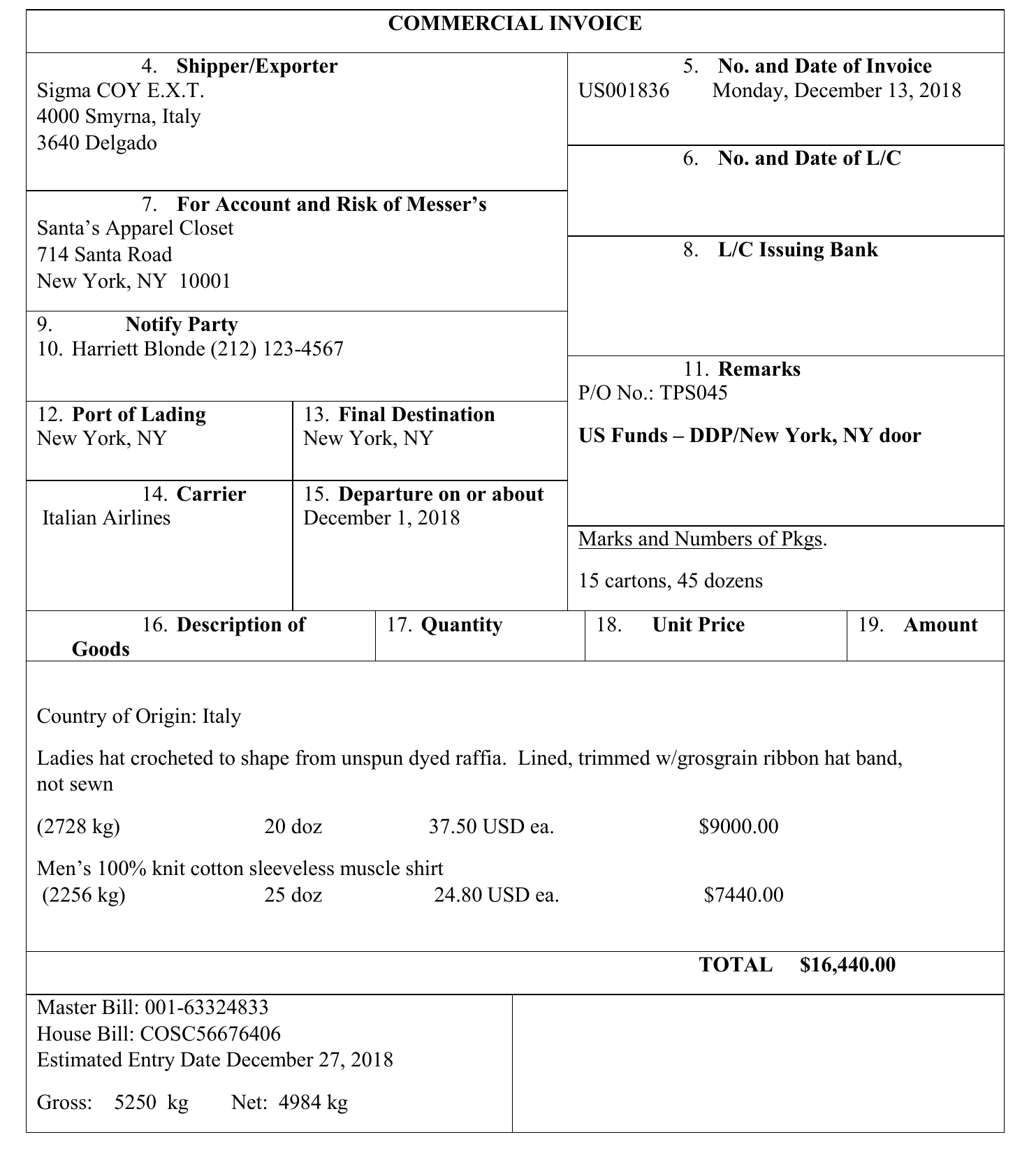
What would the Entry Type code be for the above invoice?
Exhibit — the document this question is answered from
Text version
COMMERCIAL INVOICE
4. Shipper/Exporter Sigma COY E.X.T. 4000 Smyrna, Italy 3640 Delgado US001836
5. No. and Date of Invoice Monday, December 13, 2018
6. No. and Date of L/C
7. For Account and Risk of Messer’s Santa’s Apparel Closet 714 Santa Road New York, NY 10001
8. L/C Issuing Bank
9. Notify Party
10. Harriett Blonde (212) 123-4567
11. Remarks P/O No.: TPS045
12. Port of Lading New York, NY
13. Final Destination New York, NY
14. Carrier Italian Airlines
15. Departure on or about December 1, 2018 US Funds – DDP/New York, NY door Marks and Numbers of Pkgs. 15 cartons, 45 dozens
16. Description of
17. Quantity
18. Unit Price
19. Amount Goods Country of Origin: Italy Ladies hat crocheted to shape from unspun dyed raffia. Lined, trimmed w/grosgrain ribbon hat band, not sewn (2728 kg) 20 doz 37.50 USD ea. $9000.00 Men’s 100% knit cotton sleeveless muscle shirt (2256 kg) 25 doz 24.80 USD ea. $7440.00
TOTAL $16,440.00
Master Bill: 001-63324833 House Bill: COSC56676406 Estimated Entry Date December 27, 2018 Gross: 5250 kg Net: 4984 kg
A 01
B 03
C 08
D 25
E 51
Show the official answer
Answer: A — 01
The worked walkthrough for this one — why the right answer is right, why each distractor fails, and where to find it in the crippled viewer — comes with the pass. The citation above is the source it’s built on; you can read it yourself in our 19 CFR navigator.
What is the CLASSIFICATION of a women’s hat crocheted to shape from unspun dyed raffia? The hat is lined and trimmed with a grosgrain ribbon hatband, and is not sewn.
Exhibit — the document this question is answered from
Text version
COMMERCIAL INVOICE
4. Shipper/Exporter Sigma COY E.X.T. 4000 Smyrna, Italy 3640 Delgado US001836
5. No. and Date of Invoice Monday, December 13, 2018
6. No. and Date of L/C
7. For Account and Risk of Messer’s Santa’s Apparel Closet 714 Santa Road New York, NY 10001
8. L/C Issuing Bank
9. Notify Party
10. Harriett Blonde (212) 123-4567
11. Remarks P/O No.: TPS045
12. Port of Lading New York, NY
13. Final Destination New York, NY
14. Carrier Italian Airlines
15. Departure on or about December 1, 2018 US Funds – DDP/New York, NY door Marks and Numbers of Pkgs. 15 cartons, 45 dozens
16. Description of
17. Quantity
18. Unit Price
19. Amount Goods Country of Origin: Italy Ladies hat crocheted to shape from unspun dyed raffia. Lined, trimmed w/grosgrain ribbon hat band, not sewn (2728 kg) 20 doz 37.50 USD ea. $9000.00 Men’s 100% knit cotton sleeveless muscle shirt (2256 kg) 25 doz 24.80 USD ea. $7440.00
TOTAL $16,440.00
Master Bill: 001-63324833 House Bill: COSC56676406 Estimated Entry Date December 27, 2018 Gross: 5250 kg Net: 4984 kg
A 6502.00.6060
B 6504.00.6000
C 6504.00.9060
D 6505.00.6030
E 6505.00.9076
Show the official answer
Answer: E — 6505.00.9076
The worked walkthrough for this one — why the right answer is right, why each distractor fails, and where to find it in the crippled viewer — comes with the pass. The citation above is the source it’s built on; you can read it yourself in our 19 CFR navigator.
What is the total duty and fees payable on the hats?
Exhibit — the document this question is answered from
Text version
COMMERCIAL INVOICE
4. Shipper/Exporter Sigma COY E.X.T. 4000 Smyrna, Italy 3640 Delgado US001836
5. No. and Date of Invoice Monday, December 13, 2018
6. No. and Date of L/C
7. For Account and Risk of Messer’s Santa’s Apparel Closet 714 Santa Road New York, NY 10001
8. L/C Issuing Bank
9. Notify Party
10. Harriett Blonde (212) 123-4567
11. Remarks P/O No.: TPS045
12. Port of Lading New York, NY
13. Final Destination New York, NY
14. Carrier Italian Airlines
15. Departure on or about December 1, 2018 US Funds – DDP/New York, NY door Marks and Numbers of Pkgs. 15 cartons, 45 dozens
16. Description of
17. Quantity
18. Unit Price
19. Amount Goods Country of Origin: Italy Ladies hat crocheted to shape from unspun dyed raffia. Lined, trimmed w/grosgrain ribbon hat band, not sewn (2728 kg) 20 doz 37.50 USD ea. $9000.00 Men’s 100% knit cotton sleeveless muscle shirt (2256 kg) 25 doz 24.80 USD ea. $7440.00
TOTAL $16,440.00
Master Bill: 001-63324833 House Bill: COSC56676406 Estimated Entry Date December 27, 2018 Gross: 5250 kg Net: 4984 kg
A $0.00
B $412.47
C $571.20
D $1,178.45
E $1,585.87
Show the official answer
Answer: D — $1,178.45
CBP's official answer: D
The answer key gives the controlling authority as HTSUS 6505.00.9076.
Why there is no walkthrough here
This question is from the April 2019 exam, which was sat against the 2018 Basic Edition HTSUS and the 2018 Annual Edition of Title 19 CFR. We check every walkthrough against the references we hold — the editions designated for the current sitting — and for this question we could not confirm the official answer from that text closely enough to walk you through it honestly.
The likely reason is edition drift rather than a mistake by anyone: tariff subheadings are split and renumbered between HTSUS editions, General Notes are re-lettered, and rates change every year. The answer was right for its exam. It may not be right today.
Use this question for the reasoning, not the number. The structure of the problem is still exactly what the current exam tests; the specific code or figure should be re-derived from the current tariff.
What is the CLASSIFICATION of the men’s 100% knit cotton sleeveless muscle shirt?
Exhibit — the document this question is answered from
Text version
COMMERCIAL INVOICE
4. Shipper/Exporter Sigma COY E.X.T. 4000 Smyrna, Italy 3640 Delgado US001836
5. No. and Date of Invoice Monday, December 13, 2018
6. No. and Date of L/C
7. For Account and Risk of Messer’s Santa’s Apparel Closet 714 Santa Road New York, NY 10001
8. L/C Issuing Bank
9. Notify Party
10. Harriett Blonde (212) 123-4567
11. Remarks P/O No.: TPS045
12. Port of Lading New York, NY
13. Final Destination New York, NY
14. Carrier Italian Airlines
15. Departure on or about December 1, 2018 US Funds – DDP/New York, NY door Marks and Numbers of Pkgs. 15 cartons, 45 dozens
16. Description of
17. Quantity
18. Unit Price
19. Amount Goods Country of Origin: Italy Ladies hat crocheted to shape from unspun dyed raffia. Lined, trimmed w/grosgrain ribbon hat band, not sewn (2728 kg) 20 doz 37.50 USD ea. $9000.00 Men’s 100% knit cotton sleeveless muscle shirt (2256 kg) 25 doz 24.80 USD ea. $7440.00
TOTAL $16,440.00
Master Bill: 001-63324833 House Bill: COSC56676406 Estimated Entry Date December 27, 2018 Gross: 5250 kg Net: 4984 kg
A 6105.10.0010
B 6105.20.2010
C 6106.10.0010
D 6110.20.2069
E 6205.20.2066
Show the official answer
Answer: D — 6110.20.2069
CBP's official answer: D
The answer key gives the controlling authority as HTSUS 6110.20.2069.
Why there is no walkthrough here
This question is from the April 2019 exam, which was sat against the 2018 Basic Edition HTSUS and the 2018 Annual Edition of Title 19 CFR. We check every walkthrough against the references we hold — the editions designated for the current sitting — and for this question we could not confirm the official answer from that text closely enough to walk you through it honestly.
The likely reason is edition drift rather than a mistake by anyone: tariff subheadings are split and renumbered between HTSUS editions, General Notes are re-lettered, and rates change every year. The answer was right for its exam. It may not be right today.
Use this question for the reasoning, not the number. The structure of the problem is still exactly what the current exam tests; the specific code or figure should be re-derived from the current tariff.
What is the total amount of duties and fees payable on the muscle shirt?
Exhibit — the document this question is answered from
Text version
COMMERCIAL INVOICE
4. Shipper/Exporter Sigma COY E.X.T. 4000 Smyrna, Italy 3640 Delgado US001836
5. No. and Date of Invoice Monday, December 13, 2018
6. No. and Date of L/C
7. For Account and Risk of Messer’s Santa’s Apparel Closet 714 Santa Road New York, NY 10001
8. L/C Issuing Bank
9. Notify Party
10. Harriett Blonde (212) 123-4567
11. Remarks P/O No.: TPS045
12. Port of Lading New York, NY
13. Final Destination New York, NY
14. Carrier Italian Airlines
15. Departure on or about December 1, 2018 US Funds – DDP/New York, NY door Marks and Numbers of Pkgs. 15 cartons, 45 dozens
16. Description of
17. Quantity
18. Unit Price
19. Amount Goods Country of Origin: Italy Ladies hat crocheted to shape from unspun dyed raffia. Lined, trimmed w/grosgrain ribbon hat band, not sewn (2728 kg) 20 doz 37.50 USD ea. $9000.00 Men’s 100% knit cotton sleeveless muscle shirt (2256 kg) 25 doz 24.80 USD ea. $7440.00
TOTAL $16,440.00
Master Bill: 001-63324833 House Bill: COSC56676406 Estimated Entry Date December 27, 2018 Gross: 5250 kg Net: 4984 kg
A $1,072.62
B $1,220.81
C $1,242.28
D $1,491.45
E $1,818.19
Show the official answer
Answer: A — $1,072.62
The worked walkthrough for this one — why the right answer is right, why each distractor fails, and where to find it in the crippled viewer — comes with the pass. The citation above is the source it’s built on; you can read it yourself in our 19 CFR navigator.
What is the total amount of duties and fees payable on the 7501?
Exhibit — the document this question is answered from
Text version
COMMERCIAL INVOICE
4. Shipper/Exporter Sigma COY E.X.T. 4000 Smyrna, Italy 3640 Delgado US001836
5. No. and Date of Invoice Monday, December 13, 2018
6. No. and Date of L/C
7. For Account and Risk of Messer’s Santa’s Apparel Closet 714 Santa Road New York, NY 10001
8. L/C Issuing Bank
9. Notify Party
10. Harriett Blonde (212) 123-4567
11. Remarks P/O No.: TPS045
12. Port of Lading New York, NY
13. Final Destination New York, NY
14. Carrier Italian Airlines
15. Departure on or about December 1, 2018 US Funds – DDP/New York, NY door Marks and Numbers of Pkgs. 15 cartons, 45 dozens
16. Description of
17. Quantity
18. Unit Price
19. Amount Goods Country of Origin: Italy Ladies hat crocheted to shape from unspun dyed raffia. Lined, trimmed w/grosgrain ribbon hat band, not sewn (2728 kg) 20 doz 37.50 USD ea. $9000.00 Men’s 100% knit cotton sleeveless muscle shirt (2256 kg) 25 doz 24.80 USD ea. $7440.00
TOTAL $16,440.00
Master Bill: 001-63324833 House Bill: COSC56676406 Estimated Entry Date December 27, 2018 Gross: 5250 kg Net: 4984 kg
A $1,273.35
B $1,842.58
C $2,091.75
D $2,251.07
E $2,684.08
Show the official answer
Answer: D — $2,251.07
CBP's official answer: D
The answer key gives no citation for this question.
Why there is no walkthrough here
This question is from the April 2019 exam, which was sat against the 2018 Basic Edition HTSUS and the 2018 Annual Edition of Title 19 CFR. We check every walkthrough against the references we hold — the editions designated for the current sitting — and for this question we could not confirm the official answer from that text closely enough to walk you through it honestly.
The answer key gives no citation for this one, so we cannot tell whether the underlying text has moved since the exam or our verifier simply could not locate it. Treat CBP's answer as correct for its exam and confirm it against the current references before relying on it.
In which block on the 7501 would you indicate the Merchandise Processing Fee total?
Exhibit — the document this question is answered from
Text version
COMMERCIAL INVOICE
4. Shipper/Exporter Sigma COY E.X.T. 4000 Smyrna, Italy 3640 Delgado US001836
5. No. and Date of Invoice Monday, December 13, 2018
6. No. and Date of L/C
7. For Account and Risk of Messer’s Santa’s Apparel Closet 714 Santa Road New York, NY 10001
8. L/C Issuing Bank
9. Notify Party
10. Harriett Blonde (212) 123-4567
11. Remarks P/O No.: TPS045
12. Port of Lading New York, NY
13. Final Destination New York, NY
14. Carrier Italian Airlines
15. Departure on or about December 1, 2018 US Funds – DDP/New York, NY door Marks and Numbers of Pkgs. 15 cartons, 45 dozens
16. Description of
17. Quantity
18. Unit Price
19. Amount Goods Country of Origin: Italy Ladies hat crocheted to shape from unspun dyed raffia. Lined, trimmed w/grosgrain ribbon hat band, not sewn (2728 kg) 20 doz 37.50 USD ea. $9000.00 Men’s 100% knit cotton sleeveless muscle shirt (2256 kg) 25 doz 24.80 USD ea. $7440.00
TOTAL $16,440.00
Master Bill: 001-63324833 House Bill: COSC56676406 Estimated Entry Date December 27, 2018 Gross: 5250 kg Net: 4984 kg
A 13
B 30
C 33
D 37
E 39
Show the official answer
Answer: E — 39
The worked walkthrough for this one — why the right answer is right, why each distractor fails, and where to find it in the crippled viewer — comes with the pass. The citation above is the source it’s built on; you can read it yourself in our 19 CFR navigator.
Pursuant to a broker’s requirement to exercise due diligence, what written notification must be on, or attached to, any power of attorney provided by the broker to an active client?
A Notification that payment to the broker will not relieve the importer of liability of customs charges in the event the charges are not paid by the broker.
B Notification that the broker is licensed by the U.S. government.
C Notification of the broker’s payment of funds for duty, tax, or other debt owed to the government.
D Notification that the execution of the power of attorney gives the broker the right to cancel shipments.
E Notification that the broker is also an importer who imports merchandise of the same general character as his client.
Show the official answer
Answer: A — Notification that payment to the broker will not relieve the importer of liability of customs charges in the event the charges are not paid by the broker.
The worked walkthrough for this one — why the right answer is right, why each distractor fails, and where to find it in the crippled viewer — comes with the pass. The citation above is the source it’s built on; you can read it yourself in our 19 CFR navigator.
CBP is conducting a broker audit of Interstate Dynamic Logistics CHB based upon evidence of improper use of HTSUS classification. During the audit, they request copies of Powers of Attorney (POAs) for entries related to four different Importer clients. Interstate Dynamic Logistics CHB is unable to provide the Power of Attorney for one of the three Importer Clients, one of the other POAs is not signed by the Importer Clients Guarantor, the third POA is not dated, and the guarantor on the fourth POA is on the U.S. Governments restricted persons list. What action can CBP take?
A A warning/penalty for conducting customs business for a client without a POA.
B Suspension of the broker’s electronic filing privilege until two of the POAs are brought into compliance.
C A $10,000 penalty for conducting customs business without a permit.
D Immediate revocation of Customs Broker License for conducting customs business without having proper POAs.
E A $10,000 recordkeeping penalty.
Show the official answer
Answer: A — A warning/penalty for conducting customs business for a client without a POA.
CBP's official answer: A
The answer key gives the controlling authority as 19 CFR 171 Appendix C.
Why there is no walkthrough here
This question is from the April 2019 exam, which was sat against the 2018 Basic Edition HTSUS and the 2018 Annual Edition of Title 19 CFR. We check every walkthrough against the references we hold — the editions designated for the current sitting — and for this question we could not confirm the official answer from that text closely enough to walk you through it honestly.
This one does not turn on a tariff number, so the answer has most likely not changed. The cited text is either not in the corpus we check against, or is there in a form our verifier could not match to the answer. We would rather show you CBP's answer with that caveat than invent a walkthrough.
Read the cited source yourself. It is short, and confirming the answer from the text is the same exercise the exam asks of you.
Jeremy is an unlicensed employee of Universal Customs House Brokerage (UCHB), a licensed entity. UCHB executed a Power of Attorney (POA) that provides Jeremy with authority to sign documents pertaining to customs business on its behalf. Which of the following correctly reflects Jeremy’s authority to sign customs documents?
A Because Jeremy is unlicensed, his licensed employer must initial any customs document he signs.
B Jeremy, as an employee of UCHB, may sign customs documents on their behalf, even without a valid POA.
C Jeremy is not a licensed broker, and therefore, he cannot sign customs documents on behalf of his employer.
D Jeremy may sign UCHB’s documents pertaining to customs business; however, UCHB, upon the request from Customs, must furnish proof of the existence of the POA executed with Jeremy.
E Jeremy may sign UCHB’s customs documents; however, prior to his ability to sign such documents, UCHB must provide the port director, at each port for which they have a permit, a copy of the POA executed with Jeremy.
Show the official answer
Answer: D — Jeremy may sign UCHB’s documents pertaining to customs business; however, UCHB, upon the request from Customs, must furnish proof of the existence of the POA executed with Jeremy.
The worked walkthrough for this one — why the right answer is right, why each distractor fails, and where to find it in the crippled viewer — comes with the pass. The citation above is the source it’s built on; you can read it yourself in our 19 CFR navigator.
________________ allows for delivery of merchandise to a Foreign Trade Zone without prior application and approval on CBP form 214.
A A temporary deposit
B CBP Form 7501
C A weekly permit
D First-In, First-Out
E Direct delivery
Show the official answer
Answer: E — Direct delivery
The worked walkthrough for this one — why the right answer is right, why each distractor fails, and where to find it in the crippled viewer — comes with the pass. The citation above is the source it’s built on; you can read it yourself in our 19 CFR navigator.
A transfer of merchandise from a Foreign Trade Zone at one port of entry to another port will be by bonded carrier, under an entry for immediate transportation on _________________.
A CBP Form 6043
B CBP Form 7512
C CBP Form 214
D CBP Form 216
E CBP Form 3171
Show the official answer
Answer: B — CBP Form 7512
The worked walkthrough for this one — why the right answer is right, why each distractor fails, and where to find it in the crippled viewer — comes with the pass. The citation above is the source it’s built on; you can read it yourself in our 19 CFR navigator.
A A port director may authorize a CBP Officer to supervise any transaction or procedure at a bonded warehouse facility.
B When merchandise is transported to a bonded warehouse facility, the proprietor or his representative must countersign a document to acknowledge receipt of the merchandise.
C A bonded carrier transferring merchandise from its facility to a container station remains liable for the proper safekeeping and delivery of merchandise, under the terms of its bond, until the merchandise is formally receipted for by a container station operator.
D A port director may suspend or revoke bonded warehouse status for cause, if the warehouse proprietor fails to obey a proper order from a CBP Officer.
E A broker may authorize certain carriers to receive merchandise for transportation in bond from one port to another.
Show the official answer
Answer: E — A broker may authorize certain carriers to receive merchandise for transportation in bond from one port to another.
The worked walkthrough for this one — why the right answer is right, why each distractor fails, and where to find it in the crippled viewer — comes with the pass. The citation above is the source it’s built on; you can read it yourself in our 19 CFR navigator.
What status of merchandise may be manipulated, manufactured, exhibited, destroyed, or transferred from a zone, without a permit?
A Non-privileged foreign
B Privileged foreign
C Foreign
D Domestic
E Zone-restricted
Show the official answer
Answer: D — Domestic
The worked walkthrough for this one — why the right answer is right, why each distractor fails, and where to find it in the crippled viewer — comes with the pass. The citation above is the source it’s built on; you can read it yourself in our 19 CFR navigator.
What is the correct CLASSIFICATION of milk chocolate bars imported from Switzerland that are shipped in 132-pound flat containers? By weight, each chocolate bar consists of 39.12% sugar, 32.50% cocoa powder, 12.88% cocoa butter, 10.50% skim milk powder, 4.03% granulated cocoa, 0.77% soy lecithin and 0.20% vanillin, with a total milk solids content of 15.3%. Each chocolate bar weighs 5 kg. Prior to shipping, the chocolate bars are placed inside bulk containers, which hold 12 bars each.
A 1704.90.1000
B 1806.20.2090
C 1806.32.0400
D 1806.90.9090
E 1901.90.0000
Show the official answer
Answer: B — 1806.20.2090
The worked walkthrough for this one — why the right answer is right, why each distractor fails, and where to find it in the crippled viewer — comes with the pass. The citation above is the source it’s built on; you can read it yourself in our 19 CFR navigator.
What is the CLASSIFICATION of a mixed apple/cranberry juice, not fortified with vitamins or minerals and not containing added sugar, imported in concentrated form?
A 2009.89.6091
B 2009.90.4000
C 2106.90.5200
D 2106.90.5400
E 2202.99.3700
Show the official answer
Answer: B — 2009.90.4000
CBP's official answer: B
The answer key gives the controlling authority as HTSUS 2009.90.4000.
Why there is no walkthrough here
This question is from the April 2019 exam, which was sat against the 2018 Basic Edition HTSUS and the 2018 Annual Edition of Title 19 CFR. We check every walkthrough against the references we hold — the editions designated for the current sitting — and for this question we could not confirm the official answer from that text closely enough to walk you through it honestly.
The likely reason is edition drift rather than a mistake by anyone: tariff subheadings are split and renumbered between HTSUS editions, General Notes are re-lettered, and rates change every year. The answer was right for its exam. It may not be right today.
Use this question for the reasoning, not the number. The structure of the problem is still exactly what the current exam tests; the specific code or figure should be re-derived from the current tariff.
What is the CLASSIFICATION of 80% green tea (Camellia Sinensis) not fermented and 20% mint leaves in crushed form packaged in a 2kg bag?
A 0902.10.1050
B 1211.90.2000
C 1211.90.4020
D 2106.20.2090
E 2101.90.9887
Show the official answer
Answer: A — 0902.10.1050
The worked walkthrough for this one — why the right answer is right, why each distractor fails, and where to find it in the crippled viewer — comes with the pass. The citation above is the source it’s built on; you can read it yourself in our 19 CFR navigator.
What is the CLASSIFICATION of Axminster woven carpets, of pile construction, imported in continuous rolls, 12 feet in width cut to lengths of 25 yards, with an overall fiber content of 45% wool, 30% nylon, 15% polypropylene and 10% jute and with a fiber content breakdown as follows: Pile Surface: 60% wool, 40% nylon; Ground Fabric: 70% polypropylene, 30% jute?
A 5702.31.2000
B 5702.32.2000
C 5702.41.2000
D 5702.42.2020
E 5702.42.2080
Show the official answer
Answer: A — 5702.31.2000
The worked walkthrough for this one — why the right answer is right, why each distractor fails, and where to find it in the crippled viewer — comes with the pass. The citation above is the source it’s built on; you can read it yourself in our 19 CFR navigator.
What is the CLASSIFICATION of a hanging wall shelf made of steel with a wood accent trim, a metal framed mirror, and a metal hanging bar with three metal hooks that extend from the bottom of the shelf? The shelf is intended to be used as a wall hanging vanity where accessories can be placed on the shelf and hung from the hooks.
A 4420.90.8000
B 7323.99.9080
C 8302.50.0000
D 9403.20.0050
E 9403.60.8081
Show the official answer
Answer: D — 9403.20.0050
CBP's official answer: D
The answer key gives the controlling authority as HTSUS 9403.20.0050.
Why there is no walkthrough here
This question is from the April 2019 exam, which was sat against the 2018 Basic Edition HTSUS and the 2018 Annual Edition of Title 19 CFR. We check every walkthrough against the references we hold — the editions designated for the current sitting — and for this question we could not confirm the official answer from that text closely enough to walk you through it honestly.
The likely reason is edition drift rather than a mistake by anyone: tariff subheadings are split and renumbered between HTSUS editions, General Notes are re-lettered, and rates change every year. The answer was right for its exam. It may not be right today.
Use this question for the reasoning, not the number. The structure of the problem is still exactly what the current exam tests; the specific code or figure should be re-derived from the current tariff.
What is the CLASSIFICATION of a 100% knit cotton infant bootie where the outer sole is not sewn to the upper?
A 6111.20.6050
B 6111.30.5050
C 6209.20.5050
D 6405.20.3090
E 6405.20.9090
Show the official answer
Answer: A — 6111.20.6050
The worked walkthrough for this one — why the right answer is right, why each distractor fails, and where to find it in the crippled viewer — comes with the pass. The citation above is the source it’s built on; you can read it yourself in our 19 CFR navigator.
The submitted sample, identified by the importer as style # KF 123, is a pair of men’s closed toe/closed heel, lace-up boots measuring 8 inches high with an outer sole of rubber or plastics. The external surface area of the upper is 80% non-vegetable textile and 20% rubber or plastics. The boots have a faux fur lining that is over 2 inches thick. The boots are completely water resistant because they have been treated with durable water repellant (DWR). The F.O.B. value is $24 per pair. What is the CLASSIFICATION of these boots?
A 6401.92.9060
B 6402.91.5020
C 6403.99.6075
D 6404.19.2030
E 6404.19.2090
Show the official answer
Answer: D — 6404.19.2030
CBP's official answer: D
The answer key gives the controlling authority as HTSUS 6404.19.2030.
Why there is no walkthrough here
This question is from the April 2019 exam, which was sat against the 2018 Basic Edition HTSUS and the 2018 Annual Edition of Title 19 CFR. We check every walkthrough against the references we hold — the editions designated for the current sitting — and for this question we could not confirm the official answer from that text closely enough to walk you through it honestly.
The likely reason is edition drift rather than a mistake by anyone: tariff subheadings are split and renumbered between HTSUS editions, General Notes are re-lettered, and rates change every year. The answer was right for its exam. It may not be right today.
Use this question for the reasoning, not the number. The structure of the problem is still exactly what the current exam tests; the specific code or figure should be re-derived from the current tariff.
What is the CLASSIFICATION for a coated dobby weave upholstery fabric, woven of yarns of different colors, containing chenille yarns visible on one side only? The fabric, weighing 233 g/m2, is composed of 100% polyester yarns (86% staple fiber / 24% filament). A visible polyurethane plastic coating, weighing 5% of the total weight of the fabric, has been applied to the reverse side, entirely coating that face of the fabric. The fabric will be imported in widths of 57 inches.
A 5407.69.4010
B 5513.13.0020
C 5516.13.0000
D 5801.36.0010
E 5903.20.1500
Show the official answer
Answer: D — 5801.36.0010
The worked walkthrough for this one — why the right answer is right, why each distractor fails, and where to find it in the crippled viewer — comes with the pass. The citation above is the source it’s built on; you can read it yourself in our 19 CFR navigator.
A baseball-style cap is constructed of a crown consisting of six panels and a typical rounded peak (also called a brim or visor). The cap features six vent holes, a fabric-covered button at the top of the crown, and an adjustable plastic strap at the back of the cap. The cap’s composition includes fabrics of multiple materials and constructions. It is a composite good. Specifically, the crown consists of four rear panels of 100% knit polyester and two front panels of 100% woven cotton. The peak is 100% woven cotton. The cap contains no braid. No single component imparts the essential character of the cap. What is the CLASSIFICATION of the cap?
A 6505.00.15
B 6505.00.20
C 6505.00.40
D 6505.00.50
E 6505.00.60
Show the official answer
Answer: E — 6505.00.60
CBP's official answer: E
The answer key gives the controlling authority as HTSUS 6505.0060.
Why there is no walkthrough here
This question is from the April 2019 exam, which was sat against the 2018 Basic Edition HTSUS and the 2018 Annual Edition of Title 19 CFR. We check every walkthrough against the references we hold — the editions designated for the current sitting — and for this question we could not confirm the official answer from that text closely enough to walk you through it honestly.
The likely reason is edition drift rather than a mistake by anyone: tariff subheadings are split and renumbered between HTSUS editions, General Notes are re-lettered, and rates change every year. The answer was right for its exam. It may not be right today.
Use this question for the reasoning, not the number. The structure of the problem is still exactly what the current exam tests; the specific code or figure should be re-derived from the current tariff.
What is the CLASSIFICATION for a coated knit upholstery fabric, consisting of a plastic face and a knit backing? The face is composed of a layer of cellular polyurethane (PU) plastic covering the entire surface of the fabric; the plastic layer has been embossed to produce the textured appearance of leather. The backing fabric, composed wholly of polyester, is of double weft knit construction using multifilament polyester yarns of different colors to form a decorative pattern; the backing fabric has been brushed for softness. The coated fabric weighs 639.0 g/m2, of which approximately 22.2% is textile and 77.8% is the plastic material, by weight.
A 3920.43.1000
B 3921.12.1500
C 3921.90.1100
D 5903.20.1500
E 5903.20.2000
Show the official answer
Answer: E — 5903.20.2000
The worked walkthrough for this one — why the right answer is right, why each distractor fails, and where to find it in the crippled viewer — comes with the pass. The citation above is the source it’s built on; you can read it yourself in our 19 CFR navigator.
You have a stainless steel flatware set that is classifiable under subheading 8215.20.0000. Within the set you have stainless steel forks, spoons, knives, and steak knives with wooden handles. None of the items are entitled to duty preference treatment. The forks are valued at $.26 each and under classification 8215.99.1500 / 0.4¢ each + 4.8%. The spoons are valued at $.23 each and under classification 8215.99.3500 / 6.8%. The knives are valued at $.57 each and under classification 8211.91.4000 / 0.3¢ each + 3.7%. The steak knives are valued at $.68 and under classification 8211.91.8030 / 0.3¢ each + 4.9%. As the duty rate for subheading 8215.20.0000 is provided by the rate of duty applicable to that article in the set subject to the highest rate of duty, what is the duty rate for this set?
A 0.0¢
B 0.4¢ each + 4.8%
C 6.8%
D 0.3¢ each + 3.7%
E 0.3¢ each + 4.9%
Show the official answer
Answer: B — 0.4¢ each + 4.8%
The worked walkthrough for this one — why the right answer is right, why each distractor fails, and where to find it in the crippled viewer — comes with the pass. The citation above is the source it’s built on; you can read it yourself in our 19 CFR navigator.
Are Brazilian V-belts that are classified in HTSUS 3926.90.55 eligible for Generalized System of Preference (GSP) benefits and why?
A No, because A+ is the special program indicator (SPI) for the Automotive Products Trade Act (APTA) and not GSP.
B No, because A+ is the special program indicator (SPI) for the African Growth and Opportunity Act (AGOA) and not GSP.
C Yes, because Brazil is a GSP country listed in HTSUS General Note 4(a).
D No, because Brazil is not a GSP LDBDC.
E No, because V-belts cannot be classified in HTSUS 3926.90.55.
Show the official answer
Answer: D — No, because Brazil is not a GSP LDBDC.
The worked walkthrough for this one — why the right answer is right, why each distractor fails, and where to find it in the crippled viewer — comes with the pass. The citation above is the source it’s built on; you can read it yourself in our 19 CFR navigator.
Do the Singapore Free Trade Agreement (SGFTA) rules of origin (ROOs) provide for a good to originate as “exclusively from originating materials” and why?
A Yes, because the SGFTA is a “tariff shift model” free trade agreement, and like all such FTAs, they provide an “exclusively from originating materials” ROO.
B No, because among our “tariff shift model” free trade agreements, the SGFTA is unique or nearly unique in that it does not have an “exclusively from originating materials” ROO.
C No, because Singapore is a small country and like other small countries with which we have FTAs, its program relies upon a regional value content + substantial transformation (RVC + ST x 100 >= 35%) ROO to determine origination.
D Yes, because the “wholly obtained or produced” ROO and “exclusively from originating materials” ROO mean exactly the same thing.
E No, because the SGFTA expired on January 1, 2013.
Show the official answer
Answer: B — No, because among our “tariff shift model” free trade agreements, the SGFTA is unique or nearly unique in that it does not have an “exclusively from originating materials” ROO.
The worked walkthrough for this one — why the right answer is right, why each distractor fails, and where to find it in the crippled viewer — comes with the pass. The citation above is the source it’s built on; you can read it yourself in our 19 CFR navigator.
HTSUS General Note 33(c)(iii)(B) · 19 CFR 10.1025(a)(2)
Automotive radial tires classified in HTSUS 4011.10.10 that were produced in Korea and originate under the terms of the U.S.-Korea FTA (KORUS) are entered into the commerce of Japan by Toyota then are rerouted to Georgetown, KY, owing to a supply chain disruption in the U.S. Are these tires eligible for KORUS duty preference upon importation into the U.S. and why?
A No, because a Japanese company does not have standing to make a preference claim under the KORUS.
B Yes, because the KORUS allows originating goods to enter the commerce of a third country without losing originating status as long as they are not further processed.
C No, because the KORUS does not allow originating goods to enter the commerce of a third country without losing originating status.
D Yes, because the KORUS allows originating goods to be further processed in another country as long as the processing is merely a finishing operation that does not result in a change in tariff classification.
E Yes, because the KORUS allows originating goods to be further processed in another country as long as the processing is not greater than the 10% permissible under de minimis.
Show the official answer
Answer: C — No, because the KORUS does not allow originating goods to enter the commerce of a third country without losing originating status.
The worked walkthrough for this one — why the right answer is right, why each distractor fails, and where to find it in the crippled viewer — comes with the pass. The citation above is the source it’s built on; you can read it yourself in our 19 CFR navigator.
Blooming potted hyacinths in HTSUS 0601.20.90 are grown in Canadian hot houses from Dutch bulbs classified in HTSUS 0601.10.30 and subsequently imported into the U.S. The value of the Dutch bulbs is 15% of the customs value of the potted hyacinths. Can the hyacinths enter the commerce of the U.S. duty free under the North American Free Trade Agreement (NAFTA) and why?
A Yes, because this is an allowable tariff shift.
B Yes, because although this is not an allowable tariff shift, by application of the de minimis exception, the blooming potted hyacinths remain NAFTA eligible.
C No, because HTSUS 0601.20.90 is ineligible for NAFTA Canada.
D Yes, because the NAFTA’s “Exceptions to Change in Tariff Classification Rules” allows horticultural goods to originate even if grown from non-originating bulbs, seed, cuttings, etc.
E No, because live plants with soil attached to roots cannot be imported into the U.S., much less benefit from NAFTA.
Show the official answer
Answer: D — Yes, because the NAFTA’s “Exceptions to Change in Tariff Classification Rules” allows horticultural goods to originate even if grown from non-originating bulbs, seed, cuttings, etc.
The worked walkthrough for this one — why the right answer is right, why each distractor fails, and where to find it in the crippled viewer — comes with the pass. The citation above is the source it’s built on; you can read it yourself in our 19 CFR navigator.
A foreign commercial invoice reports a value of $7200 with an addition of $800 for “distributor fee”, or a total invoice value of $8000. The nature of the fee charged by the seller was to compensate the exclusive U.S. distributor who, by agreement with the foreign seller, receives 10% of all sales in the U.S. as a commission. The distributor receives this regardless of whether or not they actually make the sale. The $800 would be:
A Not part of Transaction Value.
B A buying commission to be added to the price actually paid or payable.
C A buying commission; part of the price actually paid or payable.
D A selling commission to be added to the price actually paid or payable.
E A selling commission; part of the price actually paid or payable.
Show the official answer
Answer: D — A selling commission to be added to the price actually paid or payable.
CBP also accepted E — A selling commission; part of the price actually paid or payable.
The worked walkthrough for this one — why the right answer is right, why each distractor fails, and where to find it in the crippled viewer — comes with the pass. The citation above is the source it’s built on; you can read it yourself in our 19 CFR navigator.
Which of the following is NOT an element of the computed value of apparel from Costa Rica?
A An amount for profit and general expenses equal to that usually reflected in sales of all apparel in the United States.
B The cost or value of materials, fabrication, and processing employed in the production of the imported merchandise.
C Packing costs.
D The value of an assist.
E An amount for profit and general expenses equal to that usually reflected in sales of Costa Rican apparel for export to the United States.
Show the official answer
Answer: A — An amount for profit and general expenses equal to that usually reflected in sales of all apparel in the United States.
The worked walkthrough for this one — why the right answer is right, why each distractor fails, and where to find it in the crippled viewer — comes with the pass. The citation above is the source it’s built on; you can read it yourself in our 19 CFR navigator.
An importer enters gas turbines manufactured in China through the Port of Boston. The importer indicates that the basis of appraisal is transaction value based upon a sale of merchandise to the importer from the unrelated manufacturer M. The importer pays a royalty to Company A for the right for manufacturer M to use patented technology in the production of the gas turbines in China. After importation, the imported gas turbines are used in the production of other goods in the United States using a patented technology for which the importer pays Company B for the right to use. The contract between the manufacturer and the importer makes no reference to either Company A’s or Company B’s patented technology, or the royalty payments to the companies. Which of the following describes the dutiable status of the royalty payments and the reason for that status is?
A The royalty payment to the Company A is dutiable; the royalty payment to Company B is not dutiable. Company A’s patented technology is necessary to produce the imported goods. Company B’s patented technology goes to the right to use technology in the United States and the imported gas turbines are not the subject of the royalty agreement.
B The royalty payment to the Company A is dutiable; the royalty payment to Company B is dutiable. Both Company A’s and Company’s B patented technology relate to the imported goods.
C The royalty payment to Company A is not dutiable; the royalty payment to Company B is not dutiable. The contract between the manufacturer M and the importer does not mention the patented technology or royalty payments.
D The royalty payment to the Company A is not dutiable; the royalty payment to Company B is dutiable. The contract between the manufacturer M and the importer does not mention Company A’s patented technology. Company B’s patented technology is used in further production using the imported goods.
E None of the above.
Show the official answer
Answer: A — The royalty payment to the Company A is dutiable; the royalty payment to Company B is not dutiable. Company A’s patented technology is necessary to produce the imported goods. Company B’s patented technology goes to the right to use technology in the United States and the imported gas turbines are not the subject of the royalty agreement.
CBP's official answer: A
The answer key gives the controlling authority as 19 CFR 152.103(f).
Why there is no walkthrough here
This question is from the April 2019 exam, which was sat against the 2018 Basic Edition HTSUS and the 2018 Annual Edition of Title 19 CFR. We check every walkthrough against the references we hold — the editions designated for the current sitting — and for this question we could not confirm the official answer from that text closely enough to walk you through it honestly.
This one does not turn on a tariff number, so the answer has most likely not changed. The cited text is either not in the corpus we check against, or is there in a form our verifier could not match to the answer. We would rather show you CBP's answer with that caveat than invent a walkthrough.
Read the cited source yourself. It is short, and confirming the answer from the text is the same exercise the exam asks of you.
Upon importation, an importer inspected its merchandise, women’s shirts, and noted that the shirts were made of 98% cotton instead of 100% cotton, and that the sizing ran small and did not match what was listed on the sewn-in label. The merchandise was entered under 6206.30.30, HTSUS and duty paid. The importer’s buyer in the United States rejected the merchandise because it was not what the buyer ordered. The importer ultimately sold the merchandise to a discounted clothing store at 10% of what the original buyer agreed to pay. The importer requested a full refund of duties paid on the merchandise claiming it was defective. Which of the following is the best description of what the importer is entitled to in this situation?
A The importer is not entitled to any refund of duties under the law.
B The importer is entitled to a full refund of duties as the merchandise is not what the importer paid for.
C The importer is entitled to a full refund of duties because the merchandise is essentially worthless.
D The importer is entitled to a partial refund of duties. The merchandise should be appraised in its condition as imported, with an allowance made in the value to the extent of the damage.
E The importer is not entitled to a refund of duties because no allowance or reduction of duties may be made for ad valorem duties paid.
Show the official answer
Answer: D — The importer is entitled to a partial refund of duties. The merchandise should be appraised in its condition as imported, with an allowance made in the value to the extent of the damage.
The worked walkthrough for this one — why the right answer is right, why each distractor fails, and where to find it in the crippled viewer — comes with the pass. The citation above is the source it’s built on; you can read it yourself in our 19 CFR navigator.
ACME, a U.S. Company, purchases 100 machines from a company in Japan. ACME will make an initial down payment for the machines. Once the machines are made, ACME will make another payment. The Japanese company ships the machines to the United States on a Free on Board (FOB) basis. Once the goods are entered into the United States, ACME will make another payment to the Japanese company. What charges would NOT be included in the dutiable value of the machines?
A As a part of the price of the machines, the invoice from the Japanese company, presented to CBP when the merchandise is entered into the United States, includes a charge to transport the machines from Nagano to Toyko, Japan so that they could be shipped to the United States.
B ACME hires its sister company in Boise, Idaho and pays them to develop design plans and technical know-how and to furnish them to the Japanese company free of charge for making the machines more efficient.
C The sales agreement indicates that if the machines are delivered on time, the Japanese company will receive a bonus payment.
D One of ACME’s customers in the United States wants modifications made to the machines. These modifications must be made at the time of production, resulting in a higher cost to make the machines. ACME does not have the funds to pay the Japanese company for the extra costs of the modification and the Japanese company will not produce machines with the modification without first receiving payment for increased production costs, so ACME has its customer send a payment to the Japanese company for the additional costs of the modifications.
E To ensure that the goods are safely shipped to the United States, ACME hires a company who charges ACME a fee to load the machines onto pallets and bubble wrap them for delivery to the United States.
Show the official answer
Answer: B — ACME hires its sister company in Boise, Idaho and pays them to develop design plans and technical know-how and to furnish them to the Japanese company free of charge for making the machines more efficient.
The worked walkthrough for this one — why the right answer is right, why each distractor fails, and where to find it in the crippled viewer — comes with the pass. The citation above is the source it’s built on; you can read it yourself in our 19 CFR navigator.
ACE Business Rules & Process Document Section 4.5.2
Which port may only use lineless Non-ABI Entry Summary input for the following entry types: excluding only Quota, AD.CVD, Reconciliation, Drawback and Vessel Repair: 01, 06, 08, 11, 21, 22, 23, 24, 25, 31, 51, and 52?
A Alaska
B Puerto Rico
C Hawaii
D U.S. Virgin Islands
E All of the above
Show the official answer
Answer: D — U.S. Virgin Islands
The worked walkthrough for this one — why the right answer is right, why each distractor fails, and where to find it in the crippled viewer — comes with the pass. The citation above is the source it’s built on; you can read it yourself in our 19 CFR navigator.
You just read the answers. On exam day you have to find them, under a clock, in a search box with no jump-to-next. Drill these same questions — with a free account, the ones you get wrong come back on a schedule.