79 usable questions with CBP’s official answer and answer-key sources where supplied. Worked walkthroughs are free for the first 10; the rest come with the pass. Answers are collapsed so you can try first.
Questions 63 are retained in our audit trail but unavailable for practice because the published copy is missing an exhibit or cannot be rendered answerably. They are not counted in the total above.
Designated references
Harmonized Tariff Schedule of the United States — 2017 Basic Edition
Title 19, Code of Federal Regulations — 2016 or 2017 Annual Edition
You, the broker, decide to open an office at a port within a district for which you already have a permit. Which of the following information about your employees do you NOT need to submit to the Port Director in that district prior to transacting business?
A Social Security Number
B Date and place of birth
C Date and place of broker exam
D Current home address and last prior home address
E Name and address of each prior employer and dates of employment for the previous 3 years
Show the official answer
Answer: C — Date and place of broker exam
CBP's official answer: C
The answer key gives the controlling authority as 19 CFR 111.28(b).
Why there is no walkthrough here
This question is from the April 2018 exam, which was sat against the 2017 Basic Edition HTSUS and the 2016 or 2017 Annual Edition of Title 19 CFR. We check every walkthrough against the references we hold — the editions designated for the current sitting — and for this question we could not confirm the official answer from that text closely enough to walk you through it honestly.
This one does not turn on a tariff number, so the answer has most likely not changed. The cited text is either not in the corpus we check against, or is there in a form our verifier could not match to the answer. We would rather show you CBP's answer with that caveat than invent a walkthrough.
Read the cited source yourself. It is short, and confirming the answer from the text is the same exercise the exam asks of you.
Which of the following will not provide for revocation of the broker’s permit?
A Nonpayment of the user fee.
B Neglecting to obtain a timely permit waiver.
C Neglecting to advise CBP of the replacement permit qualifier within 120 days of loss
D Nonpayment of permit qualifiers triennial fee
E Neglecting to advise CBP of a replacement permit qualifier within 180 days of loss
Show the official answer
Answer: C — Neglecting to advise CBP of the replacement permit qualifier within 120 days of loss
CBP's official answer: C
The answer key gives the controlling authority as 19 CFR 111.45.
Why there is no walkthrough here
This question is from the April 2018 exam, which was sat against the 2017 Basic Edition HTSUS and the 2016 or 2017 Annual Edition of Title 19 CFR. We check every walkthrough against the references we hold — the editions designated for the current sitting — and for this question we could not confirm the official answer from that text closely enough to walk you through it honestly.
This one does not turn on a tariff number, so the answer has most likely not changed. The cited text is either not in the corpus we check against, or is there in a form our verifier could not match to the answer. We would rather show you CBP's answer with that caveat than invent a walkthrough.
Read the cited source yourself. It is short, and confirming the answer from the text is the same exercise the exam asks of you.
In the case of a new employee, a customs broker must notify the CBP port director that the broker has hired the new employee within _____.
A Five calendar days after the new employee has been employed by the broker for 60 consecutive days
B Seven calendar days of hiring the new employee
C Ten working days of hiring the new employee
D Ten calendar days after the new employee has been employed by the broker for 30 consecutive days
E 30 calendar days of hiring the new employee
Show the official answer
Answer: D — Ten calendar days after the new employee has been employed by the broker for 30 consecutive days
CBP's official answer: D
The answer key gives the controlling authority as 19 CFR 111.28(b)(1)(ii).
Why there is no walkthrough here
This question is from the April 2018 exam, which was sat against the 2017 Basic Edition HTSUS and the 2016 or 2017 Annual Edition of Title 19 CFR. We check every walkthrough against the references we hold — the editions designated for the current sitting — and for this question we could not confirm the official answer from that text closely enough to walk you through it honestly.
This one does not turn on a tariff number, so the answer has most likely not changed. The cited text is either not in the corpus we check against, or is there in a form our verifier could not match to the answer. We would rather show you CBP's answer with that caveat than invent a walkthrough.
Read the cited source yourself. It is short, and confirming the answer from the text is the same exercise the exam asks of you.
Payment for the __________________ is required every three years.
A Local Permit fee
B National Permit fee
C Merchandise Processing fee
D Triennial Status Report fee
E Harbor Maintenance fee
Show the official answer
Answer: D — Triennial Status Report fee
Why D is Correct: Triennial Status Report Fee
The Rule
19 CFR § 111.30(d)(1) states:
"Each broker must file a triennial status report with CBP on February 1 of each third year after 1985... and will not be considered received by CBP until payment of the triennial status report fee prescribed in § 111.96(d) is received."
This is crystal clear: the Triennial Status Report fee is what must be paid every three years (triennially). The report itself must be filed via a CBP-authorized EDI system, and it is not considered received until the fee is paid.
Why the Closest Distractor is Wrong
Option B – National Permit fee is the most tempting distractor because brokers also pay permit-related fees. However:
The national permit fee under § 111.19 is a one-time or periodic permit fee, not a triennial requirement tied to a status report.
Nothing in the authoritative context links the national permit fee to a three-year cycle.
Options A, C, and E are entirely different fee categories:
Local Permit fee – relates to permits to do business in a specific port district, not a triennial cycle.
Merchandise Processing Fee (MPF) – is an entry-level fee paid per shipment, not by brokers on a three-year basis.
Harbor Maintenance Fee (HMF) – is assessed on imports/exports based on cargo value, completely unrelated to broker licensing.
Key Facts to Remember
Requirement
Frequency
Citation
Triennial Status Report + Fee
Every 3 years (Feb 1)
19 CFR § 111.30(d)(1) & § 111.96(d)
Late filing suspension
March 1 if not filed
19 CFR § 111.30(d)(4)
License revocation
60 days after suspension notice
19 CFR § 111.30(d)(4)
Tip: "Triennial" = three years. The fee is required alongside the report filing — the report is not considered received without it.
Find it fast: In the reference viewer, search for '111.30' then scan down to paragraph '(d)(1)' — look for the phrase 'triennial status report fee' to confirm the payment requirement.
Which of the following customs transactions is NOT required to be performed by a licensed customs broker?
A Temporary Importation under Bond
B Transportation in bond
C Permanent Exhibition Bond
D Trade Fair Entry
E Foreign Trade Zone Entry
Show the official answer
Answer: B — Transportation in bond
Why B (Transportation in bond) is Correct
The Rule
19 CFR § 111.2(a)(2)(iv) explicitly carves out an exemption from the broker licensing requirement:
"Any carrier bringing merchandise to the port of arrival or any bonded carrier transporting merchandise for another may make entry for that merchandise for transportation in bond without being a broker."
This is one of the enumerated exceptions to the general rule that customs business must be transacted by a licensed broker. Because the regulation specifically names transportation in bond, no license is required to perform this transaction.
Why the Closest Distractor (E – Foreign Trade Zone Entry) is Wrong
19 CFR § 111.2(a)(2)(vi) does provide an FTZ-related exemption, but it is narrower than it might appear:
"A foreign trade zone operator or user need not be licensed as a broker in order to engage in activities within a zone that do not involve the transfer of merchandise to the customs territory of the United States."
The question asks about a Foreign Trade Zone Entry (i.e., a formal CBP entry), which involves transactions with CBP and potentially the transfer of merchandise into U.S. customs territory. That activity does require a licensed broker (or the importer acting for themselves). The FTZ exemption only covers internal zone activities that stay within the zone. So Choice E is not a blanket exemption and cannot be the answer.
Why Choices A, C, and D are Wrong
A (Temporary Importation under Bond): This involves classification, valuation, and entry filing with CBP — core "customs business" under 19 CFR § 111.1. No specific exemption exists; a broker is generally required unless the importer acts for themselves.
C (Permanent Exhibition Bond): Similar entry/admissibility activity requiring customs business transactions; no exemption listed in § 111.2(a)(2).
D (Trade Fair Entry): An entry type under CBP regulations involving customs business; no exemption in § 111.2(a)(2).
Key Takeaway
Only Transportation in bond is explicitly exempted by name in 19 CFR § 111.2(a)(2)(iv), making B the correct answer.
Find it fast: Open Part 111 and Ctrl+F search for 'transportation in bond' — the phrase appears verbatim in § 111.2(a)(2)(iv) and will land you directly on the exemption.
Bills resulting from dishonored checks or dishonored Automated Clearinghouse (ACH) transactions are due?
A within 10 days of the date of issuance of the bill
B within 30 days of the date of issuance of the bill
C within 15 days of the date of issuance of the bill
D within 2 days of the date of issuance of the bill
E within 20 days of the date of issuance of the bill
Show the official answer
Answer: C — within 15 days of the date of issuance of the bill
CBLE Explanation: Dishonored Payment Bills Due Date
✅ Correct Answer: C — within 15 days of the date of issuance of the bill
Why C is Correct
19 CFR 24.3(e) explicitly creates two separate deadlines for Customs bills:
Standard bills (duties, taxes, fees, interest, other charges): due and payable within 30 days of the date of issuance.
Bills resulting from dishonored payments (e.g., a dishonored check or a dishonored ACH transaction): due and payable within 15 days of the date of issuance.
The regulation states verbatim:
*"Bills resulting from dishonored payments (e.g., a check or Automated Clearinghouse (ACH) transaction), are due and payable within 15 days of the date of the issuance of the bill."
This shorter 15-day window reflects the heightened urgency when a payment attempt has already failed.
❌ Why the Closest Distractor (B — 30 days) is Wrong
Answer B (30 days) is the deadline for ordinary bills for duties, taxes, fees, and interest — not for dishonored payment bills. The regulation specifically carves out dishonored payment bills as an exception to the standard 30-day rule, replacing it with the stricter 15-day deadline. Choosing B confuses the general rule with the specific exception.
📌 Key Rule to Remember
Normal bill → 30 days
Dishonored check or ACH bill → 15 days (half the normal time)
The other answer choices (10 days, 2 days, 20 days) have no basis anywhere in 19 CFR 24.3.
Find it fast: In the reference viewer, search for '24.3' to jump to the regulation, then look for the word 'dishonored' — it appears in section (e) and immediately reveals the 15-day rule.
A District means the geographic area covered by a customs broker permit other than a national permit
B Employee of Broker, acting solely for his employer, is not required to be licensed
C In order for a corporation to qualify for a broker’s license all officers must be a broker
D In order to obtain a broker’s license an individual must be of good moral character
E The status report fee is $100.00 to defray the cost of administering the reporting requirement.
Show the official answer
Answer: C — In order for a corporation to qualify for a broker’s license all officers must be a broker
CBLE Walkthrough: Broker Compliance — What Statement is FALSE?
✅ Correct Answer: C — "In order for a corporation to qualify for a broker's license, all officers must be a broker."
This statement is FALSE, and that makes it the correct answer to a "which is FALSE" question.
📖 Governing Regulation: 19 CFR § 111.11(c)
*"In order to qualify for a broker's license, an association or corporation must: … (2) Have at least one officer who is a broker."
The regulation requires only at least one officer to hold a broker's license — not all officers. Choice C overstates the requirement by saying "all officers," which directly contradicts the plain language of § 111.11(c)(2). This is the false statement.
❌ Why the Closest Distractor Fails
Choice D — "An individual must be of good moral character" — is TRUE per § 111.11(a)(3), so it cannot be the false statement. It's a plausible trap because it sounds like a subjective or unusual requirement, but it is explicitly listed in the regulation.
🔍 Why the Other Choices Are TRUE (and therefore wrong answers)
Choice
Basis
Status
A
Definition of "district" under 19 CFR Part 111 — geographic area of a permit other than a national permit
TRUE
B
19 CFR § 111.1 — an unlicensed employee acting solely for their employer is excluded from the definition of "broker"
TRUE
D
19 CFR § 111.11(a)(3) — good moral character is an explicit individual requirement
TRUE
E
19 CFR § 111.30(d)(2) — $100 status report fee
TRUE
🎯 Key Rule to Memorize
Entity Type
Broker Requirement
Partnership
At least one member must be a broker (§ 111.11(b))
Corporation/Association
At least one officer must be a broker (§ 111.11(c)(2))
The word "at least one" is critical — never "all."
Find it fast: In the exam viewer, open 19 CFR Part 111 and search: [111.11] — then scan down to subsection (c)(2). The phrase 'at least one officer' will appear quickly in the short paragraph. For distractor B, search [111.1] and look for the definition of 'broker' and the employee exclusion language.
Appendix C Part 171 · Customs Regulations for the Imposition and Mitigation of Penalties for Violations of 19 U.S.C. 1641
Which of the following is NOT a factor that is indicative of a lack of supervision or lack of working knowledge of customs procedures for which CBP may issue a $5,000 penalty against a broker?
A A high rate of late filing liquidated damages cases when compared with other brokers in the permitted district
B A high rate of entry rejections when compared with other brokers in a permitted district
C Failure to settle liquidated damages claims in a timely manner
D An inordinate number of entries for which free entry is claimed with documentation
E A high number of missing entry summary documents when compared with other brokers in the permitted district
Show the official answer
Answer: D — An inordinate number of entries for which free entry is claimed with documentation
CBP's official answer: D
The answer key gives the controlling authority as Appendix C Part 171 · Customs Regulations for the Imposition and Mitigation of Penalties for Violations of 19 U.S.C. 1641.
Why there is no walkthrough here
This question is from the April 2018 exam, which was sat against the 2017 Basic Edition HTSUS and the 2016 or 2017 Annual Edition of Title 19 CFR. We check every walkthrough against the references we hold — the editions designated for the current sitting — and for this question we could not confirm the official answer from that text closely enough to walk you through it honestly.
This one does not turn on a tariff number, so the answer has most likely not changed. The cited text is either not in the corpus we check against, or is there in a form our verifier could not match to the answer. We would rather show you CBP's answer with that caveat than invent a walkthrough.
Read the cited source yourself. They are short, and confirming the answer from the text is the same exercise the exam asks of you.
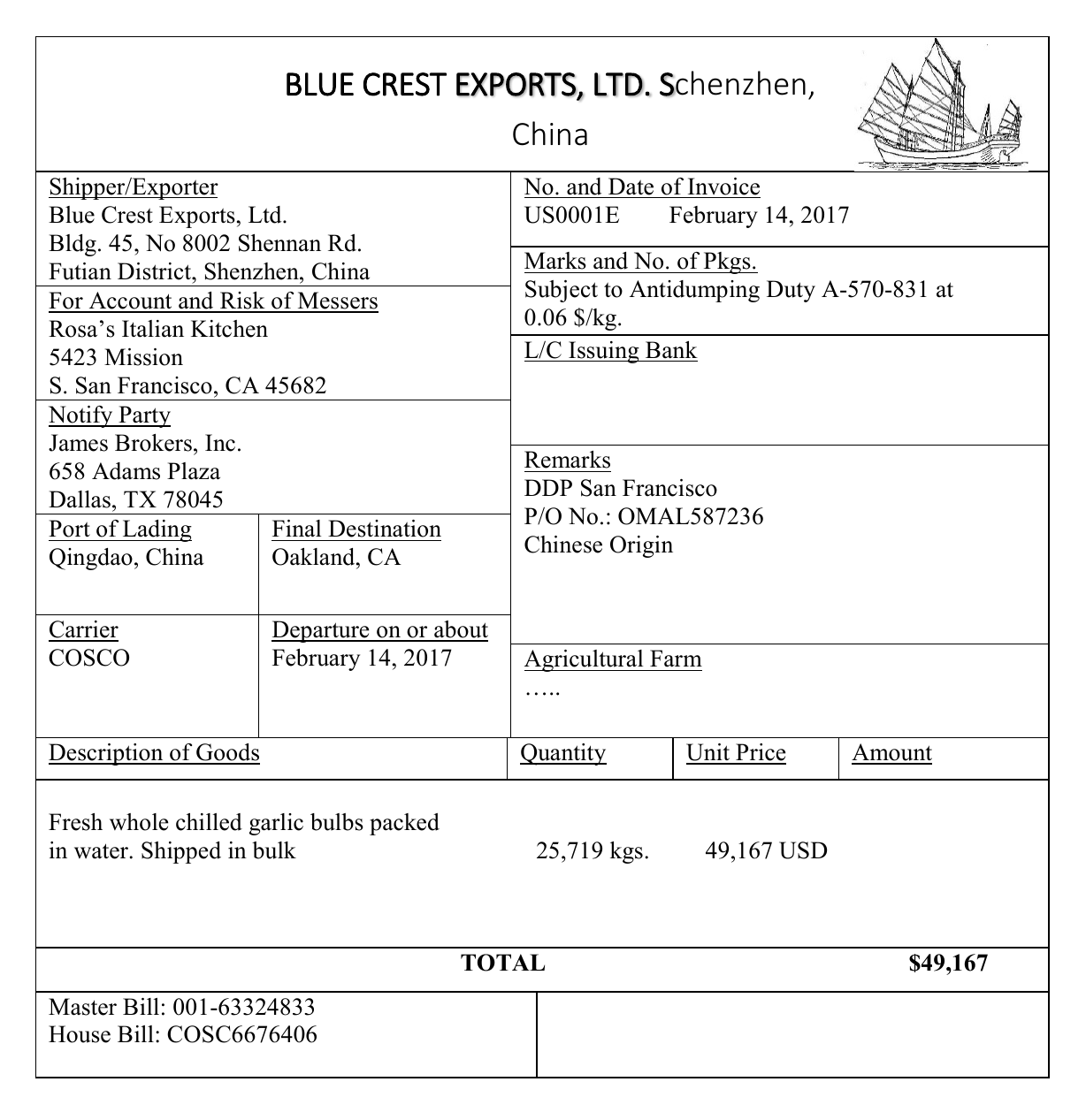
What is the CLASSIFICATION of the imported merchandise?
Exhibit — the document this question is answered from
Text version
BLUE CREST EXPORTS, LTD. Schenzhen, China Shipper/Exporter Blue Crest Exports, Ltd. Bldg. 45, No 8002 Shennan Rd. Futian District, Shenzhen, China For Account and Risk of Messers Rosa’s Italian Kitchen 5423 Mission S. San Francisco, CA 45682 Notify Party James Brokers, Inc. 658 Adams Plaza Dallas, TX 78045 Port of Lading Final Destination Qingdao, China Oakland, CA Carrier COSCO No. and Date of Invoice US0001E February 14, 2017 Marks and No. of Pkgs. Subject to Antidumping Duty A-570-831 at 0.06 $/kg. L/C Issuing Bank Remarks DDP San Francisco P/O No.: OMAL587236 Chinese Origin Departure on or about February 14, 2017 Agricultural Farm ….. Description of Goods Quantity Fresh whole chilled garlic bulbs packed in water. Shipped in bulk 25,719 kgs.
TOTAL
Master Bill: 001-63324833 House Bill: COSC6676406 Unit Price Amount 49,167 USD $49,167
A 0703.20.0015
B 0703.20.0020
C 0703.20.0090
D 0712.90.4040
E 2005.99.9700
Show the official answer
Answer: A — 0703.20.0015
CBP's official answer: A
The answer key gives the controlling authority as HTSUS 0703.20.0015.
Why there is no walkthrough here
This question is from the April 2018 exam, which was sat against the 2017 Basic Edition HTSUS and the 2016 or 2017 Annual Edition of Title 19 CFR. We check every walkthrough against the references we hold — the editions designated for the current sitting — and for this question we could not confirm the official answer from that text closely enough to walk you through it honestly.
The likely reason is edition drift rather than a mistake by anyone: tariff subheadings are split and renumbered between HTSUS editions, General Notes are re-lettered, and rates change every year. The answer was right for its exam. It may not be right today.
Use this question for the reasoning, not the number. The structure of the problem is still exactly what the current exam tests; the specific code or figure should be re-derived from the current tariff.
The port code to be identified in Block 20 of CBP Form 7501 is _______.
Exhibit — the document this question is answered from
Text version
BLUE CREST EXPORTS, LTD. Schenzhen, China Shipper/Exporter Blue Crest Exports, Ltd. Bldg. 45, No 8002 Shennan Rd. Futian District, Shenzhen, China For Account and Risk of Messers Rosa’s Italian Kitchen 5423 Mission S. San Francisco, CA 45682 Notify Party James Brokers, Inc. 658 Adams Plaza Dallas, TX 78045 Port of Lading Final Destination Qingdao, China Oakland, CA Carrier COSCO No. and Date of Invoice US0001E February 14, 2017 Marks and No. of Pkgs. Subject to Antidumping Duty A-570-831 at 0.06 $/kg. L/C Issuing Bank Remarks DDP San Francisco P/O No.: OMAL587236 Chinese Origin Departure on or about February 14, 2017 Agricultural Farm ….. Description of Goods Quantity Fresh whole chilled garlic bulbs packed in water. Shipped in bulk 25,719 kgs.
TOTAL
Master Bill: 001-63324833 House Bill: COSC6676406 Unit Price Amount 49,167 USD $49,167
A 0901
B 1808
C 2811
D 3881
E 5501
Show the official answer
Answer: C — 2811
CBP Form 7501 – Block 20: Port Code
Correct Answer: C. 2811
What is Block 20?
Block 20 of CBP Form 7501 (Entry Summary) requires the U.S. Port of Entry code — a four-digit numeric code identifying the CBP port through which the merchandise entered the United States.
How Port Codes Work
CBP port codes are standardized four-digit codes where:
The first two digits identify the CBP district
The last two digits identify the specific port within that district
Common examples:
2811 = El Paso, Texas (District 28, Port 11)
0901 = Portland, Maine area
1808 = a port in the Chicago/Great Lakes district
3881 = a port in the Los Angeles district
5501 = a port in the Honolulu district
Why C (2811) is Correct
In the context of this practical exercise, the scenario designates El Paso, TX (port code 2811) as the port of entry. This four-digit code must be entered exactly in Block 20 of the CBP Form 7501. The port code is determined by the actual port where CBP processes the entry, as specified in the exercise's fact pattern.
Why the Closest Distractor is Wrong
Option D (3881) — Los Angeles/Long Beach area — is a common distractor because it is one of the busiest U.S. ports and frequently appears in exam scenarios. However, without the scenario specifying that port, entering 3881 would be incorrect. Port codes are not interchangeable; each code is tied to a specific geographic location, and Block 20 must reflect the actual port of arrival stated in the entry documents.
Key Rule
Block 20 must contain the correct 4-digit CBP port code for the port where the goods entered. Using the wrong port code constitutes an entry error and can result in liquidation issues or penalties under 19 CFR Part 142 (entry of merchandise).
Tip: On the exam, always match the port code to the city/location named in the scenario's fact pattern. The code 2811 = El Paso, TX is a frequently tested port code.
Find it fast: In the reference viewer, search '7501' to locate CBP Form 7501 instructions, then search 'Block 20' or 'port code' to jump directly to the port-of-entry field description. For Schedule D port codes, search '2811' or 'El Paso' to verify the code.
The amount of the harbor maintenance and merchandise processing fees is _____.
Exhibit — the document this question is answered from
Text version
BLUE CREST EXPORTS, LTD. Schenzhen, China Shipper/Exporter Blue Crest Exports, Ltd. Bldg. 45, No 8002 Shennan Rd. Futian District, Shenzhen, China For Account and Risk of Messers Rosa’s Italian Kitchen 5423 Mission S. San Francisco, CA 45682 Notify Party James Brokers, Inc. 658 Adams Plaza Dallas, TX 78045 Port of Lading Final Destination Qingdao, China Oakland, CA Carrier COSCO No. and Date of Invoice US0001E February 14, 2017 Marks and No. of Pkgs. Subject to Antidumping Duty A-570-831 at 0.06 $/kg. L/C Issuing Bank Remarks DDP San Francisco P/O No.: OMAL587236 Chinese Origin Departure on or about February 14, 2017 Agricultural Farm ….. Description of Goods Quantity Fresh whole chilled garlic bulbs packed in water. Shipped in bulk 25,719 kgs.
TOTAL
Master Bill: 001-63324833 House Bill: COSC6676406 Unit Price Amount 49,167 USD $49,167
A $61.46
B $86.46
C $103.25
D $231.77
E $340.62
Show the official answer
Answer: D — $231.77
The worked walkthrough for this one — why the right answer is right, why each distractor fails, and where to find it in the crippled viewer — comes with the pass.
The amount of the duty due to U.S. Customs and Border Protection is _____________.
Exhibit — the document this question is answered from
Text version
BLUE CREST EXPORTS, LTD. Schenzhen, China Shipper/Exporter Blue Crest Exports, Ltd. Bldg. 45, No 8002 Shennan Rd. Futian District, Shenzhen, China For Account and Risk of Messers Rosa’s Italian Kitchen 5423 Mission S. San Francisco, CA 45682 Notify Party James Brokers, Inc. 658 Adams Plaza Dallas, TX 78045 Port of Lading Final Destination Qingdao, China Oakland, CA Carrier COSCO No. and Date of Invoice US0001E February 14, 2017 Marks and No. of Pkgs. Subject to Antidumping Duty A-570-831 at 0.06 $/kg. L/C Issuing Bank Remarks DDP San Francisco P/O No.: OMAL587236 Chinese Origin Departure on or about February 14, 2017 Agricultural Farm ….. Description of Goods Quantity Fresh whole chilled garlic bulbs packed in water. Shipped in bulk 25,719 kgs.
TOTAL
Master Bill: 001-63324833 House Bill: COSC6676406 Unit Price Amount 49,167 USD $49,167
A $110.59
B $342.36
C $5506.70
D $11059.17
E $14651.77
Show the official answer
Answer: A — $110.59
The worked walkthrough for this one — why the right answer is right, why each distractor fails, and where to find it in the crippled viewer — comes with the pass. The citation above is the source it’s built on; you can read it yourself in our 19 CFR navigator.
Exhibit — the document this question is answered from
Text version
BLUE CREST EXPORTS, LTD. Schenzhen, China Shipper/Exporter Blue Crest Exports, Ltd. Bldg. 45, No 8002 Shennan Rd. Futian District, Shenzhen, China For Account and Risk of Messers Rosa’s Italian Kitchen 5423 Mission S. San Francisco, CA 45682 Notify Party James Brokers, Inc. 658 Adams Plaza Dallas, TX 78045 Port of Lading Final Destination Qingdao, China Oakland, CA Carrier COSCO No. and Date of Invoice US0001E February 14, 2017 Marks and No. of Pkgs. Subject to Antidumping Duty A-570-831 at 0.06 $/kg. L/C Issuing Bank Remarks DDP San Francisco P/O No.: OMAL587236 Chinese Origin Departure on or about February 14, 2017 Agricultural Farm ….. Description of Goods Quantity Fresh whole chilled garlic bulbs packed in water. Shipped in bulk 25,719 kgs.
TOTAL
Master Bill: 001-63324833 House Bill: COSC6676406 Unit Price Amount 49,167 USD $49,167
A $15.43
B $1,543.14
C $1824.04
D $2950.02
E $3402.01
Show the official answer
Answer: B — $1,543.14
CBP's official answer: B
The answer key gives no citation for this question.
Why there is no walkthrough here
This question is from the April 2018 exam, which was sat against the 2017 Basic Edition HTSUS and the 2016 or 2017 Annual Edition of Title 19 CFR. We check every walkthrough against the references we hold — the editions designated for the current sitting — and for this question we could not confirm the official answer from that text closely enough to walk you through it honestly.
The answer key gives no citation for this one, so we cannot tell whether the underlying text has moved since the exam or our verifier simply could not locate it. Treat CBP's answer as correct for its exam and confirm it against the current references before relying on it.
Prep of 7501 Instructions (Block 17) · 19 CFR 141.69(b)
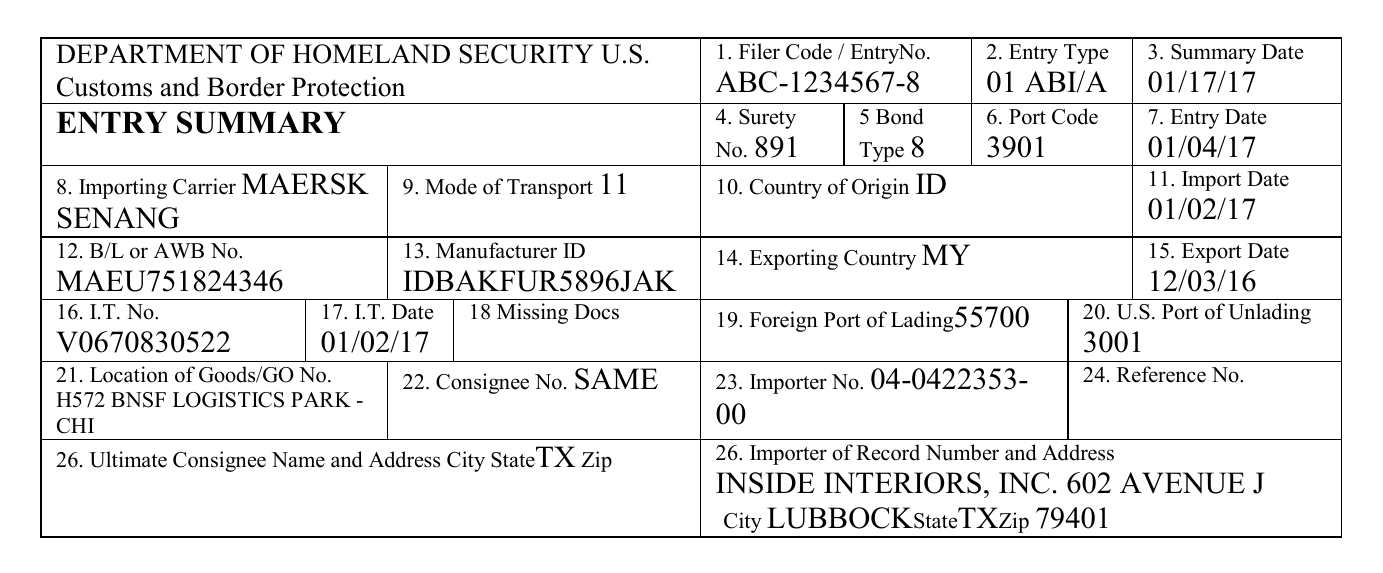
Which date is used for calculating the applicable rate of duty?
Exhibit — the document this question is answered from
Text version
DEPARTMENT OF HOMELAND SECURITY U.S. Customs and Border Protection
1. Filer Code / EntryNo.
2. Entry Type ABC-1234567-8 01 ABI/A 01/17/17 ENTRY SUMMARY
4. Surety No. 891
6. Port Code
7. Entry Date 3901 01/04/17
8. Importing Carrier MAERSK 5 Bond Type 8
9. Mode of Transport 11
10. Country of Origin ID
12. B/L or AWB No.
13. Manufacturer ID MAEU751824346 IDBAKFUR5896JAK
14. Exporting Country MY
11. Import Date 01/02/17 SENANG
16. I.T. No.
17. I.T. Date V0670830522 01/02/17
21. Location of Goods/GO No. H572 BNSF LOGISTICS PARK CHI 18 Missing Docs
19. Foreign Port of Lading55700
22. Consignee No. SAME
23. Importer No. 04-0422353-
26. Ultimate Consignee Name and Address City StateTX Zip
3. Summary Date
15. Export Date 12/03/16
20. U.S. Port of Unlading 3001
24. Reference No. 00
26. Importer of Record Number and Address INSIDE INTERIORS, INC. 602 AVENUE J City LUBBOCKStateTXZip 79401
A Export
B Import
C Entry
D Entry Summary
E Immediate Transportation
Show the official answer
Answer: E — Immediate Transportation
CBP's official answer: E
The answer key gives the controlling authority as Prep of 7501 Instructions (Block 17) · 19 CFR 141.69(b).
Why there is no walkthrough here
This question is from the April 2018 exam, which was sat against the 2017 Basic Edition HTSUS and the 2016 or 2017 Annual Edition of Title 19 CFR. We check every walkthrough against the references we hold — the editions designated for the current sitting — and for this question we could not confirm the official answer from that text closely enough to walk you through it honestly.
This one does not turn on a tariff number, so the answer has most likely not changed. The cited text is either not in the corpus we check against, or is there in a form our verifier could not match to the answer. We would rather show you CBP's answer with that caveat than invent a walkthrough.
Read the cited source yourself. They are short, and confirming the answer from the text is the same exercise the exam asks of you.
Prep of 7501 Instructions (Block 39 – “Other Fee Summary”
Block 39 of CBP Form 7501 should reflect which Fee Class Code?
Exhibit — the document this question is answered from
Text version
DEPARTMENT OF HOMELAND SECURITY U.S. Customs and Border Protection
1. Filer Code / EntryNo.
2. Entry Type ABC-1234567-8 01 ABI/A 01/17/17 ENTRY SUMMARY
4. Surety No. 891
6. Port Code
7. Entry Date 3901 01/04/17
8. Importing Carrier MAERSK 5 Bond Type 8
9. Mode of Transport 11
10. Country of Origin ID
12. B/L or AWB No.
13. Manufacturer ID MAEU751824346 IDBAKFUR5896JAK
14. Exporting Country MY
11. Import Date 01/02/17 SENANG
16. I.T. No.
17. I.T. Date V0670830522 01/02/17
21. Location of Goods/GO No. H572 BNSF LOGISTICS PARK CHI 18 Missing Docs
19. Foreign Port of Lading55700
22. Consignee No. SAME
23. Importer No. 04-0422353-
26. Ultimate Consignee Name and Address City StateTX Zip
3. Summary Date
15. Export Date 12/03/16
20. U.S. Port of Unlading 3001
24. Reference No. 00
26. Importer of Record Number and Address INSIDE INTERIORS, INC. 602 AVENUE J City LUBBOCKStateTXZip 79401
A 012
B 013
C 311
D 501
E 610
Show the official answer
Answer: D — 501
CBP's official answer: D
The answer key gives the controlling authority as Prep of 7501 Instructions (Block 39 – “Other Fee Summary”.
Why there is no walkthrough here
This question is from the April 2018 exam, which was sat against the 2017 Basic Edition HTSUS and the 2016 or 2017 Annual Edition of Title 19 CFR. We check every walkthrough against the references we hold — the editions designated for the current sitting — and for this question we could not confirm the official answer from that text closely enough to walk you through it honestly.
This one does not turn on a tariff number, so the answer has most likely not changed. The cited text is either not in the corpus we check against, or is there in a form our verifier could not match to the answer. We would rather show you CBP's answer with that caveat than invent a walkthrough.
Read the cited source yourself. It is short, and confirming the answer from the text is the same exercise the exam asks of you.
Exhibit — the document this question is answered from
Text version
DEPARTMENT OF HOMELAND SECURITY U.S. Customs and Border Protection
1. Filer Code / EntryNo.
2. Entry Type ABC-1234567-8 01 ABI/A 01/17/17 ENTRY SUMMARY
4. Surety No. 891
6. Port Code
7. Entry Date 3901 01/04/17
8. Importing Carrier MAERSK 5 Bond Type 8
9. Mode of Transport 11
10. Country of Origin ID
12. B/L or AWB No.
13. Manufacturer ID MAEU751824346 IDBAKFUR5896JAK
14. Exporting Country MY
11. Import Date 01/02/17 SENANG
16. I.T. No.
17. I.T. Date V0670830522 01/02/17
21. Location of Goods/GO No. H572 BNSF LOGISTICS PARK CHI 18 Missing Docs
19. Foreign Port of Lading55700
22. Consignee No. SAME
23. Importer No. 04-0422353-
26. Ultimate Consignee Name and Address City StateTX Zip
3. Summary Date
15. Export Date 12/03/16
20. U.S. Port of Unlading 3001
24. Reference No. 00
26. Importer of Record Number and Address INSIDE INTERIORS, INC. 602 AVENUE J City LUBBOCKStateTXZip 79401
A Extruded rubber thread from Malaysia that is subject to an antidumping duty
B Oil circular tubular goods from Indonesia subject to a countervailing duty
C Tuna caught in Indonesian waters that is subject to a tariff rate quota
D Women’s apparel that is placed in a foreign trade zone
E Wooden bedroom furniture from Indonesia
Show the official answer
Answer: E — Wooden bedroom furniture from Indonesia
CBP's official answer: E
The answer key gives the controlling authority as CBP Form 7501 Instructions at Block 2 Narrative.
Why there is no walkthrough here
This question is from the April 2018 exam, which was sat against the 2017 Basic Edition HTSUS and the 2016 or 2017 Annual Edition of Title 19 CFR. We check every walkthrough against the references we hold — the editions designated for the current sitting — and for this question we could not confirm the official answer from that text closely enough to walk you through it honestly.
This one does not turn on a tariff number, so the answer has most likely not changed. The cited text is either not in the corpus we check against, or is there in a form our verifier could not match to the answer. We would rather show you CBP's answer with that caveat than invent a walkthrough.
Read the cited source yourself. It is short, and confirming the answer from the text is the same exercise the exam asks of you.
If CBP believes that acceptance of an antidumping entry secured by a continuous bond would place the revenue in jeopardy or otherwise hamper the enforcement of applicable laws or regulations, CBP shall require additional security pursuant to_______________.
A 19 CFR 151.65
B 19 CFR 113.13(d)
C 19 CFR 152.101(3)
D 19 CFR 351.203(a)
E 19 CFR 351.205(b)(1)
Show the official answer
Answer: B — 19 CFR 113.13(d)
The worked walkthrough for this one — why the right answer is right, why each distractor fails, and where to find it in the crippled viewer — comes with the pass. The citation above is the source it’s built on; you can read it yourself in our 19 CFR navigator.
The determination of the applicable AD/CVD investigations or orders is governed by the “time of entry” according to which:
A 19 CFR 142.3
B 19 CFR 141.0(a)
C 19 CFR 159.10
D 19 CFR 141.68
E 19 CFR 132.4
Show the official answer
Answer: D — 19 CFR 141.68
CBP's official answer: D
The answer key gives the controlling authority as 19 CFR 141.68 · 19 CFR 151.69.
Why there is no walkthrough here
This question is from the April 2018 exam, which was sat against the 2017 Basic Edition HTSUS and the 2016 or 2017 Annual Edition of Title 19 CFR. We check every walkthrough against the references we hold — the editions designated for the current sitting — and for this question we could not confirm the official answer from that text closely enough to walk you through it honestly.
This one does not turn on a tariff number, so the answer has most likely not changed. The cited text is either not in the corpus we check against, or is there in a form our verifier could not match to the answer. We would rather show you CBP's answer with that caveat than invent a walkthrough.
Read the cited source yourself. They are short, and confirming the answer from the text is the same exercise the exam asks of you.
Company A imported seven ball bearings with integral shafts from Germany, which are classified under subheading 8482.10.1080, Harmonized Tariff Schedule of the United States, at a 2.4 percent ad valorem duty rate and are subject to antidumping duties. The ball bearings are shipped by air and formally entered at John F. Kennedy International Airport. The total value of the shipment is $5,798.00. The applicable antidumping duty cash deposit rate is 68.89 percent. What are the total amount of fees and estimated duties that should be reported on CBP Form 7501?
A $4,019.24
B $3,994.24
C $4133.39
D $4,158.39
E $164.15
Show the official answer
Answer: D — $4,158.39
The worked walkthrough for this one — why the right answer is right, why each distractor fails, and where to find it in the crippled viewer — comes with the pass. The citation above is the source it’s built on; you can read it yourself in our 19 CFR navigator.
Absolute Quota merchandise imported in excess of the admissible quantity must be disposed of using an approved method. Which of the following is not an approved method of disposal?
A Place into a Foreign Trade Zone, until the next quota opening period
B Enter into a Warehouse, until the next quota opening period
C Enter into the U. S. Commerce
D Exported under Customs supervision
E Destroyed under Customs supervision
Show the official answer
Answer: C — Enter into the U. S. Commerce
The worked walkthrough for this one — why the right answer is right, why each distractor fails, and where to find it in the crippled viewer — comes with the pass. The citation above is the source it’s built on; you can read it yourself in our 19 CFR navigator.
Which part of 19 CFR addresses Inspection, Search, and Seizure?
A 112
B 128
C 133
D 134
E 162
Show the official answer
Answer: E — 162
The worked walkthrough for this one — why the right answer is right, why each distractor fails, and where to find it in the crippled viewer — comes with the pass. The citation above is the source it’s built on; you can read it yourself in our 19 CFR navigator.
Whenever goods subject to different rates of duty are so packed together that the quantity or value of each class of goods cannot be readily ascertained by customs officers by means sampling, verification of packing lists, or commercial settlement tests, then the commingled goods shall be subject to _________.
A the lowest rate of duty applicable to any part of the shipment
B the average rate of duty applicable to any part of the shipment
C the highest rate of duty applicable to any part of the shipment
D 10% the value of the shipment
E 100% the value of the shipment
Show the official answer
Answer: C — the highest rate of duty applicable to any part of the shipment
The worked walkthrough for this one — why the right answer is right, why each distractor fails, and where to find it in the crippled viewer — comes with the pass. The citation above is the source it’s built on; you can read it yourself in our 19 CFR navigator.
Under which situation below would HTSUS General Notes 3(e)(v) apply?
A Merchandise was exported from Houston, TX on December 30, 2014, and arrived in Panama City, Republic of Panama, on January 10, 2015. The merchandise was released by the Panamanian National Customs Authority and moved to the consignee’s warehouse where the sale was canceled by the purchaser. The merchandise was returned to the carrier and returned to Houston, TX on January 25, 2015.
B Merchandise was exported from Houston, TX on December 30, 2014, and arrived in Panama City, Republic of Panama, on January 10, 2015. The merchandise remained in possession of the carrier at the shipping terminal where the sale was canceled. The merchandise was returned to Houston, TX on February 20, 2015.
C Merchandise was exported from Houston, TX on December 30, 2014, and arrived in Panama City, Republic of Panama, on January 10, 2015. The merchandise remained in possession of the carrier at the shipping terminal where the sale was canceled. The merchandise was returned to Houston, TX on February 6, 2015.
D Merchandise was exported from Houston, TX on December 30, 2014, and arrived in Panama City, Republic of Panama, on January 10, 2015. The merchandise was released by the Panamanian National Customs Authority and delivered to the buyer at the buyer’s storage facility. The carrier realized that the wrong merchandise was delivered to the buyer and immediately notified the buyer of the error. The buyer returned the merchandise to the carrier with the original seal intact. The carrier shipped the merchandise back to Houston, TX on February 6, 2015.
E Merchandise was exported from Houston, TX on December 30, 2014, and arrived in Panama City, Republic of Panama, on January 10, 2015. The merchandise was held by Panamanian National Customs Authority and determined to be inadmissible into Panama. The container was returned by Panamanian Customs directly to the carrier and shipped back to Houston, TX on February 26, 2015.
Show the official answer
Answer: C — Merchandise was exported from Houston, TX on December 30, 2014, and arrived in Panama City, Republic of Panama, on January 10, 2015. The merchandise remained in possession of the carrier at the shipping terminal where the sale was canceled. The merchandise was returned to Houston, TX on February 6, 2015.
The worked walkthrough for this one — why the right answer is right, why each distractor fails, and where to find it in the crippled viewer — comes with the pass. The citation above is the source it’s built on; you can read it yourself in our 19 CFR navigator.
Loudspeakers mounted in an enclosure were previously exported from the U.S. to Canada for repairs. The repaired speakers are re-exported to the U.S. and the importer claims preferential treatment under the North American Free Trade Agreement. The speakers are classifiable under subheading 8518.21.00 of the Harmonized Tariff Schedule of the United States (HTSUS), dutiable at 2.4% ad valorem. The importer enters the speakers under subheading 9802.00.50, HTSUS and substantiates the claim. The speakers are appraised at $8,000.00 and the value of the repairs is $1,800.00. What is the consumption duty on this merchandise?
A $0.00
B $43.20
C $235.20
D $192.00
E $148.80
Show the official answer
Answer: B — $43.20
The worked walkthrough for this one — why the right answer is right, why each distractor fails, and where to find it in the crippled viewer — comes with the pass. The citation above is the source it’s built on; you can read it yourself in our 19 CFR navigator.
Customs Directive Right to Make Entry # 3530-002A § 2, 5.1, 5.5.1
A nominal consignee is unable to secure the services of a broker to make entry on his behalf. What option is available to the nominal consignee?
A He may make entry as the importer of record
B He may notify the purchaser of the goods to designate him as the importer of record
C He may serve as the ultimate consignee
D He may notify the owner or the purchaser to designate a licensed Customs broker to make entry
E He may secure the permission of the actual owner of the goods to be importer of record
Show the official answer
Answer: D — He may notify the owner or the purchaser to designate a licensed Customs broker to make entry
The worked walkthrough for this one — why the right answer is right, why each distractor fails, and where to find it in the crippled viewer — comes with the pass. The citation above is the source it’s built on; you can read it yourself in our 19 CFR navigator.
Which of the following is eligible for informal entry?
A Shipments of commercial merchandise valued between $3,000 and $9,500
B Personal effects not exceeding $2,500 in value of citizens who have died abroad.
C An open container of 100 cigars for personal use by, and in the possession of, a crewmember upon arrival of the vessel
D Antique 1940s furniture shipped from Italy, valued at $10,000
E Household effects used abroad and imported in pursuance of an agreement for purchase.
Show the official answer
Answer: B — Personal effects not exceeding $2,500 in value of citizens who have died abroad.
The worked walkthrough for this one — why the right answer is right, why each distractor fails, and where to find it in the crippled viewer — comes with the pass. The citation above is the source it’s built on; you can read it yourself in our 19 CFR navigator.
19 CFR 145.38 & 145.1, 145.2, 145.37(c) and 145.40
Which of the following mail articles are not subject to examination or inspection by Customs?
A Bona-fide gifts with an aggregate fair retail value not exceeding $800 in the country of shipment
B Mail packages addressed to officials of the U.S. Government containing merchandise
C Diplomatic pouches bearing the official seal of France and certified as only containing documents
D Personal and household effects of military and civilian personnel returning to the United States upon the completion of extended duty abroad
E Plant material imported by mail for purposes of immediate exportation by mail
Show the official answer
Answer: C — Diplomatic pouches bearing the official seal of France and certified as only containing documents
The worked walkthrough for this one — why the right answer is right, why each distractor fails, and where to find it in the crippled viewer — comes with the pass. The citation above is the source it’s built on; you can read it yourself in our 19 CFR navigator.
Which of the following scenarios is NOT subject to NAFTA restrictions on the duty referral program?
A Qualifying imported metal-bearing materials placed in a bonded warehouse for smelting or refining that is processed and subsequently withdrawn for exportation to Canada or Mexico
B Merchandise imported from Chile and entered under subheading 9813.00.05 of the Harmonized Tariff Schedule of the United States (HTSUS) for repair, alteration and processing that is destined for exportation to Canada or Mexico
C Merchandise in domestic status that is withdrawn from a foreign trade zone for exportation to Canada or Mexico
D Merchandise in non-privileged foreign status that is withdrawn from a foreign trade zone for exportation to Canada or Mexico
E Merchandise in privileged foreign status that is withdrawn from a foreign trade zone for exportation to Canada or Mexico
Show the official answer
Answer: C — Merchandise in domestic status that is withdrawn from a foreign trade zone for exportation to Canada or Mexico
CBP's official answer: C
The answer key gives the controlling authority as 19 CFR 181.53(a)(1)(ii), (b)(3)-(b)(5) · 19 CFR 146.43(a).
Why there is no walkthrough here
This question is from the April 2018 exam, which was sat against the 2017 Basic Edition HTSUS and the 2016 or 2017 Annual Edition of Title 19 CFR. We check every walkthrough against the references we hold — the editions designated for the current sitting — and for this question we could not confirm the official answer from that text closely enough to walk you through it honestly.
This one does not turn on a tariff number, so the answer has most likely not changed. The cited text is either not in the corpus we check against, or is there in a form our verifier could not match to the answer. We would rather show you CBP's answer with that caveat than invent a walkthrough.
Read the cited source yourself. They are short, and confirming the answer from the text is the same exercise the exam asks of you.
A Articles exported from the United States which are returned within 45 days after such exportation from the United States as undeliverable and which have not left the custody of the carrier or foreign customs service
B Articles exported from the United States which are returned within 90 days after such exportation from the United States as undeliverable and which have not left the custody of the carrier or foreign customs service
C An individual shipment valued at $1,000
D Flowers shipped to the United States for funeral homes
E An informal mail entry, not exceeding $2,500 in value
Show the official answer
Answer: A — Articles exported from the United States which are returned within 45 days after such exportation from the United States as undeliverable and which have not left the custody of the carrier or foreign customs service
CBP's official answer: A
The answer key gives the controlling authority as HTSUS General Note 1 & 3 · 19 CFR 128.24(e) · 19 CFR 145.12(b)(2) · 19 CFR 10.151 · 19 CFR 10.153.
Why there is no walkthrough here
This question is from the April 2018 exam, which was sat against the 2017 Basic Edition HTSUS and the 2016 or 2017 Annual Edition of Title 19 CFR. We check every walkthrough against the references we hold — the editions designated for the current sitting — and for this question we could not confirm the official answer from that text closely enough to walk you through it honestly.
The likely reason is edition drift rather than a mistake by anyone: tariff subheadings are split and renumbered between HTSUS editions, General Notes are re-lettered, and rates change every year. The answer was right for its exam. It may not be right today.
Use this question for the reasoning, not the number. The structure of the problem is still exactly what the current exam tests; the specific code or figure should be re-derived from the current tariff.
What is the CLASSIFICATION for a lace-trimmed bed sheet made from printed, nonnapped 55% cotton and 45% polyester woven fabric?
A 6302.10.0008
B 6302.21.3020
C 6302.21.5020
D 6302.21.9020
E 6302.31.5020
Show the official answer
Answer: C — 6302.21.5020
The worked walkthrough for this one — why the right answer is right, why each distractor fails, and where to find it in the crippled viewer — comes with the pass. The citation above is the source it’s built on; you can read it yourself in our 19 CFR navigator.
What is the CLASSIFICATION of a men’s sweater vest constructed of 50% polyester, 50% cotton, knit fabric, the outer surface of which measures 8 stitches per 2 centimeters in the direction the stitches were formed?
A 6110.20.2010
B 6110.20.2030
C 6110.30.3010
D 6110.30.3030
E 6211.33.9054
Show the official answer
Answer: C — 6110.30.3010
CBP's official answer: C
The answer key gives the controlling authority as HTSUS 6110.30.3010 · Note 2(a) · HTSUS Section XI · Subheading Note 2(A) · HTSUS Chapter 61 · Statistical Note 3 and HTSUS Chapter 62.
Why there is no walkthrough here
This question is from the April 2018 exam, which was sat against the 2017 Basic Edition HTSUS and the 2016 or 2017 Annual Edition of Title 19 CFR. We check every walkthrough against the references we hold — the editions designated for the current sitting — and for this question we could not confirm the official answer from that text closely enough to walk you through it honestly.
The likely reason is edition drift rather than a mistake by anyone: tariff subheadings are split and renumbered between HTSUS editions, General Notes are re-lettered, and rates change every year. The answer was right for its exam. It may not be right today.
Use this question for the reasoning, not the number. The structure of the problem is still exactly what the current exam tests; the specific code or figure should be re-derived from the current tariff.
What is the CLASSIFICIATION of glazed ceramic mosaic cubes on a mesh backing which measure approximately 1 centimeter wide by 1 centimeter long by 1 centimeter thick, and have a water absorption coefficient by weight of .3 percent?
A 6802.10.0000
B 6907.21.2000
C 6907.21.3000
D 6907.30.3000
E 6914.10.8000
Show the official answer
Answer: D — 6907.30.3000
CBP's official answer: D
The answer key gives the controlling authority as HTSUS 6907.30.3000 · HTSUS Note 1 to Chapter 69 · HTSUS 6907.21.
Why there is no walkthrough here
This question is from the April 2018 exam, which was sat against the 2017 Basic Edition HTSUS and the 2016 or 2017 Annual Edition of Title 19 CFR. We check every walkthrough against the references we hold — the editions designated for the current sitting — and for this question we could not confirm the official answer from that text closely enough to walk you through it honestly.
The likely reason is edition drift rather than a mistake by anyone: tariff subheadings are split and renumbered between HTSUS editions, General Notes are re-lettered, and rates change every year. The answer was right for its exam. It may not be right today.
Use this question for the reasoning, not the number. The structure of the problem is still exactly what the current exam tests; the specific code or figure should be re-derived from the current tariff.
HTSUS 4911.91.3000 · HTSUS Additional U.S. Note 1 to Chapter 49 and HTSUS Note 2 to Chapter 97
What is the CLASSIFICATION of current-production wall art depicting abstract flowers and birds that is mechanically printed, via lithography, onto sheets of paper, the paper measuring .35 mm in thickness that have been permanently mounted onto a backing of .50 mm thick paperboard?
A 4911.91.2040
B 4911.91.3000
C 4911.99.6000
D 9701.10.0000
E 9702.00.0000
Show the official answer
Answer: B — 4911.91.3000
The worked walkthrough for this one — why the right answer is right, why each distractor fails, and where to find it in the crippled viewer — comes with the pass. The citation above is the source it’s built on; you can read it yourself in our 19 CFR navigator.
HTSUS 4202.92.0807 · HTSUS Additional U.S. Note 2 to Chapter 42 and HTSUS Note 2(m) to Chapter 39
Company XYZ plans to import an insulated cooler bag constructed with an exterior surface of textile material that is 55 percent nylon and 45 percent polyester, of man-made fibers. The bag features a fabric strap and a top zipper closure around three sides. The interior of the bag is lined with a waterproof plastic sheeting material and has a mesh pocket on one interior wall to hold a can or bottle in place. The bag is designed to maintain the temperature of food and beverages during travel. What is the CLASSIFICATION for the insulated cooler bag?
A 3923.29.0000
B 4202.92.0807
C 4202.92.1000
D 4202.92.4500
E 6307.90.9889
Show the official answer
Answer: B — 4202.92.0807
CBP's official answer: B
The answer key gives the controlling authority as HTSUS 4202.92.0807 · HTSUS Additional U.S. Note 2 to Chapter 42 and HTSUS Note 2(m) to Chapter 39.
Why there is no walkthrough here
This question is from the April 2018 exam, which was sat against the 2017 Basic Edition HTSUS and the 2016 or 2017 Annual Edition of Title 19 CFR. We check every walkthrough against the references we hold — the editions designated for the current sitting — and for this question we could not confirm the official answer from that text closely enough to walk you through it honestly.
The likely reason is edition drift rather than a mistake by anyone: tariff subheadings are split and renumbered between HTSUS editions, General Notes are re-lettered, and rates change every year. The answer was right for its exam. It may not be right today.
Use this question for the reasoning, not the number. The structure of the problem is still exactly what the current exam tests; the specific code or figure should be re-derived from the current tariff.
What is the correct CLASSIFICATION of 1 kilogram of peanuts, not roasted or cooked, in the shell from Brazil imported for personal use to make peanut butter?
A 1202.30.0500
B 1202.41.0540
C 1207.10.0000
D 2008.11.0200
E 2008.11.4200
Show the official answer
Answer: B — 1202.41.0540
CBP's official answer: B
The answer key gives the controlling authority as HTSUS 1202.41.0540 · General Note 15(b).
Why there is no walkthrough here
This question is from the April 2018 exam, which was sat against the 2017 Basic Edition HTSUS and the 2016 or 2017 Annual Edition of Title 19 CFR. We check every walkthrough against the references we hold — the editions designated for the current sitting — and for this question we could not confirm the official answer from that text closely enough to walk you through it honestly.
The likely reason is edition drift rather than a mistake by anyone: tariff subheadings are split and renumbered between HTSUS editions, General Notes are re-lettered, and rates change every year. The answer was right for its exam. It may not be right today.
Use this question for the reasoning, not the number. The structure of the problem is still exactly what the current exam tests; the specific code or figure should be re-derived from the current tariff.
What is the CLASSIFICATION of full-sized, unshelled, frozen lima beans, of the Phaseolus genus, entered on June 10, 2017?
A 0708.20.1000
B 0708.20.9010
C 0710.22.1000
D 0710.22.1500
E 0713.39.2140
Show the official answer
Answer: D — 0710.22.1500
CBP's official answer: D
The answer key gives the controlling authority as HTSUS 0710.22.1500 · GRI 1.
Why there is no walkthrough here
This question is from the April 2018 exam, which was sat against the 2017 Basic Edition HTSUS and the 2016 or 2017 Annual Edition of Title 19 CFR. We check every walkthrough against the references we hold — the editions designated for the current sitting — and for this question we could not confirm the official answer from that text closely enough to walk you through it honestly.
The likely reason is edition drift rather than a mistake by anyone: tariff subheadings are split and renumbered between HTSUS editions, General Notes are re-lettered, and rates change every year. The answer was right for its exam. It may not be right today.
Use this question for the reasoning, not the number. The structure of the problem is still exactly what the current exam tests; the specific code or figure should be re-derived from the current tariff.
Which of the following is NOT a feature or requirement listed in the definition of recreational performance outerwear?
A Pockets with a zipper closure
B Reinforced knees
C Adjustable powder skirt
D Sealed inner leg seams
E Multi-adjustable hood
Show the official answer
Answer: D — Sealed inner leg seams
CBP's official answer: D
The answer key gives the controlling authority as Additional U.S. Note 3 to Chapter 62.
Why there is no walkthrough here
This question is from the April 2018 exam, which was sat against the 2017 Basic Edition HTSUS and the 2016 or 2017 Annual Edition of Title 19 CFR. We check every walkthrough against the references we hold — the editions designated for the current sitting — and for this question we could not confirm the official answer from that text closely enough to walk you through it honestly.
The likely reason is edition drift rather than a mistake by anyone: tariff subheadings are split and renumbered between HTSUS editions, General Notes are re-lettered, and rates change every year. The answer was right for its exam. It may not be right today.
Use this question for the reasoning, not the number. The structure of the problem is still exactly what the current exam tests; the specific code or figure should be re-derived from the current tariff.
HTSUS 6203.43.1190 · Additional U.S. Note 2 and 3 to Chapter 62 and Statistical Note 4 to Chapter 62
What is the CLASSIFICATION of a pair of boys’ 100% polyester trousers with the following features: water resistant within the meaning of Additional U.S. Note 2 to Chapter 62, critically sealed seams, hook and loop cargo pockets, outer leg vents, articulated knees, hidden elastic leg sleeve, and a weatherproof front zipper closure?
A 6203.43.0920
B 6203.43.1110
C 6203.43.1190
D 6203.43.7510
E 6203.43.7590
Show the official answer
Answer: C — 6203.43.1190
CBP's official answer: C
The answer key gives the controlling authority as HTSUS 6203.43.1190 · Additional U.S. Note 2 and 3 to Chapter 62 and Statistical Note 4 to Chapter 62.
Why there is no walkthrough here
This question is from the April 2018 exam, which was sat against the 2017 Basic Edition HTSUS and the 2016 or 2017 Annual Edition of Title 19 CFR. We check every walkthrough against the references we hold — the editions designated for the current sitting — and for this question we could not confirm the official answer from that text closely enough to walk you through it honestly.
The likely reason is edition drift rather than a mistake by anyone: tariff subheadings are split and renumbered between HTSUS editions, General Notes are re-lettered, and rates change every year. The answer was right for its exam. It may not be right today.
Use this question for the reasoning, not the number. The structure of the problem is still exactly what the current exam tests; the specific code or figure should be re-derived from the current tariff.
HTSUS 6911.10.2500 · Additional U.S. Note 5(b), 6(a) and 6(b) to Chapter 69
What is the CLASSIFICATION of a teacup that is made of a porcelain containing 28 percent of tricalcium phosphate, valued at $18, and offered for sale in the same pattern as all of the other articles listed in Additional U.S. Note 6(b) to Chapter 69, HTSUS, with the aggregate value of all those articles listed in that note being $900?
A 6911.10.2500
B 6911.10.3810
C 6911.10.5800
D 6911.10.8010
E 6912.00.4500
Show the official answer
Answer: A — 6911.10.2500
CBP's official answer: A
The answer key gives the controlling authority as HTSUS 6911.10.2500 · Additional U.S. Note 5(b), 6(a) and 6(b) to Chapter 69.
Why there is no walkthrough here
This question is from the April 2018 exam, which was sat against the 2017 Basic Edition HTSUS and the 2016 or 2017 Annual Edition of Title 19 CFR. We check every walkthrough against the references we hold — the editions designated for the current sitting — and for this question we could not confirm the official answer from that text closely enough to walk you through it honestly.
The likely reason is edition drift rather than a mistake by anyone: tariff subheadings are split and renumbered between HTSUS editions, General Notes are re-lettered, and rates change every year. The answer was right for its exam. It may not be right today.
Use this question for the reasoning, not the number. The structure of the problem is still exactly what the current exam tests; the specific code or figure should be re-derived from the current tariff.
The submitted sample, identified by the importer as “Zori-style # SF123,” is a pair of women’s, open-toe/open-heel, and flip-flop thong sandals with foamed rubber or plastic outer soles. The “V” shaped strap uppers consist of textile straps and thongs which go between the first and second toes. The upper straps and thongs are assembled to the soles by rubber/plastic plugs. The thickness of the outer soles of the sample measure 1.75 inches at the thickest point and 1.25 inches at the thinnest point. Rubber or plastics accounts for more than 10 percent total weight of the shoe. The F.O.B. value is $6.50 per pair. What is the CLASSIFICATION subheading, within the Harmonized Tariff Schedule of the United States (HTSUS), for these sandals?
A 6402.20.0000
B 6402.99.3165
C 6403.20.0000
D 6404.19.3960
E 6404.19.4260
Show the official answer
Answer: D — 6404.19.3960
CBP's official answer: D
The answer key gives the controlling authority as HTSUS 6404.19.3960.
Why there is no walkthrough here
This question is from the April 2018 exam, which was sat against the 2017 Basic Edition HTSUS and the 2016 or 2017 Annual Edition of Title 19 CFR. We check every walkthrough against the references we hold — the editions designated for the current sitting — and for this question we could not confirm the official answer from that text closely enough to walk you through it honestly.
The likely reason is edition drift rather than a mistake by anyone: tariff subheadings are split and renumbered between HTSUS editions, General Notes are re-lettered, and rates change every year. The answer was right for its exam. It may not be right today.
Use this question for the reasoning, not the number. The structure of the problem is still exactly what the current exam tests; the specific code or figure should be re-derived from the current tariff.
HTSUS 3808.92 · HTSUS Note 2 to Chapter 33 · HTSUS Note 1 to Chapter 29 and HTSUS Note 2 to Section VI
You have a mixture of the following chemical substances ((1,2-phenylene)bis(iminocarbonothioyl)) bis(carbamate) (CAS # 23564-05-8), and 30 percent other additives and dispersing agents. The main chemical ingredient listed is a fungicide, used to kill fungus on various plants. In its pure chemical form the main ingredient is an "Organo-sulfur compounds: Other: Aromatic: Pesticides of Heading 2930. The product is packaged for sale as imported for retail sale directly to consumers. In which of the following 6 digit subheadings would you classify the imported product described above?
A 2924.11
B 2930.90
C 3302.10
D 3808.92
E 3824.99
Show the official answer
Answer: D — 3808.92
The worked walkthrough for this one — why the right answer is right, why each distractor fails, and where to find it in the crippled viewer — comes with the pass. The citation above is the source it’s built on; you can read it yourself in our 19 CFR navigator.
What is the CLASSIFICATION of a mixture of an essential oil and odoriferous compounds obtained from extraction of peach pits, mixed with colorant, and not containing any alcohol, for use in the manufacturing of a soda type beverage?
A 1507.10.0000
B 1511.10.0000
C 1518.00.4000
D 3302.10.1000
E 3824.99.9295
Show the official answer
Answer: D — 3302.10.1000
The worked walkthrough for this one — why the right answer is right, why each distractor fails, and where to find it in the crippled viewer — comes with the pass. The citation above is the source it’s built on; you can read it yourself in our 19 CFR navigator.
What is the CLASSIFICATION of a work glove, made of a synthetic suede (a non-woven polyester fabric with the textile making up 85% of the weight and the plastic making up 15%)? The glove features fourchettes, thermo-plastic rubber attachments on the knuckles on the back side, rubber overlays on the palm side of the thumb, and a cuff with a hook and loop closure to tighten the glove at the wrist.
A 6116.10.7520
B 6216.00.2425
C 6216.00.2925
D 6216.00.5420
E 6216.00.5820
Show the official answer
Answer: E — 6216.00.5820
CBP's official answer: E
The answer key gives the controlling authority as HTSUS 6216.00.5820.
Why there is no walkthrough here
This question is from the April 2018 exam, which was sat against the 2017 Basic Edition HTSUS and the 2016 or 2017 Annual Edition of Title 19 CFR. We check every walkthrough against the references we hold — the editions designated for the current sitting — and for this question we could not confirm the official answer from that text closely enough to walk you through it honestly.
The likely reason is edition drift rather than a mistake by anyone: tariff subheadings are split and renumbered between HTSUS editions, General Notes are re-lettered, and rates change every year. The answer was right for its exam. It may not be right today.
Use this question for the reasoning, not the number. The structure of the problem is still exactly what the current exam tests; the specific code or figure should be re-derived from the current tariff.
What is the CLASSIFICATION of a floor-standing, coin-operated, shoe brushing/polishing machine used in public places such as hotels and airports, the user inserts the required monetary payment and places his/her foot onto the foot plate. Using rotating internal brushes powered by a self-contained electric motor, the machine automatically brushes/polishes the surface and both sides of the shoe. While waiting for the process to be completed, the user can view material posted on the machine’s advertising board. The process stops when (1) the user removes his/her foot or (2) the fixed brushing/polishing time is over.
A 8453.20.0000
B 8467.29.0035
C 8476.89.0000
D 8479.10.0080
E 8479.89.9499
Show the official answer
Answer: E — 8479.89.9499
The worked walkthrough for this one — why the right answer is right, why each distractor fails, and where to find it in the crippled viewer — comes with the pass. The citation above is the source it’s built on; you can read it yourself in our 19 CFR navigator.
A The price actually paid or payable for the merchandise
B The price actually paid or payable for the merchandise plus buying commissions, royalties, assists, packing costs and proceeds
C The price actually paid or payable for the merchandise plus selling commissions, royalties, assists, packing costs and proceeds
D The price actually paid or payable for the merchandise plus selling commissions, royalties, packing costs and U.S. inland freight
E The price actually paid or payable plus buying commissions, royalties, assists, packing and freight costs
Show the official answer
Answer: C — The price actually paid or payable for the merchandise plus selling commissions, royalties, assists, packing costs and proceeds
The worked walkthrough for this one — why the right answer is right, why each distractor fails, and where to find it in the crippled viewer — comes with the pass. The citation above is the source it’s built on; you can read it yourself in our 19 CFR navigator.
A U.S. importer and a foreign manufacturer enter into a contract for 500 wooden tables. In the contract, the manufacturer agrees to provide 500 tables at a price of $500 per table. The tables are to be delivered in lots of 100 tables on the first of each month for a period of five months. The importer provided the foreign manufacturer with an assist in the form of special tools. The tools were purchased from an unrelated party in Chicago, and delivered for free to the manufacturer abroad. The tools have a useful life of 500 tables. Several weeks later, the first shipment under the contract, which contains the first 100 tables, arrives in the United States. Which of the following methods of apportioning the assist is NOT acceptable?
A Apportion the entire value of the assist to the first 100-table shipment
B Apportion the value of the assist over the entire anticipated production
C Apportion the entire value of the assist to the second 100-table shipment when it arrives
D Apportion the value of the assist over the number of units produced up to the time of the first shipment
E Apportion the value of the assist in another manner in accordance with GAAP
Show the official answer
Answer: C — Apportion the entire value of the assist to the second 100-table shipment when it arrives
The worked walkthrough for this one — why the right answer is right, why each distractor fails, and where to find it in the crippled viewer — comes with the pass. The citation above is the source it’s built on; you can read it yourself in our 19 CFR navigator.
Your client is importing a used aircraft engine manufactured in England from a Canadian shipper. Your client has accepted the aircraft engine on consignment and has promised to find a US buyer for the engine. Your client will receive a commission on the sale of 5%. The asking price for the engine is $90,000. The shipper paid all of the transportation costs ($1,000) from its dock to your client’s dock on a through bill of lading. What is the entered value of the used aircraft engine?
A Under transaction value, the entered value of the aircraft engine is the asking price of $90,000
B Under transaction value, the dutiable value of the aircraft engine is the asking price of $90,000, minus the $1,000 transportation cost, plus the sales commission due the importer of $4,500 ($90,000x5%), or $93,500
C Under transaction value, the entered value of the aircraft engine is the asking price of $90,000, plus the $1,000 transportation cost, plus the sales commission due the importer of $4,500 ($90,000 x 5%), or $95,500
D Under transaction value, the entered value of the aircraft engine is the asking price of $90,000, minus the $1,000 transportation cost, minus the sales commission due the importer of $4,500 ($90,000 x 5%), or $84,500
E Transaction value cannot be used on a consignment shipment, the entered value of the aircraft engine cannot be determined under transaction value and one of the other bases of appraisement must be applied
Show the official answer
Answer: E — Transaction value cannot be used on a consignment shipment, the entered value of the aircraft engine cannot be determined under transaction value and one of the other bases of appraisement must be applied
The worked walkthrough for this one — why the right answer is right, why each distractor fails, and where to find it in the crippled viewer — comes with the pass. The citation above is the source it’s built on; you can read it yourself in our 19 CFR navigator.
HTSUS Ch. 9802 · Subchapter II · U.S. Note 3 (articles Returned for Repairs)”: HTSUS Chapter 9802 · Statistical Note 2
A shipment of Evaporative Air Coolers with a documented U.S. value of $100,000 was exported to Taiwan for $2000 in repairs, and then reimported into the U.S. Which of the following value(s) and classification(s) apply to the Evaporative Air Coolers?
A $98,000 under 9802.00.5060
B $102,000 under 8479.60.0000
C $100,000 under 8479.60.0000 and $2000 under 9802.00.5060
D $100,000 under 9802.00.5060 and $2000 under 8479.60.0000
E $102,000 under 9802.00.5060
Show the official answer
Answer: D — $100,000 under 9802.00.5060 and $2000 under 8479.60.0000
CBP's official answer: D
The answer key gives the controlling authority as HTSUS Ch. 9802 · Subchapter II · U.S. Note 3 (articles Returned for Repairs)”: HTSUS Chapter 9802 · Statistical Note 2.
Why there is no walkthrough here
This question is from the April 2018 exam, which was sat against the 2017 Basic Edition HTSUS and the 2016 or 2017 Annual Edition of Title 19 CFR. We check every walkthrough against the references we hold — the editions designated for the current sitting — and for this question we could not confirm the official answer from that text closely enough to walk you through it honestly.
The likely reason is edition drift rather than a mistake by anyone: tariff subheadings are split and renumbered between HTSUS editions, General Notes are re-lettered, and rates change every year. The answer was right for its exam. It may not be right today.
Use this question for the reasoning, not the number. The structure of the problem is still exactly what the current exam tests; the specific code or figure should be re-derived from the current tariff.
Seller S offers the following quantity discounts on the goods purchased by the importer prior to their importation. - 1 to 49 units - no discount - 50 to 99 units - 5% discount - Over 100 units - 10% discount In the first case, importer A purchases and imports 60 units in a single shipment. The invoice price reflects a 5% discount. In the second case, importer B purchases 60 units in a single transaction at a price which reflects a 5% discount but imports them in 3 separate shipments each comprising 20 units. What is the customs value of the imported merchandise in both cases?
A In both cases, the customs value is the price actually paid or payable for the imported goods reflecting a 5% discount.
B In the first case, the customs value is the price actually paid or payable for the imported goods reflecting a 5% discount. In the second case, the customs value is the price actually paid or payable for the imported goods reflecting no discounts.
C In both cases, the customs value is the price actually paid or payable for the imported goods reflecting a 10% discount.
D In the first case, the customs value is the price actually paid or payable for the imported goods reflecting a 5% discount. In the second case, the customs value is the price actually paid or payable for the imported goods reflecting a 10% discount.
E In both cases, the customs value is the price actually paid or payable for the imported goods reflecting no discounts.
Show the official answer
Answer: A — In both cases, the customs value is the price actually paid or payable for the imported goods reflecting a 5% discount.
The worked walkthrough for this one — why the right answer is right, why each distractor fails, and where to find it in the crippled viewer — comes with the pass. The citation above is the source it’s built on; you can read it yourself in our 19 CFR navigator.
The importer, Company A, imports 1,000 batteries from an unrelated overseas seller at a price of $0.50 CIF per battery. The overseas seller buys the batteries in bulk from an overseas manufacturer. Company A requires each battery to be individually wrapped in polythene with a cardboard backing for display at retail outlets in the United States. Company A provides the polythene and cardboard backing materials free of charge to the overseas seller. Company A obtains the materials from a supplier in the United States at a cost of $40 for the quantity required to wrap 1,000 batteries. The seller of the imported batteries arranges for an overseas packing company to carry out the wrapping/packing. This company charges the seller of the imported goods, $60 per 1,000 batteries for this service. The documents show that the total overseas freight and insurance costs totaled $10. What is the customs value in the United States for a shipment of 1,000 batteries?
A $530
B $500
C $600
D $540
E None of the above.
Show the official answer
Answer: A — $530
The worked walkthrough for this one — why the right answer is right, why each distractor fails, and where to find it in the crippled viewer — comes with the pass. The citation above is the source it’s built on; you can read it yourself in our 19 CFR navigator.
Which of the following documents is an acceptable proof of export for drawback purposes?
A Notice of Intent to Export
B Certificate of Delivery
C Certificate of Manufacture and Delivery
D Bill of lading with laden on board date
E Waiver of Prior Notice of Intent to Export
Show the official answer
Answer: D — Bill of lading with laden on board date
CBP's official answer: D
The answer key gives the controlling authority as 19 CFR 171.72.
Why there is no walkthrough here
This question is from the April 2018 exam, which was sat against the 2017 Basic Edition HTSUS and the 2016 or 2017 Annual Edition of Title 19 CFR. We check every walkthrough against the references we hold — the editions designated for the current sitting — and for this question we could not confirm the official answer from that text closely enough to walk you through it honestly.
This one does not turn on a tariff number, so the answer has most likely not changed. The cited text is either not in the corpus we check against, or is there in a form our verifier could not match to the answer. We would rather show you CBP's answer with that caveat than invent a walkthrough.
Read the cited source yourself. It is short, and confirming the answer from the text is the same exercise the exam asks of you.
When can a claimant amend an unliquidated drawback claim?
A Claims may be amended at any time provided the claim is unliquidated
B Within 90 days of the date the claim was received by CBP
C Within 180 days of the date the claim was received by CBP
D Within 3 years after the date of exportation or destruction of the articles which are the subject of the original drawback claim
E Within 5 years after the date of exportation or destruction of the articles which are the subject of the original drawback claim
Show the official answer
Answer: D — Within 3 years after the date of exportation or destruction of the articles which are the subject of the original drawback claim
CBP's official answer: D
The answer key gives the controlling authority as 19 CFR 191.52(c).
Why there is no walkthrough here
This question is from the April 2018 exam, which was sat against the 2017 Basic Edition HTSUS and the 2016 or 2017 Annual Edition of Title 19 CFR. We check every walkthrough against the references we hold — the editions designated for the current sitting — and for this question we could not confirm the official answer from that text closely enough to walk you through it honestly.
This one does not turn on a tariff number, so the answer has most likely not changed. The cited text is either not in the corpus we check against, or is there in a form our verifier could not match to the answer. We would rather show you CBP's answer with that caveat than invent a walkthrough.
Read the cited source yourself. It is short, and confirming the answer from the text is the same exercise the exam asks of you.
Based on the information below, what is the claimed amount for the merchandise processing fee (MPF) on an Unused Direct Identification 1313(j)(1) drawback claim?
Imported merchandise: 500 bikes ($200 per unit) $100,000 500 spare parts ($175 per unit) $87,500 Invoice value $187,500 Less Non-Dutiable Charges (NDC) -$2,500 Total Entered Value $185,000 Total MPF paid $485.00 MPF rate .3464%
Exported merchandise for drawback purposes: 200 bikes
A $103.47
B $102.43
C $138.56
D $137.17
E $480.15
Show the official answer
Answer: B — $102.43
The worked walkthrough for this one — why the right answer is right, why each distractor fails, and where to find it in the crippled viewer — comes with the pass. The citation above is the source it’s built on; you can read it yourself in our 19 CFR navigator.
What is the difference between restricted gray market goods and goods bearing counterfeit marks?
A There is no difference. Gray Market and counterfeit goods are considered the same.
B Gray Market goods are harder to distinguish than counterfeit goods.
C The seizure process is different between Gray Market and counterfeit goods.
D Gray Market goods bear a trademark or trade name which has been applied with the approval of the trademark owner as genuine and is recorded with Customs and Border Protection.
E Gray Market products are of lesser quality products just like counterfeit products.
Show the official answer
Answer: D — Gray Market goods bear a trademark or trade name which has been applied with the approval of the trademark owner as genuine and is recorded with Customs and Border Protection.
The worked walkthrough for this one — why the right answer is right, why each distractor fails, and where to find it in the crippled viewer — comes with the pass. The citation above is the source it’s built on; you can read it yourself in our 19 CFR navigator.
If imported merchandise is detained because CBP suspects it bears a counterfeit version of a mark that is registered with the U.S. Patent and Trademark Office and recorded with CBP, and the importer, upon written notification, does not provide information within seven days of such notification that establishes to CBP’s satisfaction that the suspect mark is not counterfeit, or provides information that is insufficient to establish that the suspect mark is not counterfeit, CBP may disclose to the right holder:
A The entry documents and a sample or digital images of the merchandise including serial numbers, dates of manufacture, lot codes, batch numbers, universal product codes or other identifying marks appearing on the merchandise or its retail packaging
B The names and addresses of the exporter and importer
C The entry documents and the name and address of the manufacturer
D A sample or digital images of the merchandise including serial numbers, dates of manufacture, lot codes, batch numbers, universal product codes or other identifying marks appearing on the merchandise or its retail packaging, but no entry documents
E All of the above
Show the official answer
Answer: D — A sample or digital images of the merchandise including serial numbers, dates of manufacture, lot codes, batch numbers, universal product codes or other identifying marks appearing on the merchandise or its retail packaging, but no entry documents
CBP's official answer: D
The answer key gives the controlling authority as 19 CFR 133.21(b)(1).
Why there is no walkthrough here
This question is from the April 2018 exam, which was sat against the 2017 Basic Edition HTSUS and the 2016 or 2017 Annual Edition of Title 19 CFR. We check every walkthrough against the references we hold — the editions designated for the current sitting — and for this question we could not confirm the official answer from that text closely enough to walk you through it honestly.
This one does not turn on a tariff number, so the answer has most likely not changed. The cited text is either not in the corpus we check against, or is there in a form our verifier could not match to the answer. We would rather show you CBP's answer with that caveat than invent a walkthrough.
Read the cited source yourself. It is short, and confirming the answer from the text is the same exercise the exam asks of you.
While examining your client’s shipment of 1,000 handbags at the container examination station, CBP discovered that the goods bear a mark suspected of infringing a trademark associated with a well-known designer. The designer’s mark is registered on the Principal Register of the U.S. Patent and Trademark Office and recorded with CBP. The suspect mark is not identical with or substantially indistinguishable from the registered and recorded mark; rather, CBP determines that it copies or simulates the registered and recorded mark and, consequently, detains the handbags. Which of the following options is available to the importer to obtain relief from detention within 30 days?
A The importer may remove or obliterate the suspect marks from the handbags in such a manner that they are incapable of being reconstituted
B The importer may label the merchandise with the following statement: “This product is not a product authorized by the United States trademark owner for importation and is physically and materially different from the authorized product”
C The importer may file a petition under 19 CFR pt. 171, persuasively arguing that the suspect marks do not actually so resemble the recorded mark as to be likely to confuse the public
D The importer may claim the personal use exemption under 19 CFR 148.55
E None of the above
Show the official answer
Answer: A — The importer may remove or obliterate the suspect marks from the handbags in such a manner that they are incapable of being reconstituted
The worked walkthrough for this one — why the right answer is right, why each distractor fails, and where to find it in the crippled viewer — comes with the pass. The citation above is the source it’s built on; you can read it yourself in our 19 CFR navigator.
Which of the following shipments does not contain restricted gray market merchandise as defined in 19 C.F.R. § 133.23?
A A shipment of jeans, bearing a trademark registered and recorded in the United States, applied by a U.S. trademark owner's foreign licensee independent of the U.S. trademark owner.
B A shipment of shoes, bearing a trademark registered and recorded in the United States, applied under the authority of a foreign trademark owner other than the U.S. owner, a parent or subsidiary of the U.S. owner, or a party under common ownership or control with the U.S. owner, to whom the U.S. owner sold the foreign title.
C A shipment of jackets, bearing a trademark registered and recorded in the United States, applied under the authority of a foreign trademark owner other than the U.S. owner, a parent or subsidiary of the U.S. owner, or a party under common ownership or control with the U.S. owner, from whom the U.S. owner acquired the domestic title.
D A shipment of books, bearing a U.S. registered and recorded trademark applied by a foreign subsidiary of the U.S. owner, determined by CBP to be different from the books authorized by the U.S. owner for importation or sale in the United States. The books feature a conspicuous label that they are not authorized by the U. S. owner for importation into the U.S. and are physically and materially different from the authorized ones.
E A shipment of shirts, bearing a genuine foreign trademark owned by a foreign trademark owner, identical with or substantially indistinguishable from a trademark registered and recorded in the United States. The shipment was imported without the authorization of the U.S. owner who is not related to the foreign owner.
Show the official answer
Answer: E — A shipment of shirts, bearing a genuine foreign trademark owned by a foreign trademark owner, identical with or substantially indistinguishable from a trademark registered and recorded in the United States. The shipment was imported without the authorization of the U.S. owner who is not related to the foreign owner.
The worked walkthrough for this one — why the right answer is right, why each distractor fails, and where to find it in the crippled viewer — comes with the pass. The citation above is the source it’s built on; you can read it yourself in our 19 CFR navigator.
Regarding “prohibited or restricted importations” relative to “articles involved in unfair competition,” after the U.S. International Trade Commission issues an exclusion order pursuant to 19 U.S.C. § 1337, an importer of record has the following option(s) with respect to the entry of merchandise subject to that exclusion order:
A The importer may enter merchandise subject to an exclusion order if the importer’s basic importation bond contains a provision authorizing such action.
B The importer may enter merchandise subject to an exclusion order for thirty days after the exclusion order issues, at which point the Commission’s exclusion order becomes final and entry is no longer permitted.
C Until the time the Commission’s exclusion order becomes final, the importer may enter merchandise subject to the exclusion order by filing a single entry bond with CBP in an amount determined by the U.S International Trade Commission to be sufficient to protect the complainant from any injury.
D Until the time the Commission’s exclusion order becomes final, the importer may enter merchandise subject to the exclusion order by filing a single entry bond with CBP in an amount set by the port director to ensure compliance with the customs and related laws.
E None of the above because an exclusion order is effective on the date it is issued and merchandise subject to that exclusion order cannot be entered lawfully after this point.
Show the official answer
Answer: C — Until the time the Commission’s exclusion order becomes final, the importer may enter merchandise subject to the exclusion order by filing a single entry bond with CBP in an amount determined by the U.S International Trade Commission to be sufficient to protect the complainant from any injury.
The worked walkthrough for this one — why the right answer is right, why each distractor fails, and where to find it in the crippled viewer — comes with the pass. The citation above is the source it’s built on; you can read it yourself in our 19 CFR navigator.
A principal is permitted to file drawback claims under the exporter's summary procedure and the principal’s claims are paid prior to final determination. The bond for that principle must include an agreement that contains all of the following conditions except:
A The principal correctly described the exported articles in the claim
B The principal agrees to provide proof of export upon request
C The principal agrees to pay any charges due CBP as provided by law or regulation
D Correctly stated the facts of exportation in the claim; the principal and surety, jointly and severally agree to refund, on demand, any money claimed by CBP to have been erroneously paid as a result of an incorrect statement on the drawback claim
E The Principal is entitled to the drawback claimed
Show the official answer
Answer: B — The principal agrees to provide proof of export upon request
The worked walkthrough for this one — why the right answer is right, why each distractor fails, and where to find it in the crippled viewer — comes with the pass. The citation above is the source it’s built on; you can read it yourself in our 19 CFR navigator.
Under 19 CFR 113 Custom Bonds which statement is FALSE.
A The surety, as well as the principal, remain liable on a terminated bond for obligations incurred prior to termination
B The amount of any CBP bond must not be less than $100, except where the law or regulation expressly provides that a lessor amount may be taken
C Each bond must bear the date it was executed
D If a bond is terminated, all new customs transactions may be charged against the bond
E No person will be accepted as surety on any CBP bond while in default as principal on any other CBP bond
Show the official answer
Answer: D — If a bond is terminated, all new customs transactions may be charged against the bond
CBP's official answer: D
The answer key gives the controlling authority as 19 CFR 113.27(c).
Why there is no walkthrough here
This question is from the April 2018 exam, which was sat against the 2017 Basic Edition HTSUS and the 2016 or 2017 Annual Edition of Title 19 CFR. We check every walkthrough against the references we hold — the editions designated for the current sitting — and for this question we could not confirm the official answer from that text closely enough to walk you through it honestly.
This one does not turn on a tariff number, so the answer has most likely not changed. The cited text is either not in the corpus we check against, or is there in a form our verifier could not match to the answer. We would rather show you CBP's answer with that caveat than invent a walkthrough.
Read the cited source yourself. It is short, and confirming the answer from the text is the same exercise the exam asks of you.
Which one of the following bonds is required to be Single Entry?
A Basic Custodial Bond
B Control of Containers and instruments on International traffic Bond
C Commercial Gauger Bond
D Production of Bill of Lading Bond
E Foreign Trade Zone Operator Bond
Show the official answer
Answer: D — Production of Bill of Lading Bond
The worked walkthrough for this one — why the right answer is right, why each distractor fails, and where to find it in the crippled viewer — comes with the pass. The citation above is the source it’s built on; you can read it yourself in our 19 CFR navigator.
The NAFTA Certificate of Origin must be retained in the _____.
A U.S. by the importer until notification of liquidation is received from CBP
B NAFTA country of origin by the producer for one year after liquidation
C NAFTA country of origin by the producer for five years after liquidation
D U.S. for five years after entry of the good with all relevant documentation
E NAFTA country of origin for five years after date of liquidation
Show the official answer
Answer: D — U.S. for five years after entry of the good with all relevant documentation
CBP's official answer: D
The answer key gives the controlling authority as 19 CFR 181.11, 12, 19, 22.
Why there is no walkthrough here
This question is from the April 2018 exam, which was sat against the 2017 Basic Edition HTSUS and the 2016 or 2017 Annual Edition of Title 19 CFR. We check every walkthrough against the references we hold — the editions designated for the current sitting — and for this question we could not confirm the official answer from that text closely enough to walk you through it honestly.
This one does not turn on a tariff number, so the answer has most likely not changed. The cited text is either not in the corpus we check against, or is there in a form our verifier could not match to the answer. We would rather show you CBP's answer with that caveat than invent a walkthrough.
Read the cited source yourself. It is short, and confirming the answer from the text is the same exercise the exam asks of you.
The chemical Rutoside will be imported into the U.S. from Germany in powder form, packed in drums. The tariff number is 2938.10.00.00, which qualifies for use of the Special Program Indicator (SPI) K. What other reference must comply to provide for a free rate of duty?
A Note 3 for HTS Chapter 29
B General Note (GN) 5
C Pharmaceutical Appendix
D Chemical Appendix
E No other reference is required with SPI K
Show the official answer
Answer: C — Pharmaceutical Appendix
The worked walkthrough for this one — why the right answer is right, why each distractor fails, and where to find it in the crippled viewer — comes with the pass. The citation above is the source it’s built on; you can read it yourself in our 19 CFR navigator.
Under the North American Free Trade Agreement (NAFTA), which of the following processes does NOT confer origin for verification of heading 2710?
A Catalytic hydroprocessing
B Cracking
C Vacuum distillation
D Eliminating solvents, including solvent water
E Atmospheric distillation
Show the official answer
Answer: D — Eliminating solvents, including solvent water
CBP's official answer: D
The answer key gives the controlling authority as General Note 12t · Chapter 27.
Why there is no walkthrough here
This question is from the April 2018 exam, which was sat against the 2017 Basic Edition HTSUS and the 2016 or 2017 Annual Edition of Title 19 CFR. We check every walkthrough against the references we hold — the editions designated for the current sitting — and for this question we could not confirm the official answer from that text closely enough to walk you through it honestly.
The likely reason is edition drift rather than a mistake by anyone: tariff subheadings are split and renumbered between HTSUS editions, General Notes are re-lettered, and rates change every year. The answer was right for its exam. It may not be right today.
Use this question for the reasoning, not the number. The structure of the problem is still exactly what the current exam tests; the specific code or figure should be re-derived from the current tariff.
A broker unknowingly employs a convicted felon and 1 year after employment discovers the existence of such a conviction. Which penalty action listed below would not lie?
A If he seeks approval of the Secretary within 30 days after discovery of the existence of the conviction, no penalty will be assessed
B If he seeks approval at some time after 30 days from the date of discovery, a $5,000 penalty would be assessed
C If he does not seek approval until after Customs becomes aware of the violation, a $10,000 penalty would be assessed
D If he does not seek approval until after Customs becomes aware of the violation, a $25,000 penalty would be assessed
E If he seeks approval, but is denied, and continues to employ the convicted felon, a $30,000 penalty would be assessed
Show the official answer
Answer: C — If he does not seek approval until after Customs becomes aware of the violation, a $10,000 penalty would be assessed
CBP's official answer: C
The answer key gives the controlling authority as 19 CFR 171.
Why there is no walkthrough here
This question is from the April 2018 exam, which was sat against the 2017 Basic Edition HTSUS and the 2016 or 2017 Annual Edition of Title 19 CFR. We check every walkthrough against the references we hold — the editions designated for the current sitting — and for this question we could not confirm the official answer from that text closely enough to walk you through it honestly.
This one does not turn on a tariff number, so the answer has most likely not changed. The cited text is either not in the corpus we check against, or is there in a form our verifier could not match to the answer. We would rather show you CBP's answer with that caveat than invent a walkthrough.
Read the cited source yourself. It is short, and confirming the answer from the text is the same exercise the exam asks of you.
A false statement contained in a petition may subject the petitioner to prosecution under the provisions of:
A 18 U.S.C. 1001
B 19 U.S.C. 1497
C 19 U.S.C. 1592
D 19 U.S.C. 1641
E 19 U.S.C. 1593a
Show the official answer
Answer: A — 18 U.S.C. 1001
The worked walkthrough for this one — why the right answer is right, why each distractor fails, and where to find it in the crippled viewer — comes with the pass. The citation above is the source it’s built on; you can read it yourself in our 19 CFR navigator.
Blue-sky customs broker is filing a petition for the restoration of sale under section 613, Tariff Act of 1920, as amended. Blue-sky’s petition must be file
A within 60 days when Blue-sky is notified in writing
B within 120 days when Blue-sky is notified in writing
C within1 month after the date of sale
D within 3 months after the date of sale
E no time limit is required.
Show the official answer
Answer: D — within 3 months after the date of sale
The worked walkthrough for this one — why the right answer is right, why each distractor fails, and where to find it in the crippled viewer — comes with the pass. The citation above is the source it’s built on; you can read it yourself in our 19 CFR navigator.
Petitions for relief from seizures must be filed within _________ from the date of mailing of the notice of seizure.
A 5 days
B 10 days
C 30 days
D 60 days
E 90 days
Show the official answer
Answer: C — 30 days
The worked walkthrough for this one — why the right answer is right, why each distractor fails, and where to find it in the crippled viewer — comes with the pass. The citation above is the source it’s built on; you can read it yourself in our 19 CFR navigator.
Which of the following terms describe the association of final products removed from or consumed within a petroleum refinery foreign trade subzone to feedstock admitted into the petroleum refinery foreign trade subzone in the current or prior manufacturing period?
A Relative value
B Feedstock factor
C Producibility
D Attribution
E Privileged foreign status
Show the official answer
Answer: D — Attribution
The worked walkthrough for this one — why the right answer is right, why each distractor fails, and where to find it in the crippled viewer — comes with the pass. The citation above is the source it’s built on; you can read it yourself in our 19 CFR navigator.
What status designation should be applied to merchandise taken into a Foreign Trade Zone for the sole purpose of exportation, destruction or storage?
A Privileged Foreign Status
B Non-Privileged Foreign Status
C Domestic Status
D Activated Status
E Zone-Restricted Status
Show the official answer
Answer: E — Zone-Restricted Status
The worked walkthrough for this one — why the right answer is right, why each distractor fails, and where to find it in the crippled viewer — comes with the pass. The citation above is the source it’s built on; you can read it yourself in our 19 CFR navigator.
Customs warehouses used for the storage of heavy and bulky imported merchandise are designated as what class of warehouse?
A Class 4
B Class 5
C Class 7
D Class 8
E Class 11
Show the official answer
Answer: A — Class 4
The worked walkthrough for this one — why the right answer is right, why each distractor fails, and where to find it in the crippled viewer — comes with the pass. The citation above is the source it’s built on; you can read it yourself in our 19 CFR navigator.
A _______________ is used to apply for admission of merchandise into a Foreign Trade Zone.
A CBP Form 28
B CBP Form 214
C CBP Form 301
D CBP Form 3461
E CBP Form 7501
Show the official answer
Answer: B — CBP Form 214
The worked walkthrough for this one — why the right answer is right, why each distractor fails, and where to find it in the crippled viewer — comes with the pass. The citation above is the source it’s built on; you can read it yourself in our 19 CFR navigator.
Which article is NOT exempt from country of origin marking requirements when imported into the United States?
A A unicycle that was manufactured in 1953
B A clothes dryer machine made in Wisconsin
C An original oil painting produced in France
D A lithograph printed poster produced in Italy
E A set of glasses to be used by the importer
Show the official answer
Answer: D — A lithograph printed poster produced in Italy
CBP's official answer: D
The answer key gives the controlling authority as 19 CFR 146.32 · 19 CFR 134.44.
Why there is no walkthrough here
This question is from the April 2018 exam, which was sat against the 2017 Basic Edition HTSUS and the 2016 or 2017 Annual Edition of Title 19 CFR. We check every walkthrough against the references we hold — the editions designated for the current sitting — and for this question we could not confirm the official answer from that text closely enough to walk you through it honestly.
This one does not turn on a tariff number, so the answer has most likely not changed. The cited text is either not in the corpus we check against, or is there in a form our verifier could not match to the answer. We would rather show you CBP's answer with that caveat than invent a walkthrough.
Read the cited source yourself. They are short, and confirming the answer from the text is the same exercise the exam asks of you.
Which of the below is not an approved marking method?
A Goods of a NAFTA country may be marked with the name of the country of origin in English, French or Spanish
B Country of Origin marking shall be marked in a conspicuous place, legibly, indelibly, and permanently
C When technically infeasible to permanently mark a good of a NAFTA country, the article may be marked by means of a string tag or adhesive label securely affixed
D Articles marked with paper sticker labels must be affixed in a conspicuous place and must be sufficiently permanent
E The country or origin label may be sewn into the inside of the pocket
Show the official answer
Answer: E — The country or origin label may be sewn into the inside of the pocket
The worked walkthrough for this one — why the right answer is right, why each distractor fails, and where to find it in the crippled viewer — comes with the pass. The citation above is the source it’s built on; you can read it yourself in our 19 CFR navigator.
Any intentional removal, defacement, destruction, or alteration of a marking of the country of origin required by section 304, Tariff Act of 1930, as amended (19 U.S.C. 1304), and 19 CFR 134 in order to conceal this information may result in criminal penalties of :
A up to $1,000 and/or imprisonment for 1 year, as provided in 19 U.S.C. 1304(h).
B up to $2,000 and/or imprisonment for 1 year, as provided in 19 U.S.C. 1304(h).
C up to $3,000 and/or imprisonment for 1 year, as provided in 19 U.S.C. 1304(h).
D up to $4,000 and/or imprisonment for 1 year, as provided in 19 U.S.C. 1304(h).
E up to $5,000 and/or imprisonment for 1 year, as provided in 19 U.S.C. 1304(h).
Show the official answer
Answer: E — up to $5,000 and/or imprisonment for 1 year, as provided in 19 U.S.C. 1304(h).
The worked walkthrough for this one — why the right answer is right, why each distractor fails, and where to find it in the crippled viewer — comes with the pass. The citation above is the source it’s built on; you can read it yourself in our 19 CFR navigator.
The worked walkthrough for this one — why the right answer is right, why each distractor fails, and where to find it in the crippled viewer — comes with the pass. The citation above is the source it’s built on; you can read it yourself in our 19 CFR navigator.
How long must a Broker retain a revoked Powers of Attorney to be retained by a broker?
A For 5 years after the date of revocation
B For 3 years after the date the client ceases to be an active client
C Until client advises no longer needed
D 12 months after the last entry the broker prepared on behalf of client
E As long as broker is in business
Show the official answer
Answer: A — For 5 years after the date of revocation
The worked walkthrough for this one — why the right answer is right, why each distractor fails, and where to find it in the crippled viewer — comes with the pass. The citation above is the source it’s built on; you can read it yourself in our 19 CFR navigator.
Powers of Attorney issued by a partnership shall be limited to a period not to exceed ____________ from the date of execution.
A 1 year
B 2 years
C 3 years
D 5 year
E 10 years
Show the official answer
Answer: B — 2 years
The worked walkthrough for this one — why the right answer is right, why each distractor fails, and where to find it in the crippled viewer — comes with the pass. The citation above is the source it’s built on; you can read it yourself in our 19 CFR navigator.
Which is the best form to use to execute a Corporate Surety Power of Attorney?
A 4455
B 4811
C 5291
D 5297
E 7501
Show the official answer
Answer: D — 5297
The worked walkthrough for this one — why the right answer is right, why each distractor fails, and where to find it in the crippled viewer — comes with the pass. The citation above is the source it’s built on; you can read it yourself in our 19 CFR navigator.
You just read the answers. On exam day you have to find them, under a clock, in a search box with no jump-to-next. Drill these same questions — with a free account, the ones you get wrong come back on a schedule.